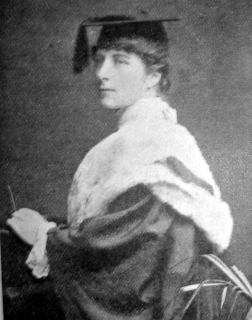
O’Farrelly is born Agnes Farrelly on June 24, 1874, in Raffony House, Virginia, County Cavan, one of five daughters and three sons of Peter Dominic Farrelly and Ann Farrelly (née Sheridan), a family with a traditional interest in the Irish language. After her articles Glimpses of Breffni and Meath are published in The Anglo-Celt in 1895, the editor, E. T. O’Hanlon, encourages her to study literature. Graduating from the Royal University of Ireland (BA 1899, MA 1900), she is appointed a lecturer in Irish at Alexandra College and Loreto College. A founder member in 1902, along with Mary Hayden, of the Irish Association of Women Graduates and Candidate Graduates, to promote equal opportunity in university education, she gives evidence to the Robertson (1902) and Fry (1906) commissions on Irish university education, arguing successfully for full co-education at UCD. Appointed lecturer in modern Irish at UCD in 1909, she is also a member of the first UCD governing body and the National University of Ireland (NUI) senate (1914–49). In 1932, on the retirement of Douglas Hyde, she is appointed professor of modern Irish at UCD, holding the position until her retirement in 1947. She is also president of the Irish Federation of University Women (1937–39) and of the National University Women Graduates’ Association (NUWGA) (1943–47).
One of the most prominent women in the Gaelic League, a member of its coiste gnótha (executive committee) and a director of the Gaelic press An Cló-Chumann Ltd, O’Farrelly is a close friend of most of its leading figures, especially Douglas Hyde, Kuno Meyer, and Eoin MacNeill. One of Hyde’s allies in his battle to avoid politicising the league, she is so close to him that students at UCD enjoy speculating about the nature of their friendship. She advocates pan-Celticism, but does not get involved in disputes on the matter within the league. A founder member, and subsequently principal for many years, of the Ulster College of Irish, Cloghaneely, County Donegal, she is also associated with the Leinster and Connacht colleges and serves as chairperson of the Federation of Irish Language Summer Schools.
Having presided at the inaugural meeting of Cumann na mBan in 1914, espousing its subordinate role in relation to the Irish Volunteers, O’Farrelly leaves the organisation soon afterward because of her support for recruitment to the British Army during World War I. A close friend of Roger Casement, in 1916, along with Col. Maurice Moore she gathers a petition that seeks a reprieve of his death sentence. She is a member of a committee of women which negotiate unsuccessfully with Irish Republican Army (IRA) leaders to avoid civil war in 1922, and is heavily defeated as an independent candidate for the NUI constituency in the general elections of 1923 and June 1927. In 1937 she is actively involved in the National University Women Graduates’ Association’s campaign against the constitution, seeking deletion of articles perceived as discriminating against women.
Popular among students at UCD, O’Farrelly has a reputation as a social figure and entertains frequently at her homes in Dublin and the Donegal Gaeltacht. A founder member (1914) and president (1914–51) of the UCD camogie club, she persuades William Gibson, 2nd Baron Ashbourne, to donate the Ashbourne Cup for the camogie intervarsities. She is also president of the Camogie Association of Ireland in 1941–42. A supporter of native Irish industry, she is president of the Irish Industrial Development Association and the Homespun Society, and administrator of the John Connor Magee Trust for the development of Gaeltacht industry. A poet and writer in both Irish and English, often using the pseudonym ‘Uan Uladh’, her principal publications in prose are The reign of humbug (1900), Leabhar an Athar Eoghan (1903), Filidheacht Segháin Uí Neachtáin (1911), and her novel Grádh agus crádh (1901); and in poetry Out of the depths (1921) and Áille an domhain (1927).
Concannon is educated by the Loreto nuns in Coleraine, County Londonderry. In 1897, she studies modern languages at the Royal University of Ireland on a three-year scholarship. She studies abroad during these years as in 1899, she travels to Germany and studies German in Berlin University accompanied by her friend, Mary Macken. She then travels to France to study French at Sorbonne University. In 1900, she graduates Bachelor of Arts with first class honours and goes on to study Master of Arts in 1902 at the Royal University of Ireland. She is fortunate to being one of the first generation of educated women.
In 1906, Concannon marries Tomás Bán Ó Conceanainn, who she met in 1900 when he arrived home from the United States. They settle down in County Galway where they share the same love for the Irish language and write many Irish texts. They have no children. In Galway, she is a professor at University College Galway where she teaches history, which mainly involves the history of Irish women. In 1909, she is offered a lectureship at University College Dublin, in Italian, but the offer is then withdrawn before she can accept it, so she decides to pursue a writing career.
Concannon produces over twenty books, including works on religion, the history of Ireland and Irish women’s history. Her works are highly impacted by her political and nationalist views. Her analyses of Irish history is based on Catholicism and patriotism. She is also an advocate of Irish language restoration. Her first writings are love poems to her husband. These poems are ”simple, sensuous and passionate.”
Concannon also produces a number of imaginative historical text for children. She uses her married name for her publications and her first book, entitled A Garden of girls, or the famous schoolgirls of former days, is published in 1914. It is about “school life and education of real little girls” Her next well known piece is the Life of St. Columban in 1915, which is a study about the Irish ancient monastic life and a biography of a sixth-century saint.
Two of Concannon’s books, Daughters of Banba (1922) and St. Patrick (1932), receive the Tailteann Medal for Literature, and The Poor Clares in Ireland (1929) wins the National University Prize, a D.Litt. higher doctorate degree for historical research.
Concannon’s most common publication, Women of ‘Ninety Eight, is dedicated to all the dead women and all the living ones who have given their loved ones. This book emerges on the ideologies of Catholicism and patriotism “praising the devotion of Irish nationalist women while emphasising the centrality of women’s spiritual and domestic role in the home to the well-being of the nation.” As this work is written during the time of the Irish War of Independence, she stresses the importance of women help during the rebellion as “they acted as messengers and intelligence officers,” and in some cases, they fought as any men.
Concerning the Land Purchase (Guarantee Fund) Bill 1935, which according to George Cecil Bennett will negatively impact the rural middle class of which he is a representative, Bennett accuses Concannon and her fellow Dublin men of not caring about the people of the country. Concannon goes on to vote that the Dáil should disagree with the Seanad Éireann-proposed bill with 71 others.
Though Concannon is a TD as a university representative, she votes with her party to remove university representation from the Dáil, leading one TD to say, “I am very much surprised to see such a distinguished scholar and such a great contributor to Irish literature as Deputy Mrs. Concannon voting for the disfranchisement of the University that she has so well and so ably represented.”
Concannon speaks on behalf of Irish women in the Dáil in 1936. She speaks on how Irish women play a fundamental role in Ireland’s agricultural economy and therefore more money should be put toward educating these women.
Concannon is one of the minority voices against the role appointed to women in Éamon de Valera‘s constitution. She does not contest the Dáil election of 1937.
After the adoption of the Constitution of Ireland in 1937, the National University of Ireland constituency is reconstituted in the new Seanad Éireann. The first election takes place in 1938, and Concannon is elected. She is a popular figure and is re-elected each election in the Seanad until she dies in office on February 27, 1952.
In the 1916 Easter Rising in Dublin, de Valera commands an occupied building and is the last commander to surrender. Because of his American birth, he escapes execution by the British but is sentenced to penal servitude. Released in 1917 but arrested again and deported in May 1918 to England, where he is imprisoned, he is acclaimed by the Irish as the chief survivor of the uprising and in October 1917 is elected president of the Irish republican and democratic socialistSinn Féin political party, which wins three-fourths of all the Irish constituencies in December 1918.
After Dáil Éireann ratifies the treaty by a small majority in 1922, de Valera supports the republican resistance in the ensuing Irish Civil War. W. T. Cosgrave’s Irish Free State ministry imprisons him, but he is released in 1924 and then organizes a republican opposition party that does not sit in Dáil Éireann. In 1927, however, he persuades his followers to sign the oath of allegiance as “an empty political formula,” and his new Fianna Fáil (“Soldiers of Destiny”) party then enters the Dáil, demanding abolition of the oath of allegiance, of the governor-general, of the Seanad Éireann (senate) as then constituted, and of land-purchase annuities payable to Great Britain. The Cosgrave ministry is defeated by Fianna Fáil in 1932, and de Valera, as head of the new ministry, embarks quickly on severing connections with Great Britain. He withholds payment of the land annuities, and an “economic war” results. Increasing retaliation by both sides enables de Valera to develop his program of austere national self-sufficiency in an Irish-speaking Ireland while building up industries behind protective tariffs. In the new Constitution of Ireland, ratified by referendum in 1937, the Irish Free State becomes Ireland, a sovereign, independent democracy tenuously linked with the British Commonwealth (under the Executive Authority (External Relations) Act 1936) only for purposes of diplomatic representation.
De Valera’s prestige is enhanced by his success as president of the council of the League of Nations in 1932 and of its assembly in 1938. He also enters negotiations with British Prime MinisterNeville Chamberlain in which he guarantees that he will never allow Ireland to be used as a base for attacking Britain in the event of war. This culminates in the Anglo-Irish defense agreement of April 1938, whereby Britain relinquishes the naval bases of Cobh, Berehaven, and Lough Swilly (retained in a defense annex to the 1921 treaty), and in complementary finance and trade treaties that end the economic war. This makes possible de Valera’s proclamation in September 1939, upon the outbreak of World War II, that Ireland will remain neutral and will resist attack from any quarter. In secret, however, de Valera also authorizes significant military and intelligence assistance to both the British and the Americans throughout the war. He realizes that a German victory will imperil Ireland’s independence, of which neutrality is the ultimate expression. By avoiding the burdens and destruction of the war, de Valera achieves a relative prosperity for Ireland in comparison with the war-torn countries of Europe, and he retains office in subsequent elections.
In 1948, a reaction against the long monopoly of power and patronage held by de Valera’s party enables the opposition, with the help of smaller parties, to form an interparty government under John A. Costello. Ironically, this precarious coalition collapses within three years after Ireland becomes a republic by means of the repeal of the Executive Authority (External Relations) Act 1936 and the severance of all ties with the British Commonwealth, an act de Valera had avoided. De Valera resumes office until 1954, when he appeals unsuccessfully for a fresh mandate, and Costello forms his second interparty ministry. No clearly defined difference now exists between the opposing parties in face of rising prices, continued emigration, and a backward agriculture. De Valera claims, however, that a strong single-party government is indispensable and that all coalitions must be weak and insecure. On this plea he obtains, in March 1957, the overall majority that he demands.
In 1959, de Valera agrees to stand as a candidate for the presidency. He resigns his position as Taoiseach and leader of the Fianna Fáil party. In June he is elected president, and is reelected in 1966. He retires to a nursing home near Dublin in 1973 and dies there on August 29, 1975.
De Valera’s career spans the dramatic period of Ireland’s modern cultural and national revolution. As an anticolonial leader, a skillful constitutionalist, and a symbol of national liberation, he dominates Ireland in the half century following the country’s independence.
(From: “Éamon de Valera, president of Ireland,” Encyclopedia Britannica, http://www.britannica.com, last updated August 14, 2025)
After a period at the University of Göttingen, de Brún is appointed professor of mathematics at St. Patrick’s Pontifical University, Maynooth, in 1914. In April 1945, he is elected by the Senate of the National University of Ireland to succeed John Hynes as President of University College, Galway, an office he holds until his retirement in 1959. His friend Thomas MacGreevy refers to de Brún as, “Rector Magnificus,” and praises his, “Olympian capacity to appreciate the most exalted works of art and literature, ancient and modern.”
The School of Mathematics, Mathematical Physics and Statistics is based in Áras de Brún, a building named in de Brún‘s honour. He subsequently becomes Chairman of the Arts Council of Ireland, a position he holds until his death in 1960. He also serves as chairman of the Council of the Dublin Institute for Advanced Studies (DIAS).
De Brún is close friend of 1916 Easter Rising leader Seán Mac Diarmada and is deeply affected by the latter’s execution.
De Brún was a prolific writer of Irish poetry in the Irish language, including the well-known poem “Tháinig Long ó Valparaiso.” He further translates into Modern Irish many great works of the Western canon, including Homer‘s Iliad and Odyssey, Sophocles‘ Antigone and Oedipus Rex, and Plutarch‘s Parallel Lives, as well as French stage plays by Jean Racine and Dante Alighieri‘s Divine Comedy. With regards to his importance to modern literature in Irish, he is recently termed “one of the most distinguished literary figures of his time.”
De Brún purchases land at Dunquin in the Dingle PeninsulaGaeltacht. In the 1920s, he also builds a house there known as Tigh na Cille, where his sister and her children often visit and stay at length. Through his literary mentorship of his niece, the future poet Máire Mhac an tSaoi, he has been credited with having an enormous influence upon the future development of modern literature in Irish.
After suffering a heart attack at his house at Seapoint, Dún Laoghaire, into which he had recently moved, de Brún dies on June 5, 1960, in St. Vincent’s nursing home, Leeson Street, Dublin.
Dinneen is a leading figure in the Irish Texts Society, publishing editions of Geoffrey Keating‘s Foras Feasa ar Éirinn, poems by Aogán Ó Rathaille, Piaras Feiritéar, Tadhg Gaelach Ó Súilleabháin, and other poets. He also writes a novel and a play in Irish, and translates such works as Charles Dickens‘s A Christmas Carol into Irish. His best known work, however, is his Irish–English dictionary, Foclóir Gaedhilge agus Béarla, which is first published in 1904. The stock and plates of the dictionary are destroyed during the Easter Rising of 1916, so Dinneen takes the opportunity to expand the dictionary. A much larger second edition, compiled with the assistance of Liam S. Gógan, is published in 1927. His request to the Irish Texts Society to include Gogan’s name on the title page is refused. Gogan continues to work on the collection of words up to his death in 1979. This complementary dictionary is published online in 2011.
A serious interest in poetry and literature begins to manifest itself during his years at TCD. In 1900, he makes the acquaintance of W. B. Yeats and George Moore and begins to frequent Dublin literary circles. In 1904 and 1905 he publishes several short poems in the London publication The Venture and in John Eglinton‘s journal Dana. His name also appears in print as the renegade priest Fr. Oliver Gogarty in George Moore’s 1905 novel The Lake.
In 1905, Gogarty becomes one of the founding members of Arthur Griffith‘s Sinn Féin, a non-violent political movement with a plan for Irish autonomy modeled after the Austro-Hungarian dual monarchy.
In July 1907, his first son, Oliver Duane Odysseus Gogarty, is born, and in autumn of that year he leaves for Vienna to finish the practical phase of his medical training. Returning to Dublin in 1908, he secures a post at Richmond Hospital, and shortly afterward purchases a house in Ely Place opposite George Moore. Three years later, he joins the staff of the Meath Hospital and remains there for the remainder of his medical career.
Gogarty maintains close friendships with many of the Dublin literati and continues to write poetry in the midst of his political and professional duties. He also tries his hand at playwriting, producing a slum drama in 1917 under the pseudonym “Alpha and Omega,” and two comedies in 1919 under the pseudonym “Gideon Ouseley,” all three of which are performed at the Abbey Theatre. He devotes less energy to his medical practice and more to his writing during the twenties and thirties.
With the onset of World War II, Gogarty attempts to enlist in the Royal Air Force (RAF) and the Royal Army Medical Corps (RAMC) as a doctor. He is denied on grounds of age. He then departs in September 1939 for an extended lecture tour in the United States, leaving his wife to manage Renvyle House, which has since been rebuilt as a hotel. When his return to Ireland is delayed by the war, he applies for American citizenship and eventually decides to reside permanently in the United States. Though he regularly sends letters, funds, and care-packages to his family and returns home for occasional holiday visits, he never again lives in Ireland for any extended length of time.
Gogarty suffers from heart complaints during the last few years of his life, and in September 1957 he collapses in the street on his way to dinner. He dies on September 22, 1957. His body is flown home to Ireland and buried in Cartron Church, Moyard, near Renvyle, County Galway.
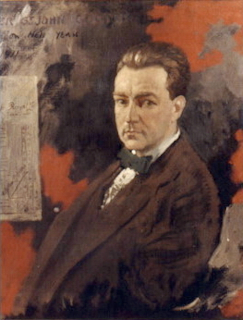
(Pictured: 1911 portrait of Oliver St. John Gogarty painted by Sir William Orpen, currently housed at the Royal College of Surgeons in Ireland)
MacFarland is the elder son of John MacFarland, draper, and his second wife Margaret Jane, daughter of Rev. William Henry, a famous Covenanting Church minister. Both parents are devout Presbyterians, well educated, with strong intellectual interests.
MacFarland teaches at Repton School in Derbyshire from 1876 to 1880. A decade later, his younger brother Robert, also a Queen’s Belfast and Cambridge mathematics graduate, also teaches at Repton.
The emissaries of the provisional council of Ormond College in the University of Melbourne are impressed with MacFarland. He negotiates a salary of £600 plus the profit from “farming” the college. On March 18, 1881, he becomes the first master of Ormond College, passing the opening-day ordeal in the presence of 440 Presbyterian grandees, clergy and their ladies.
On Sir John Madden‘s death in 1918, MacFarland becomes chancellor of the university and is knighted in 1919. He presides over a period of considerable expansion, working closely with Sir John Monash, vice-chancellor from 1923, and Sir James Barrett.
MacFarland is immensely and properly proud of his careful financial management, but the erstwhile reformers are hardly tender enough in balancing economy with humanity. The professors become increasingly restive about the limited responsibility for academic matters and allocation of resources council allows them. When the issues come to a head in 1928, MacFarland’s prestige is too much for the professoriate who have great respect for his administrative capacity, humanity and reasonableness. Even in his eighties he does not retire as chancellor, probably wisely concluding that his likely successor, Barrett, will prove to be too divisive.
MacFarland’s reputation as a business manager leads to his directorship from about 1905 of the National Mutual Life Association, serving as chairman from 1928, and of the Trustees Executors and Agency Company. From 1913 he represents the Trustees Executors on the Felton Bequests Committee. He is also the popular chairman from its foundation in 1908 of the Alexandra Club Co. as the members of the leading female social club prefer men to control their finances.
In his younger days MacFarland is a vigorous cyclist and walker in the Australian Alps, Tasmania and New Zealand. By the age of 40 he is spending a month each summer trout-fishing in the South Island of New Zealand. He is also a regular golfer at Royal Melbourne and belongs to the Melbourne Club.
“Few men in any community, and almost no man in this community, can have won such universal esteem. No evil was ever spoken of him or could be thought of in connection with him; before him evil quailed. The greatest disciple of the greatest of the Greeks called his dead master ‘our friend whom we may truly call the wisest, and the justest, and the best of all men we have ever known’. And many of us can sincerely say that of John Henry MacFarland.”
(From: “Sir John Henry MacFarland (1851-1935)” by Geoffrey Serle, Australian Dictionary of Biography, http://www.adb.anu.edu.au, 1986)
Thomas “Tom” Michael Kettle, parliamentarian, writer, and soldier, is born on February 9, 1880, in Artane, Dublin, the seventh among twelve children of Andrew Kettle, farmer and agrarian activist, and his wife, Margaret (née McCourt). His father’s record in nationalist politics and land agitation, including imprisonment in 1881, is a valuable political pedigree.
The family is prosperous. Kettle and his brothers attend Christian Brothers’ O’Connell School in Richmond Street, Dublin, before being sent to board at Clongowes Wood College, County Kildare. Popular, fiery, and something of a prankster, he soon proves to be an exceptional scholar and debater, as well as a keen athlete, cyclist, and cricketer. He enrolls in 1897 at University College Dublin (UCD), his contemporaries including Patrick Pearse, Oliver St. John Gogarty and James Joyce. He thrives in student politics, where his rhetorical genius soon wins him many admirers and is recognised in his election as auditor of the college’s Literary and Historical Society. He also co-founds the Cui Bono Club, a discussion group for recent graduates. In 1899, he distributes pro-Boer propaganda and anti-recruitment leaflets, arguing that the British Empire is based on theft, while becoming active in protests against the Irish Literary Theatre‘s staging of The Countess Cathleen by W. B. Yeats. In 1900, however, he is prevented from taking his BA examinations due to a mysterious “nervous condition” – very likely a nervous breakdown. Occasional references in his private diaries and notes suggest that he is prone to bouts of depression throughout his life. He spends the following two years touring in Europe, including a year at the University of Innsbruck, practising his French and German, before taking a BA in mental and moral science of the Royal University of Ireland (RUI) in 1902. He continues to edit the college newspaper, remaining active in student politics. He participates, for example, in protests against the RUI’s ceremonial playing of “God Save the King” at graduations as well as its senate’s apparent support for government policy, threatening on one occasion to burn publicly his degree certificate.
In 1903, Kettle is admitted to the Honourable Society of King’s Inns to read law and is called to the bar two years later. Nonetheless, he soon decides on a career in political journalism. Like his father, he is a keen supporter of the Irish Parliamentary Party (IPP), and in 1904 is a co-founder of the resonantly titled Young Ireland Branch of the United Irish League. Here he comes to the notice of John Redmond, who offers him the prospect of a parliamentary seat, but he chooses instead to put his energies into editing the avowedly pro-Irish-party paper, The Nationist, in which he promises that a home rule administration will uphold women’s rights, industrial self-sufficiency, and Gaelic League control of Irish education. He hopes that the paper will offer a corrective alternative to The Leader, run by D. P. Moran, but in 1905 he is compelled to resign the editorship due to an article thought to be anti-clerical. In July 1906, he is persuaded to stand in a by-election in East Tyrone, which he wins with a margin of only eighteen votes. As one of the youngest and most talented men in an ageing party, he is already tipped as a potential future leader. His oratory is immediately put to good use by the party in a propaganda and fund-raising tour of the United States, as well as on the floor of the House of Commons, where his oratorical skills earn him a fearsome reputation. He firmly advocates higher education for Catholics and the improvement of the Irish economy, while developing a close alliance with Joseph Devlin and the Ancient Order of Hibernians (AOH).
Kettle meanwhile makes good use of his connections to ArchbishopWilliam Walsh, the UCD Sodality of the Blessed Virgin Mary, and the Catholic Graduates and Undergraduates Association, as well as political support, to secure the professorship of national economics. T. P. Gill, of the Department of Agriculture and Technical Instruction, exceptionally acts as his referee. His detractors regard the appointment as a political sinecure and Kettle as a somewhat dilettantish “professor of all things,” who frequently neglects his academic duties. However, he takes a keen interest in imperial and continental European economies. He does publish on fiscal policy, even if always taking a pragmatic interest in wider questions, greatly impressing a young Kevin O’Higgins, later Vice-President of the Executive Council of the Irish Free State. He has little time for what he regards as the abstract educational and economic idealism of D. P. Moran. He acknowledges that the “Hungarian policy” of Arthur Griffith has contributed significantly to a necessary debate about the economy, but argues that the Irish are “realists,” that Ireland’s natural resources ought to be scientifically measured, and that the imperial connection is crucial to Ireland’s future development. The achievement of home rule would, he asserts, encourage a healthy self-reliance as opposed to naive belief in self-sufficiency.
Kettle is encouraged by the heightened atmosphere of the constitutional crisis over the 1909 David Lloyd Georgebudget, culminating in the removal of the House of Lords veto, which has been an obstacle to home rule. He is also a supporter of women’s enfranchisement, while stressing that the suffragist cause should not delay or deflect attention from the struggle for home rule. He holds his East Tyrone seat in the January 1910 United Kingdom general election but decides not to stand at the general election in December of the same year. Returning to an essentially journalistic career, he publishes a collection of essays outlining his constitutional nationalist position. He opposes suffragette attacks on private property, but, in contrast, supports the Dublin strikers in 1913, highlighting their harsh working and living conditions. He tries without success to broker an agreement between employers and workers though a peace committee he has formed, on which his colleagues include Joseph Plunkett and Thomas P. Dillon. His efforts are not assisted, however, by an inebriated appearance at a crucial meeting. Indeed, by this time his alcoholic excesses are widely known, forcing him to attend a private hospital in Kent.
In spite of deteriorating health, Kettle becomes deeply involved in the Irish Volunteers formed in November 1913 to oppose the Ulster Volunteers. His appraisal of Ulster unionism is somewhat short-sighted, dismissing it as being “not a party [but] merely an appetite,” and calling for the police to stand aside and allow the nationalists to deal with unionists, whose leaders should be shot, hanged, or imprisoned. These attitudes are mixed in with a developing liberal brand of imperialism based on dominion federalism and devolution, warmly welcoming a pro-home-rule speech by Winston Churchill with a Saint Patrick’s Day toast to “a national day and an empire day.” Nevertheless, he uses his extensive language skills and wide experience of Europe to procure arms for the Irish Volunteers. He is in Belgium when the Germans invade, and the arms he procured are confiscated by the Belgian authorities, to whom they were donated by Redmond on the outbreak of war.
On his return to Dublin, Kettle follows Redmond’s exhortation to support the war effort. He is refused an immediate commission on health grounds, but is eventually granted the rank of lieutenant, with responsibilities for recruitment in Ireland and England. He makes further enemies among the advanced nationalists of Sinn Féin, taunting the party for its posturing and cowardly refusal to confront Ulster unionists, the British Army, and German invaders alike. Coming from a staunchly Parnellite tradition, he is no clericalist, yet he is a devout if liberal Catholic, imbued by his Jesuit schooling with a cosmopolitan admiration for European civilisation which has been reinforced by his European travels, and in particular has been outraged by the German destruction of the ancient university library of Louvain. Despite a youthful flirtation with the philosophy of Friedrich Nietzsche, he comes to regard “Prussianism” as the deadliest enemy of European civilisation and the culture of the Ten Commandments, there not being “room on earth for the two.” He increasingly believes that the German threat is so great that Irish farmers’ sons ought to be conscripted to defend Ireland. He also believes that considerable good might come out of the conflict, exhorting voters in East Galway to support what is practically a future home rule prime minister, cabinet, and Irish army corps. He unsuccessfully seeks nomination as nationalist candidate in the 1914 East Galway by-election in December. Nevertheless, he continues to work tirelessly on behalf of the party, publishing reviews, translations, and treatises widely in such journals as the Freeman’s Journal, The Fortnightly Review, and the Irish Ecclesiastical Record.
As a recruiting officer based far from the fighting, Kettle is stung by accusations of cowardice from advanced nationalists. He had tried repeatedly to secure a front-line position, but was rejected, effectively because of his alcoholism. He is appalled by trench conditions and the prolongation of the war, a disillusionment further encouraged by the Easter Rising, in which his brother-in-law, Francis Sheehy-Skeffington, is murdered by a deranged Anglo-Irish officer, J. C. Bowen-Colthurst. He senses that opinion in Ireland is changing, anticipating that the Easter insurgents will “go down in history as heroes and martyrs,” while he will go down, if at all, as “a bloody British officer.” Nevertheless, he regards the cause of European civilisation as greater than that of Ireland, remaining as determined as ever to secure a combat role. Despite his own poor health and the continuing intensity of the Somme campaign, he insists on returning to his unit, the 9th Battalion, Royal Dublin Fusiliers.
Kettle’s writings demonstrate the mortal danger he is placing himself in, evident not least in his frequently quoted poem, “To my daughter, Betty, the gift of God,” as well as letters settling debts, apologising for old offences, and providing for his family – his wealth at death being less than £200. He has no death wish, wearing body armour frequently, but as Patrick Maume notes, “As with Pearse, there is some self-conscious collusion with the hoped-for cult.” He is killed on September 9, 1916, during the Irish assault on German positions at Ginchy.
Kettle marries Mary Sheehy, alumna of UCD, student activist, suffragist, daughter of nationalist MPDavid Sheehy, and sister-in-law of his friend Francis Sheehy Skeffington, on September 8, 1909. In 1913 the couple has a daughter, Elizabeth.
Kettle is commemorated by a bust in St. Stephen’s Green, Dublin, and in the House of Commons war memorial in London. He is a man of great passions and proven courage. George William Russell put his sacrifice on a par with Thomas MacDonagh and the Easter insurgents:
“You proved by death as true as they, In mightier conflicts played your part, Equal your sacrifice may weigh, Dear Kettle, of the generous heart (quoted in Summerfield, The myriad minded man, 187).
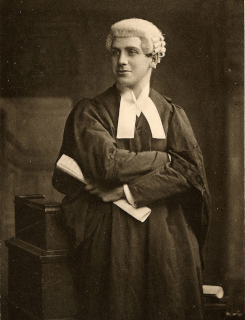
(From: “Kettle, Thomas Michael (‘Tom’)” by Donal Lowry, Dictionary of Irish Biography, http://www.dib.ie, October 2009 | Pictured: Tom Kettle as a barrister when called to the Irish law bar in 1905)
She studies in the school of Old Irish established by Professor Osborn Bergin and is strongly influenced by the Irish Australian professor O’Daly. She later teaches Latin through Irish at Ballingeary and becomes proficient in French, German, Italian and Spanish.
She spends the last £100 of her scholarship on a dowry for her marriage to Sean MacGearailt, later first Accountant General of Revenue in the Irish civil service, with whom she lives originally in Glasnevin and then in Dalkey.
She is a founder member of the radical Craobh an Chéitinnigh, the Keating branch of Conradh na Gaeilge, composed mainly of Dublin-based Kerry people and regarded, by themselves at least, as the intellectual focus of the League.
In August 1904, some six years after the establishment of the earliest women’s hurling teams, the rules of camogie (then called camoguidheacht), first appears in Banba, a journal produced by Craobh an Chéitinnigh. Camogie had come to public attention when it was showcased at the annual Oireachtas (Conradh na Gaeilge Festival) earlier that year, and it differed from men’s hurling in its use of a lighter ball and a smaller playing-field. Ní Chinnéide and Cáit Ní Dhonnchadha, like Ní Chinnéide, an Irish-language enthusiast and cultural nationalist, are credited with having created the game, with the assistance of Ní Dhonnchadha’s scholarly brother Tadhg Ó Donnchadha, who drew up its rules. She is on the first camogie team to play an exhibition match in Navan, County Meath, in July 1904, becomes an early propagandist for the game and, in 1905, is elected president of the infant Camogie Association.
She first visits the Blasket Islands in 1932 with her daughter Niamh, who dies tragically young. In the summer of 1934, she puts the idea into Peig Sayers‘s head to write a memoir. According to a later interview with Ní Chinnéide “she knew and admired her gift for easy conversation, her gracious charm as a hostess, her talent for illustrating a point she was making by a story out of her own experience that was as rich in philosophy and thought as it was limited geographically.” Peig answers that she has “nothing to write.” She had learned only to read and write in English at school and most of it has been forgotten.
Ní Chinnéide suggests Peig should dictate her memoir to her son Micheal, known to everyone on the island as An File (“The Poet”), but Peig “only shook her head doubtfully.” At Christmas, a packet arrives from the Blaskets with a manuscript, she transcribes it word for word and the following summer brings it back to the Blaskets to read it to Peig. She then edits the manuscript for the Talbot Press. Peig becomes well known as a prescribed text on the Leaving Certificate curriculum in Irish.
Ní Chinnéide has an acting part in the first modern play performed in Irish on the stage, Casadh an tSugáin by Douglas Hyde in 1901. She is later author of children’s plays staged by An Comhar Drámuidhachta at the Oireachtas and the Peacock Theatre, of which Gleann na Sidheóg and An Dúthchas (1908) are published. She is a broadcaster in Irish on 2RN, a wholly owned subsidiary of Raidió Teilifís Éireann, after its foundation in 1926 and author of a translation of Grimms’ Fairy Tales (1923). She is president of the Gaelic Players Dramatic group during the 1930s and a founder of the Gaelic Writers Association in 1939.
She soon becomes interested in writing children’s plays, including Gleann na Sidheóg (Fairy Glen, 1905) and Sidheoga na mBláth (Flower Fairies, 1909. Although there is little information available on the staging of her first play, by the time her second children’s play, Sidheóga na mBláth, is published in An Claidheamh Soluis in December 1907, “Éire Óg” (“Young Ireland”) branches of Conradh na Gaeilge have been established in conjunction with adults’ branches. Patrick Pearse in particular voices the expectation that this play will be staged by many “Éire Óg” branches “before the New Year is very old,” thus indicating the immediate take up of such plays. Indeed, a week after the play’s publication, it is staged in the Dominican College in Donnybrook, Dublin, where Ní Chinnéide had spent several years as an Irish teacher.
Duffy is born in Nice, France, on July 17, 1884, the daughter of the Irish nationalist Sir Charles Gavan Duffy, one of the founders of The Nation and his third wife, Louise (née Hall) from Cheshire, England. Her mother dies when she is four. She is then raised in Nice by her Australian half-sisters from her father’s second marriage. It is a well-to-do and culturally vibrant home where she is exposed to political figures and ideas.
Duffy’s first visit to Ireland is in 1903, at the age of 18, when her father dies and is buried in Glasnevin Cemetery. This is when she first hears Irish spoken. She finds a grammar book in a bookshop and becomes curious. Her father was not an Irish speaker, though her grandmother in the early 1800s was likely fluent.
Duffy spends the years between 1903 and 1907 between France and England. She takes courses through Cusack’s College in London so that she can matriculate.
Duffy decides to continue her studies in Dublin but cannot afford to move until she receives a small inheritance from her grandmother on the Hall side of the family. Once in Ireland in 1907, at the age of 23, she begins her university studies, taking arts. She lives in the Women’s College, Dominican Convent, as women are not allowed to attend lectures in the Royal University of Ireland. She goes occasionally to the Gaeltacht to learn Irish. Graduating in 1911 with a Bachelor of Arts from University College Dublin (UCD), she is one of the first women to do so.
Given the lack of teachers, even without a full qualification, Duffy then teaches in Patrick Pearse‘s St. Ita’s school for girls in Ranelagh. She studies with the Dominicans again in Eccles Street, gaining a Teaching Diploma from Cambridge University.
A supporter of women’s suffrage, Duffy speaks at a mass meeting in Dublin in 1912 in favour of having the Home Rule bill include a section to grant women the vote. She also joins the Irish republican women’s paramilitary organisation Cumann na mBan, as a founding member in April 1914, serving on the provisional committee with Mary Colum, as a co-secretary.
Duffy is aware that being a suffragist and a nationalist are not necessarily the same thing, realising her involvement in Cumann na mBan is in support of nationalism. When St. Ita’s closes due to funding problems in 1912, she takes the opportunity to complete her qualifications. After receiving her Cambridge teacher’s diploma in 1913, she returns to UCD to study for a Master of Arts degree.
Duffy is in fact working on her master’s thesis during the Easter break in 1916 when the rumour comes to her that the Rising has begun in Dublin city centre. She walks to the Rebel headquarters in the GPO where she tells Pearse, one of the leaders, that she does not agree with the violent uprising.
Duffy spends all of Easter week working in the GPO kitchens with other volunteers like Desmond FitzGerald and a couple of captured British soldiers, ensuring the volunteers are cared for. The women in the GPO are given the opportunity to leave under the protection of the Red Cross on the Thursday as the shelling of the building has caused fires, but almost all of them refuse. In the end, she is among the second group of the people to leave the GPO on the Friday, tunnelling through the walls of the buildings to avoid coming under fire.
Duffy’s group makes it to Jervis Street Hospital where they spend the night. The next day, Saturday, Pearse formally surrenders. She heads for Jacob’s Biscuit Factory, another volunteer position, on the morning after the surrender, to see what is happening. There she finds a holdout of volunteers who are unaware of the surrender or that the fighting is over.
After 1916 Duffy is elected to the Cumann na mBan’s executive and in 1918 is one of the signatories to a petition for self-determination for Ireland which is presented to President Woodrow Wilson by Hanna Sheehy-Skeffington. During her time in the GPO, she had collected names of the volunteers and promised to take messages to their families. This possibly influences her in being involved in the National Aid Association and Volunteers Dependants Fund. In the aftermath of the rebellion there are 64 known dead among the volunteers, while 3,430 men and 79 women are arrested. Families need support. These organisations are able to arrange funding from the United States.
In 1917, Duffy co-founds and runs Scoil Bhríde, as a secondary school for girls in Dublin through the medium of Gaelic. It is still in operation as a primary school. Her co-founder is Annie McHugh, who later marries Ernest Blythe. The end of the Rising leads to the Irish War of Independence (1919-21). During this time, she is mostly focused on the school. However, it is raided by the military and Duffy later admits it is in fact used for rebel meetings and to safeguard documents. In October 1920, the Irish leader Michael Collins meets Archbishop Patrick Clune there in secret. In an effort to support the nationwide boycott of the police, the Royal Irish Constabulary (RIC), in 1920, she has a leaflet sent to all branches of Cumann na mBan which states in part that the RIC are the “eyes and ears of the enemy. Let those eyes and ears know no friendship.”
The war ends with the Anglo-Irish Treaty in 1921. The result is the Irish Civil War which lasts until 1923. Duffy is a supporter of the Treaty, which her brother had signed, and as such she leaves Cumann na mBan and joins Cumann na Saoirse, in which she is instrumental in founding as an Irish republican women’s organisation which supports the Pro-Treaty side.
Once the civil war is over, Duffy leaves the political arena and returns to education. She especially needs to focus on funding in the early years of the school. She works with UCD’s Department of Education from 1926, once Scoil Bhríde is recognised as a teacher training school. She publishes educational documents like School Studies in The Appreciation of Art with Elizabeth Aughney and published by UCD in 1932.
Until her retirement, Duffy also lectures on the teaching of French. She retires as principal in 1944.
Recognising the importance of her first-hand experience and with a good political understanding, Duffy records her memories of the events in which she has taken part. In 1949, she gives an account of her life in relation to nationalist activities to the Bureau of Military History. She is involved in a Radio Éireann broadcast in 1956 about the women in the Rising. In 1962, she takes part in the RTÉ TV program Self Portrait broadcast on March 20, 1962. In March 1966 she gives a lecture in UCD to mark the 50th anniversary of the Rising which is published in The Easter rising, 1916, and University College Dublin (1966).
Duffy dies, unmarried, on October 12, 1969, aged 85, and is interred in the family plot in Glasnevin Cemetery.
In 2014, An Post issues a stamp to commemorate the centenary of the founding of Cumann na mBan. In 2016, for the centenary, a documentary is produced, discussing seven of the women, including Duffy, who were involved in the Easter Rising.


 seamus dubhghaill