Stokes is educated at St. Columba’s College where he is taught the Irish language by Denis Coffey, author of Primer of the Irish Language. Through his father he comes to know the Irish antiquariesSamuel Ferguson, Eugene O’Curry, John O’Donovan and George Petrie. He enters Trinity College Dublin in 1846 and graduates with a BA in 1851. His friend and contemporary Rudolf Thomas Siegfried (1830–63) becomes assistant librarian at TCD in 1855, and the college’s first professor of Sanskrit in 1858. Stokes likely learns both Sanskrit and comparative philology from Siegfried, thus acquiring a skill-set rare among Celtic scholars in Ireland at the time.
Stokes qualifies for the bar at Inner Temple. His instructors in the law are Arthur Cayley, Hugh McCalmont Cairns, and Thomas Chitty. He becomes an English barrister on November 17, 1855, practicing in London before going to India in 1862, where he fills several official positions. In 1865 he marries Mary Bazely by whom he has four sons and two daughters. One of his daughters, Maïve, compiles a book of Indian Fairy Tales in 1879 when she is 12 years old, based on stories told to her by her Indian ayahs and a man-servant. It also includes some notes by Mrs. Mary Stokes. Mary dies while the family is still living in India. In 1877, Stokes is appointed legal member of the viceroy’s council, and he drafts the codes of civil and criminal procedure and does much other valuable work of the same nature. In 1879 he becomes president of the commission on Indian law. Nine books he writes on Celtic studies are published in India. He returns to settle permanently in London in 1881 and marries Elizabeth Temple in 1884. In 1887 he is made a Companion of the Order of the Star of India (CSI), and two years later an Order of the Indian Empire (CIE). He is an original fellow of the British Academy, an honorary fellow of Jesus College, Oxford and foreign associate of the Institut de France.
Stokes is perhaps most famous as a Celtic scholar, and in this field he works both in India and in England. He studies Irish, Breton and Cornish texts. His chief interest in Irish is as a source of material for comparative philology. Despite his learning in Old Irish and Middle Irish, he never acquires Irish pronunciation and never masters Modern Irish. In the hundred years since his death he continues to be a central figure in Celtic scholarship. Many of his editions have not been superseded during this time and his total output in Celtic studies comes to over 15,000 pages. He is a correspondent and close friend of Kuno Meyer from 1881 onwards. With Meyer he establishes the journal Archiv für celtische Lexicographie and is the co-editor, with Ernst Windisch, of the Irische Texteseries. In 1876 his translation of Vita tripartita Sancti Patricii, along with a written introduction, is published.
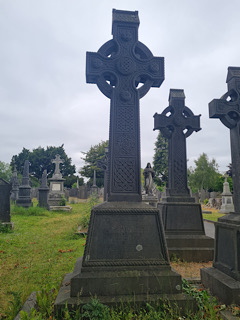
Stokes dies at his London home, 15 Grenville Place, Kensington, on April 13, 1909, and is buried in Paddington Old Cemetery, Willesden Lane, where his grave is marked by a Celtic cross. Another Celtic cross is erected as a memorial to him at St. Fintan’s Cemetery, Sutton, Dublin. The Gaelic League newspaper An Claidheamh Soluis calls him “the greatest of the Celtologists” and expresses pride that an Irishman has excelled in a field which is at that time dominated by continental scholars. In 1929 the Canadian scholar James F. Kenney describes him as “the greatest scholar in philology that Ireland has produced, and the only one that may be ranked with the most famous of continental savants.”
A conference entitled “Ireland, India, London: The Tripartite Life of Whitley Stokes” takes place at the University of Cambridge on September 18-19, 2009. The event is organised to mark the centenary of Stokes’s death. A volume of essays based on the papers delivered at this conference, The Tripartite Life of Whitley Stokes (1830–1909), is published by Four Courts Press in autumn 2011.
In 2010 Dáibhí Ó Cróinín publishes Whitley Stokes (1830–1909): The Lost Celtic Notebooks Rediscovered, a volume based on the scholarship in Stokes’s 150 notebooks which had been resting unnoticed at the Leipzig University Library, Leipzig since 1919.
Williams is born on May 4, 1838, in Coleraine, County Londonderry. He claims to be descended on his father’s side from Worcestershireyeomen living in the parishes of Tenbury and Mamble. On his mother’s side he descends from Scottish settlers who planted Ulster in 1610. He is educated at Belfast Academy in Belfast under Dr. Reuben John Bryce and at a Greenwich private school under Dr. Goodwin. Later on, he goes to the southern United States for his health and takes part in a filibustering expedition to Nicaragua, where he sees some hard fighting and reportedly wins the reputation of a blockade runner. He is separated from his party and is lost in the forest for six days. Fevered, he discovers a small boat and manages to return to the nearest British settlement. He serves in the London Irish Rifles and has the rank of sergeant.
Williams returns to England in 1859, where he becomes a volunteer, and a leader writer for the London Evening Herald. In October 1859, he begins a connection with The Standard which lasts until 1884. From 1860 until 1863, he works as a first editor for the London Evening Standard and from 1882 until 1884, as editor of The Evening News.
Williams is best known for being a war correspondent. He is described as an admirable war correspondent, a daring rider as well as writer. For The Standard, he is at the headquarters of the Armée de la Loire, a French army, during the Franco-Prussian War in 1870. He is also one of the first correspondents in Strasbourg, where the French forces are defeated. In the summer and autumn of 1877, he is a correspondent to Ahmed Muhtar Pasha who commands the Turkish forces in Armenia during the Russo-Turkish War of 1877 and 1878. He remains constantly at the Turkish front, and his letters are the only continuous series that reaches England. In 1878, he publishes this series in a revised and extended form as The Armenian Campaign: A Diary of the Campaign on 1877, in Armenia and Koordistan, which is a large accurate record of the war, even though it is pro-Turkish. From Armenia, he follows Muhtar Pasha to European Turkey and describes his defence of the lines of Constantinople against the Imperial Russian Army. He is with General Mikhail Skobelev at the headquarters of the Imperial Russian Army when the Treaty of San Stefano is signed in March 1878. He reports this at the Berlin Congress.
At the end of 1878, Williams is in Afghanistan reporting the war, and in 1879 publishes the Notes on the Operations in Lower Afghanistan, 1878–9, with Special Reference to Transport.
In 1887, Williams meets with then General of the United States Army, Philip Sheridan, in Washington, D.C. to update the general on European affairs and the prospects of upcoming conflicts.
Williams is said to possess a voice of thunder and expresses with terrific energy. He conducts a lecture tour of the United States where he describes the six campaigns, illustrated by limelight photographs. His audience in Brooklyn, New York, is described by The New York Times as highly delighted by his lecture about the hardships and adventures. His presentation is “a feast for the eyes and ears and was highly appreciated by the large audience assembled.” He later tours England, Scotland, and Ireland speaking about his then seven campaigns.
Williams also writes fiction, including his book John Thaddeus Mackay, a tale about religious tolerance and understanding. With the sanction of Commander in Chief, Field MarshalGarnet Wolseley, he edits a book Songs for Soldiers for the March The Camp and the Barracks to improve morale and relieve boredom. Included in the book are a number of songs that he composed. He also writes about ecclesiastical questions, and contributes articles and stories to different periodicals.
Williams is a strong adherent to Wolseley’s military views and policy, and has considerable military knowledge. He also publishes military subjects in several publications such as the United Service Magazine, the National Review, and other periodicals. In 1892, he publishes Life of Sir H. Evelyn Wood, which is controversial as he defends the actions of Wood after the Battle of Majuba Hill in 1881. In 1902, he publishes a pamphlet, entitled Hush Up, in which he protests against the proposed limited official inquiry into the South African War and calls for an investigation.
Early in his career, Williams shares an office with friend and colleague Robert Gascoyne-Cecil, who later becomes Prime Minister of the United Kingdom. They have a standing tradition of always sending out for two beers with payment alternating between each man. Many years later, Williams is in the lobby of the House of Lords and Gascoyne-Cecil approaches him with an outstretched hand and asks, “By the way, Mr. Williams, whose turn is it to stand the beer?”
In 1884, the steamer carrying Williams and colleague Frederic Villiers of The Graphic overturns in the Nile River. Their rescue leads Williams to later commission a unique ivory and gold mitre for the Bishop of London as a thank-offering to God for his safe return from Khartoum.
Williams receives a personal invitation from King Edward VII to attend the funeral of his mother, Queen Victoria.
Both of Williams‘a sons became journalists. Frederick is a noted parliamentary reporter, writer, and historian in Canada. Francis Austin Ward Williams practices journalism in Sydney, Australia.
In the Nile Campaign of 1884-85, application is made to the War Office with the support of the Commander in Chief Lord Wolseley for medals for Willams and correspondent Bennet Burleigh. Williams has been twice requested to take command of some of the men by senior officers on the spot. The Secretary of War is unable to grant the recognition under the rules of the day but writes a letter saying that he regrets that this must be his decision.
Williams is a recipient of the Queen’s Sudan Medal, an award given to British and Egyptian forces which took part in the Sudan campaign between 1896 and 1898.
Field Marshall Garnet Wolseley recognizes the contributions of Williams on the battlefield. He says in a speech that from “Charles Williams, he had at various times received the greatest possible help in the field.”
Williams dies in Brixton, London, on February 9, 1904. He is buried in Nunhead Cemetery in London. His son, journalist Fred Williams, first learns of his father’s death on the wire service he is monitoring at his newspaper in Toronto, Ontario, Canada.
Williams’s funeral is well attended by the press as well as members of the military including Field Marshal Sir Evelyn Wood. Colleague Henry Nevison writes a long reflection on Williams. It includes, “On the field he possessed a kind of instinctive sense of what was going to happen. When I went to big field-days with him he was already an elderly man, and much broken down with the hardships of a war correspondent’s life; but he invariably appeared at the critical place exactly at the right moment, and I once heard the Duke of Connaught, who was commanding, say, ‘When I see Charlie Williams shut up his telescope, I know it’s all over.’ And now he is gone, with his rage, his generosity, his innocent pride, his faithful championship of every friend, and his memories of so many a strange event. His greatest joy was to encourage youth to follow in his steps, and the world is sadder and duller for his going.”
Colin MiddletonMBE, Northern Irishlandscape artist, figure painter, and surrealist, is born on January 29, 1910, in Victoria Gardens in north Belfast. Hus prolific output in an eclectic variety of modernist styles is characterised by an intense inner vision, augmented by his lifelong interest in documenting the lives of ordinary people. He has been described as “Ireland’s greatest surrealist.”
Middleton is the only child of damask designer Charles Middleton. He attends the nearby Belfast Royal Academy until 1927 and then continues his studies with night classes at Belfast School of Art where he trains in design under the Cornish artist Newton Penprase. However, he finds the college too traditional in outlook, as his first influence, his father, had been a follower of European Modernism, particularly the Impressionists.
Middleton shows his first works with the Ulster Academy of Arts in 1931, where he exhibits frequently until the late nineteen-forties. He first comes to public attention with the inclusion of his works in the groundbreaking inaugural exhibition of the Ulster Unit at Locksley Hall, Belfast, in December 1933. The Ulster Unit is a short-lived grouping of Ulster artists who take their inspiration from Paul Nash’s Unit One formed earlier in the same year. Just two years thereafter in the same year, he marries Maye McLain, also an artist and a domestic science teacher, who unfortunately dies four years later. He is also a poet and writer, whom along with his wife, is an active member of the Northern Drama League in the 1930s, with whom he designs sets. After the death of his first wife he destroys all of his early paintings and enters a period of seclusion at his mother’s home outside Belfast. He becomes a follower of Vincent van Gogh and James Ensor after viewing exhibitions in London and Belgium respectively. On his return to Ulster he begins to experiment with styles derived from European Modernism, the antithesis to traditional academism. Throughout the 1930s he is also a keen follower of Paul Nash, Tristam Hillier and Edward Wadsworth. After exposure to the works of Salvador Dalí, he declares himself “the only surrealist painter working in Ireland.”
Middleton’s work first appears at the Royal Hibernian Academy in 1938 where he shows intermittently until the final year of his life. He participates in an exhibition at 36 Arthur Street, Belfast, with the Czech artist Otakar Gregor, Joan Loewenthal and Sidney Smith in aid of the war effort at the end of 1940. He completes three paintings immediately after the Belfast Blitz and the trauma of the events prevent him from working for six months before his work is included in a portfolio of lithographs published by the Ulster Academy in December 1941 to raise money for rebuilding the Ulster Children’s and Women’s Hospital which had been destroyed in the Blitz earlier in the year.
Middleton’s first solo exhibition is given by the Belfast Municipal Museum and Art Gallery in 1943. It is the first exhibition staged at the gallery when it re-opens after the Belfast Blitz. At the time it is the largest one-person show the gallery has staged comprising one hundred fifteen works and it is also the first solo exhibition accorded to a local contemporary artist by the gallery. In an interview with Patrick Murphy in 1980, he says that the paintings represent “a first endeavour to harmonize the seemingly opposed and conflicting tendencies in human nature.” Dickon Hall says of this period that “Middleton’s painting is dominated by the female form; it is only rarely that men appear in his work. In part these women reflect his experience of Belfast and the difficult conditions that so many lived through.” This can be seen in the three female figures of The Poet’s Garden (1943), and even more so in The Conspirators (1942), both of which are featured in the 1943 exhibition. “The female form, pictorially and symbolically, becomes the landscape and the life force.”
The Belfast exhibition is followed by his first one-man show at the Grafton Galleries, Dublin, in 1944. In the following year he debuts at the Irish Exhibition of Living Art where he returns on a number of occasions, particularly in the periods 1949–55 and 1963–71. In 1945, he is married for the second time, to Kate Giddens, after both are named co-respondents at the Belfast High Court a few months earlier, in civil servant Lionel P. Barr’s application for a decree nisi. The suit is undefended and the couple has costs awarded against them. In the same year Middleton returns to the Belfast Museum for a solo exhibition arranged by the Council for the Encouragement of Music and the Arts. He is a founding member of the Northern Ireland branch of the Artists’ International Association, who show at the Belfast Municipal Gallery in spring 1945. Other members include Joan Loewenthal, Kathleen Crozier, Pat Hicking, Trude Neu, Sidney Smith, Nevill Johnston, George Campbell and Gerard Dillon.
Middleton’s work is displayed in New York‘s Associated American Artists gallery in 1947 with a selection of works chosen by Dublin art critic Theodore Goodman that includes paintings by his Northern contemporaries Daniel O’Neill, George Campbell, Gerard Dillon and Patrick Scott. He also retires from the family business that year to devote his time to painting, having worked at the business since his father’s death in 1933. He then takes his wife and child to live and work on John Middleton Murry’sSuffolk commune for a short period, before returning to Belfast in 1948. Their life in Suffolk is not a success as the family suffers from ill health, but the experience of working the land is to prove a profound influence on his future work.
In 1949, Middleton shows his first works at the Oireachtas na Gaeilge, where he returns periodically until 1977. Upon their return from Suffolk, his wife sends Victor Waddington photos of his work whereupon Waddington comes to represent him for a period of five years, until the Waddington Galleries face financial hardship in 1958. It is Waddington’s patronage that enables the Middleton family to live and work in Ardglass, County Down, for four years from 1949, which Middleton later describes as the happiest time of his life. When his works are displayed at Victor Waddington’s Dublin gallery in that same year, it acts as a springboard that opens Middleton’s work to an international audience. Group exhibitions in Boston and London follow in 1950 and 1951 respectively.
Middleton’s first solo show at London’s Tooth Gallery takes place in 1952, where his work had been shown in the previous year.
In 1953, Middleton moves to Bangor, County Down, where he designs for Marjery Mason‘s The Repertory Theatre. He later designs sets for the Circle Theatre and the Lyric Theatre, including the sets for a series of W. B. Yeats’s plays in 1970, and Seán O’Casey‘s Red Roses for Me in 1972, both at the latter. In 1952, he exhibits alongside Daniel O’Neill, Nevill Johnson, Gerard Dillon and Thurloe Connolly at the Tooth Galleries in London. He begins his career as an art teacher by the invitation of James Warwick who offers him a one year part-time post at the Belfast College of Art in 1954. That year he shows forty-two works at the Belfast Municipal Gallery under the auspices of the Council for the Encouragement of Music and the Arts. In the following year he delivers full-time classes at the Coleraine Technical School, before becoming head of art at Friends’ School, Lisburn in 1961 where he remains until 1970. He lives on Plantation Avenue in Lisburn for nine years next door to fellow artist and pedagogueDennis Osborne, who presents a portrait of Middleton at the annual exhibition of the Royal Ulster Academy in 1965.
A poet and musician, Middleton also produces murals, mosaics and posters. One such mural is commissioned for a house in Ballymena designed by the architect Noel Campbell in an international modernist style in 1951, and other works include a mosaic for a school in Lisburn, and a mural in a health clinic. He shows in many group shows throughout the fifties including the Royal Academy of Arts in 1955, in addition to more solo exhibitions at the Waddington Galleries in 1955, and his first showing at the Richie Hendricks Gallery in 1958. Of the Waddington exhibition TheDublin Magazine writes: “Apart from the brilliance of his paint, he has one rare quality in his inexhaustible capacity for wonder.”
Middleton shows in the Arts Council of Northern Ireland‘s gallery in 1965 with additional works at the Bell Gallery and his Bruges Series is shown at Alice Berger Hammerschlag’s New Gallery upon his return from a Belgian trip in 1966. The Arts Council of Northern Ireland suffers an extensive fire at their storage facility in south Belfast in autumn 1967 which decimates their collection of contemporary art and theatre costumes. Losses include several of Middleton’s paintings, in addition to the works of many other leading Ulster artists such as William Conor and T. P. Flanagan. He Is among the prizewinners at the Arts Council of Northern Ireland’s 4th Open Painting Exhibition in 1968. In the same year, John Hewitt curatea a joint exhibition of his paintings with T. P. Flanagan at the Herbert Art Gallery and Museum in Coventry.
The Arts Council hosts a joint retrospective of Middleton’s work in co-operation with the Scottish Arts Council in 1970. A major retrospective is to follow at the Ulster Museum and the Hugh Lane Municipal Gallery of Modern Art in Dublin in 1976. Comprising almost three hundred exhibits, the show is accompanied by a monograph written by Middleton’s lifelong friend, the patron and poet John Hewitt. Hewitt later bequeaths his art collection, including several of Middleton’s paintings to the Ulster Museum.
The Royal Mail uses Middleton’s painting of Slieve na Brock in the Mourne Mountains to commemorate the Ulster ’71 exhibition in a series of postage stamps that also feature the work of Thomas Carr and T. P. Flanagan. In 1972, Middleton tours extensively with his wife visiting Australia for two months and shows his works from the trip at the McClelland International Galleries on Belfast’s Lisburn Road the following year. In 1973 he also visits Barcelona and later shows a series of surrealist works inspired by the two trips at the Tom Caldwell Gallery in Belfast.
Middleton lives the last twelve years of his life in Bangor, County Down.
Middleton dies of leukemia in Belfast City Hospital on December 23, 1983. He is survived by his wife Kate, their daughter and a step-daughter. His son predeceases him by a year. Christie’s of London is entrusted with the sale of his studio works in 1985. The works are displayed before auction in both Dublin and Belfast during August 1985. In 2005, the Ulster History Circle unveils a commemorative blue plaque at his former home on Victoria Road in Bangor.
In September 2023, eighty years since the ground-breaking exhibition Middleton held at the Belfast Museum and Art Gallery, now the Ulster Museum, and forty years after his death, the Ulster Museum holds a new exhibition of his works, celebrating his association with Belfast, the city of which he says, “I belong here as I never belonged anywhere else in the country.” This exhibition brings together works held in the public collection with those from private lenders to provide a full picture of the artist’s talent and life.
Middleton wins the Royal Dublin Society‘s Taylor Scholarship worth £50 in 1932, and two further awards of £10 in 1933. In 1935, he is elected associate of the Ulster Academy, inducted alongside Helen Brett, Kathleen Bridle, Patrick Marrinan, Maurice Wilks, Romeo Toogood and William St. John Glenn,and in 1948 he becomes an elected Academician at the same.
In 1968, Middleton is appointed MBE in the Queen’s birthday honours list, and in 1969 he is elected an associate at the Royal Hibernian Academy with full membership conferred just a year later. He is awarded an honoraryMaster of Arts degree from Queen’s University Belfast in 1972. The Arts Council of Northern Ireland grants him a substantial subsistence award in 1970 which covers two years enabling him to retire from teaching to concentrate on painting full-time. In the same year, the Arts Council of Northern Ireland also commissions him to paint a portrait of their director, Kenneth Jamison.
O’Hegarty is born to John and Katherine (née Hallahan) Hegarty. His parents’ families emigrate to the United States after the Great Famine, and his parents are married in Boston, Massachusetts. His father is a member of the Irish Republican Brotherhood (IRB).
O’Hegarty is educated at North Monastery CBS, where he forms an enduring friendship with Terence MacSwiney. In 1888, his father dies of tuberculosis at the age of 42. Left destitute, his mother pawns her wedding ring to pay for an advertisement looking for work, and eventually becomes a cook.
O’Hegarty serves at the main Postal Sorting Office in Mount Pleasant, London, from 1902 to 1913. Along with J. J. Walsh, he spends three years at King’s College London, studying for the Secretary’s Office. While he succeeds in his studies, Walsh does not and returns to Ireland. O’Hegarty becomes the IRB representative for South East England and joins the Gaelic League and Sinn Féin and becomes a strong advocate of the Irish language. In 1905, he is elected secretary of the local Dungannon Club, which draws in as members Robert Lynd, Herbert Hughes and George Cavan. In 1907, as Sinn Féin’s London Secretary, he approves and signs the membership card of Michael Collins, later becoming friend and mentor to Collins.
O’Hegarty has to return to Ireland for a break due to overwork in 1909 and gives up some of his work for the Gaelic League. However, he takes over as editor of the IRB publication, Irish Freedom. It is in this publication that he famously writes, concerning the visit of King George V to Ireland in 1911: “Damn your concessions, England: we want our country!” In 1912, at the height of the Playboy riots, he writes four articles entitled “Art and the Nation” in Irish Freedom, which take a very liberal and inclusionist approach to Anglo-Irish literature and art in general but invokes the wrath of many of the paper’s readers.
In 1913, he is re-posted to Queenstown (present-day Cobh) as postmaster. He continues editing nationalist newspapers such as Irish Freedom (founded in 1910 and suppressed in December 1914 on account of its seditious content) and An tÉireannach and joins the Irish Volunteers. At the outbreak of war he is moved to Shrewsbury, probably on account of his political activities. In 1915, he marries Wilhelmina “Mina” Smyth, a schoolteacher and suffragist, and is then moved to Welshpool, Montgomeryshire. In the aftermath of the 1916 Easter Rising, he is opposed to physical force. In 1918, he refuses to take the British Oath of Allegiance and resigns his position in the Post Office.
O’Hegarty feels that the Abbey Theatre is “doing good for Ireland” and supports W. B. Yeats against attacks from Arthur Griffith and like-minded Nationalists. He opposes the extremist views of D. P. Moran, who seeks a Roman Catholic Irish-speaking Ireland.
O’Hegarty is Secretary of the Irish Department of Post and Telegraphs from 1922 to 1945. He is elected a member of the Irish Academy of Letters in 1954.
O’Hegarty’s son, Seán Ó hÉigeartaigh, is a founder of the Irish-language publishing house Sáirséal agus Dill. His daughter Gráinne, a harpist, marries Senator Michael Yeats, son of W. B. Yeats.
Macardle is born in Dundalk, County Louth, on March 7, 1889, into a wealthy brewing family famous for producing Macardle’s Ale. Her father, Sir Thomas Callan Macardle, is a Catholic who supports John Redmond and the Irish Home Rule movement, while her mother, Lucy “Minnie” Macardle, comes from an English Anglican background and is politically a unionist. Lucy converts to Catholicism upon her marriage to Thomas. Macardle and her siblings are raised as Catholics, but Lucy, who is politically isolated in Ireland, “inculcated in her children an idealised view of England and an enthusiasm for the British empire“. She receives her secondary education in Alexandra College, Dublin—a school under the management of the Church of Ireland—and later attends University College Dublin (UCD). Upon graduating, she returns to teach English at Alexandra where she had first encountered Irish nationalism as a student. This is further developed by her first experiences of Dublin’s slums, which “convinced her that an autonomous Ireland might be better able to look after its own affairs” than the Dublin Castle administration could.
Between 1914 and 1916, Macardle lives and works in Stratford-upon-Avon in Warwickshire, England. There, her encounters with upper-class English people who express anti-Irish sentiment and support keeping Ireland in the British Empire by force further weakens her Anglophilia. Upon the outbreak of World War I, she supports the Allies, as does the rest of her family. Her father leads the County Louth recruiting committee while two of her brothers volunteer for the British Army. Her brother, Lieutenant Kenneth Callan Macardle, is killed at the Battle of the Somme, while another brother, Major John Ross Macardle, survives the war and earns the Military Cross. While Macardle is a student, the Easter Rising occurs, an experience credited for a further divergence of her views regarding republicanism and her family.
On January 19, 1919, Macardle is in the public gallery for the inaugural meeting of the First Dáil and witnesses it declare unilateral independence from the United Kingdom, which is ultimately the catalyst for the Irish War of Independence.
By 1919 Macardle has befriended Maud Gonne MacBride, the widow of the 1916 Easter Rising participant John MacBride, and together the two work at the Irish White Cross, attending to those injured in the war. It is during this period she also becomes a propagandist for the nationalist side.
Following the signing of the Anglo-Irish Treaty in December 1921, Macardle takes the anti-treaty side in the ensuing Irish Civil War. Alongside Gonne MacBride and Despard, she helps found the Women Prisoners’ Defence League, which campaigns and advocates for republicans imprisoned by the newly established Irish Free State government. It is also during this same time that she begins working alongside Erskine Childers in writing for anti-treaty publications An Phoblacht and Irish Freedom.
In October 1922, Despard, Gonne MacBride and Macardle are speaking at a protest on O’Connell Street, Dublin against the arrest of Mary MacSwiney, a sitting Teachta Dála, by the Free State when Free State authorities move to break it up. Rioting follows and Free State forces open fire, resulting in 14 people being seriously wounded while hundreds of others are harmed in the subsequent stampede to flee. Following the event, Macardle announces she is going to pursue support of the Anti-treaty side full-time in a letter to Alexandra College, which ultimately leads to her dismissal on November 15, 1922. In the following days Macardle is captured and imprisoned by the Free State government and subsequently serves time in both Mountjoy Prison and Kilmainham Gaol, with Rosamond Jacob as her cellmate. During one point at her time in Kilmainham, Macardle is beaten unconscious by male wardens. She becomes close friends with Jacob and shares a flat with her in Rathmines later in the 1920s.
The Irish Civil War concludes in the spring of 1923, and Macardle is released from prison on May 9.
Following the Irish Civil War, Macardle remains active in Sinn Féin and is drawn into the camp of its leader Éamon de Valera and his wife Sinéad. She travels alongside the de Valeras as they tour the country and she is a frequent visitor to their home. As the trust between Macardle and de Valera develops, de Valera asks her to travel to County Kerry to investigate and document what later becomes known as the Ballyseedy massacre of March 1923, in which a number of unarmed republican prisoners are reportedly killed in reprisals. She obliges, and by May 1924 she has compiled a report that is released under the title of The Tragedies of Kerry.” Immediately upon the release of the report, the Minister for DefenceRichard Mulcahy sets up an inquiry in June 1924 to carry out a separate investigation by the government. However, the government’s inquiry comes to the conclusion there had been no wrongdoing committed. Her book The Tragedies of Kerry remains in print and is the first journalistic historical account of the Irish Civil War from those on the republican side detailing Ballyseedy, Countess Bridge and various other incidents that occur in Kerry during this time.
In 1926, Éamon de Valera resigns as President of Sinn Féin and walks out of the party following a vote against his motion that members of the party should end their policy of abstentionism against Dáil Éireann. De Valera and his supporters, including Macardle, form the new political party Fianna Fáil in May 1926, with Macardle immediately elected to the party’s National Executive|Ard Chomhairle, one of six female members out of twelve on the original party National Executive, the others being Hanna Sheehy-Skeffington, Kathleen Clarke, Countess Constance Markievicz and Linda Kearns. Macardle is made the party’s director of publicity. However, she resigns from Fianna Fáil in 1927 when the new party endorses taking their seats in Dáil Eireann. Nevertheless, her views remain relatively pro-Fianna Fáil and pro-de Valera.
Macardle recounts her civil war experiences in Earthbound: Nine Stories of Ireland (1924). She continues as a playwright for the next two decades. In her dramatic writing, she uses the pseudonymMargaret Callan. In many of her plays a domineering female character is always present. This is thought to be symbolic of her own relationship with her own mother. Her parents’ marriage had broken up as her mother returned to England and her father raised the children with servants in Cambrickville and they were sent away for school. This female character holds back the growth and development of the younger female character in Dorothy’s plays and writings.
By 1931, Macardle takes up work as a writer for The Irish Press, which is owned by de Valera and leans heavily toward supporting Fianna Fáil and Irish republicanism in general. In addition to being a theatre and literary critic for the paper, she also occasionally writes pieces of investigative journalism such as reports on Dublin’s slums. In the mid-1930s she also becomes a broadcaster for the newly created national radio station Radio Éireann.
In 1937, Macardle writes and publishes the work by which she is best known, The Irish Republic, an in-depth account of the history of Ireland between 1919 until 1923. Because of the book, political opponents and some modern historians consider her to have been a hagiographer toward de Valera’s political views. In 1939 she admits, “I am a propagandist, unrepentant and unashamed.” Overall, however, the book is well-received, with reviews ranging from “glowing” to measured praise. She is widely praised for her research, thorough documentation, range of sources and narration of dramatic events, alongside reservations about the book’s political slant. The book is reprinted several times, most recently in 2005. Éamon de Valera considers The Irish Republic the only authoritative account of the period from 1916 to 1926, and the book is widely used by de Valera and Fianna Fáil over the years and by history and political students. She spends seven years writing the book in a cottage in Delgany, County Wicklow, and it is a day-by-day account of the history of the events in Ireland from 1919 to 1923 recorded in painstaking detail together with voluminous source material.
In 1937, de Valera’s Fianna Fáil government is able to create a new Constitution of Ireland following a successful referendum. However, there is widespread criticism of the new Constitution from women, particularly republican women, as the language of the new Constitution emphasises that a woman’s place should be in the home. Macardle is among them, deploring what she sees as the reduced status of women in this new Constitution. Furthermore, she notes that the new Constitution drops the commitment of the 1916 Proclamation of the Irish Republic to guarantee equal rights and opportunities “without distinction of sex” and writes to de Valera questioning how anyone “with advanced views on the rights of women” can support it. DeValera also finds her criticising compulsory Irish language teaching in schools.
While working as a journalist with the League of Nations in the late 1930s, Macardle acquires a considerable affinity with the plight of Czechoslovakia being pressed to make territorial concessions to Nazi Germany. Believing that “Hitler‘s war should be everybody’s war,” she disagrees with de Valera’s policy of neutrality. She goes to work for the BBC in London, develops her fiction and, in the war’s aftermath, campaigns for refugee children – a crisis described in her book Children of Europe (1949). In 1951, she becomes the first president of the Irish Society of Civil Liberties.
Macardle dies of cancer on December 23, 1958, in a hospital in Drogheda, at the age of 69. Though she is somewhat disillusioned with the new Irish State, she leaves the royalties from The Irish Republic to her close friend Éamon de Valera, who had written the foreword to the book. De Valera visits her when she is dying. She is accorded a state funeral, with de Valera giving the oration. She is buried in Sutton, Dublin.
Cruise O’Brien follows his cousin Owen into Sandford Park School, which has a predominantly Protestant ethos despite objections from Catholic clergy. He subsequently attends Trinity College Dublin (TCD) before joining the Irish diplomatic corps.
Although he is a fierce advocate of his homeland, Cruise O’Brien is a strong critic of Irish Republican Army (IRA) violence and of what he considers the romanticized desire for reunification with Northern Ireland. His collection of essays Maria Cross: Imaginative Patterns in a Group of Modern Catholic Writers (1952; written under the pseudonym Donat O’Donnell) impresses UN Secretary-GeneralDag Hammarskjöld, who in 1961 appoints him UN special representative in the Congo, later the Democratic Republic of the Congo. He orders UN peacekeeping forces into the breakaway Katanga province, and the resulting scandal forces him out of office. Despite UN objections, he writes To Katanga and Back (1963) to explain his actions.
After serving as vice-chancellor of the University of Ghana (1962–65) and Albert Schweitzer Professor of Humanities at New York University (1965–69), Cruise O’Brien enters Irish politics. He holds a Labour Party seat in Dáil Éireann from 1969 to 1977 and then in the Senate from 1977 to 1979, representing Trinity College, of which he is pro-chancellor (1973–2008).
In 1979, Cruise O’Brien is named editor in chief of the British Sunday newspaper The Observer, but he leaves after three tumultuous years. He remains an active newspaper columnist, especially for the Irish Independent until 2007. His books include States of Ireland (1972) and On the Eve of the Millennium (1995), as well as perceptive studies of Charles Stewart Parnell, Edmund Burke, and Thomas Jefferson.
In early July 1996, in the period of Cruise O’Brien’s involvement as a UK Unionist Party (UKUP) representative in talks at Stormont, he suffers a mild stroke. He recovers well, but is left with anxiety about his recall of names. His last public appearance is on September 7, 2006, to deliver an address on the ninetieth anniversary of the death of Tom Kettle, in the old House of Lords chamber of the Bank of Ireland on College Green.
Brennan is born in Dublin on January 6, 1917, one of four siblings, and grows up at 48 Cherryfield Avenue in the Dublin suburb of Ranelagh. She and her sisters are each named after ancient Irish Queens: Emer, Deirdre and Maeve. Her parents, Robert and Úna Brennan, both from County Wexford, are republicans and are deeply involved in the Irish political and cultural struggles of the early twentieth century. They participate in the 1916 Easter Rising but while Úna is imprisoned for a few days, Robert is sentenced to death. The sentence is commuted to penal servitude.
Robert’s continuing political activity results in further imprisonments in 1917 and 1920. Brennan is born while he was in prison. He is director of publicity for the anti-Treaty Irish Republican Army during the Irish Civil War. He also founds and is the director of The Irish Press newspaper. His imprisonments and activities greatly fragment her childhood. In her story The Day We Got Our Own Back she recounts her memory of how, when she was five, her home was raided by Irish Free State forces looking for her father, who was on the run.
Robert Brennan is appointed the Irish Free State’s first minister to the United States, and the family moves to Washington, D.C. in 1934, when Brennan is seventeen. She attends the Sisters of ProvidenceCatholic school in Washington, Immaculata Seminary, graduating in 1936. She then graduates with a degree in English from American University in 1938. She and her two sisters remain in the United States when her parents and brother return to Ireland in 1944.
Brennan moves to New York City and finds work as a fashion copywriter at Harper’s Bazaar in the 1940s. She also writes a Manhattan column for the Dublin society magazine Social and Personal, and writes several short pieces for The New Yorker magazine. In 1949, she is offered a staff job by William Shawn, The New Yorker‘s managing editor.
Brennan first writes for The New Yorker as a social diarist. She writ’s sketches about New York life in The Talk of the Town section under the pseudonym “The Long-Winded Lady.” She also contributes fiction criticism, fashion notes, and essays. She writes about both Ireland and the United States.
The New Yorker begins publishing Brennan’s short stories in 1950. The first of these stories is called The Holy Terror. In it, Mary Ramsay, a “garrulous, greedy heap of a woman” tries to keep her job as a ladies’ room attendant in a Dublin hotel.
Brennan’s work is fostered by William Keepers Maxwell, Jr., and she writes under The New Yorker managing editors Harold Ross and William Shawn. Although she is widely read in the United States in the 1950s and 1960s, she is almost unknown in Ireland, even though Dublin is the setting of many of her short stories.
A compendium of Brennan’s New Yorker articles called The Long-Winded Lady: Notes from the New Yorker is published in 1969. Two collections of short stories, In and Out of Never-Never Land (1969) and Christmas Eve (1974) are also published.
Brennan’s career does not really take off until after her death which leads many of her stories to be reintroduced to the public and many articles written about her up until her passing.
The love of Brennan’s life is reportedly writer and theatre critic/director Walter Kerr but he breaks off their engagement and marries writer Bridget Jean Collins.
In 1954, Brennan marries St. Clair McKelway, The New Yorker‘s managing editor. McKelway has a history of alcoholism, womanizing and manic depression and has already been divorced four times. She and McKelway divorce after five years.
Brennan is writing consistently and productively in the late 1960s. By the time her first books are published, however, she is showing signs of mental illness. Her previously immaculate appearance becomes unkempt. Her friends begin to find her eccentricities disturbing rather than entertaining. She becomes obsessive.
In the 1970s, Brennan becomes paranoid and alcoholic. Hospitalized on numerous occasions, she becomes destitute and homeless, frequently sleeping in the women’s lavatory at The New Yorker. She is last seen at the magazine’s offices in 1981.
In the 1980s, Brennan vanishes from view and her work is forgotten. After wandering from one transient hotel to another along 42nd Street, she is admitted to Lawrence Nursing Home in Arverne.
Brennan dies of a heart attack on November 1, 1993, aged 76, and is buried in Queens, New York City.
Concannon is educated by the Loreto nuns in Coleraine, County Londonderry. In 1897, she studies modern languages at the Royal University of Ireland on a three-year scholarship. She studies abroad during these years as in 1899, she travels to Germany and studies German in Berlin University accompanied by her friend, Mary Macken. She then travels to France to study French at Sorbonne University. In 1900, she graduates Bachelor of Arts with first class honours and goes on to study Master of Arts in 1902 at the Royal University of Ireland. She is fortunate to being one of the first generation of educated women.
In 1906, Concannon marries Tomás Bán Ó Conceanainn, who she met in 1900 when he arrived home from the United States. They settle down in County Galway where they share the same love for the Irish language and write many Irish texts. They have no children. In Galway, she is a professor at University College Galway where she teaches history, which mainly involves the history of Irish women. In 1909, she is offered a lectureship at University College Dublin, in Italian, but the offer is then withdrawn before she can accept it, so she decides to pursue a writing career.
Concannon produces over twenty books, including works on religion, the history of Ireland and Irish women’s history. Her works are highly impacted by her political and nationalist views. Her analyses of Irish history is based on Catholicism and patriotism. She is also an advocate of Irish language restoration. Her first writings are love poems to her husband. These poems are ”simple, sensuous and passionate.”
Concannon also produces a number of imaginative historical text for children. She uses her married name for her publications and her first book, entitled A Garden of girls, or the famous schoolgirls of former days, is published in 1914. It is about “school life and education of real little girls” Her next well known piece is the Life of St. Columban in 1915, which is a study about the Irish ancient monastic life and a biography of a sixth-century saint.
Two of Concannon’s books, Daughters of Banba (1922) and St. Patrick (1932), receive the Tailteann Medal for Literature, and The Poor Clares in Ireland (1929) wins the National University Prize, a D.Litt. higher doctorate degree for historical research.
Concannon’s most common publication, Women of ‘Ninety Eight, is dedicated to all the dead women and all the living ones who have given their loved ones. This book emerges on the ideologies of Catholicism and patriotism “praising the devotion of Irish nationalist women while emphasising the centrality of women’s spiritual and domestic role in the home to the well-being of the nation.” As this work is written during the time of the Irish War of Independence, she stresses the importance of women help during the rebellion as “they acted as messengers and intelligence officers,” and in some cases, they fought as any men.
Concerning the Land Purchase (Guarantee Fund) Bill 1935, which according to George Cecil Bennett will negatively impact the rural middle class of which he is a representative, Bennett accuses Concannon and her fellow Dublin men of not caring about the people of the country. Concannon goes on to vote that the Dáil should disagree with the Seanad Éireann-proposed bill with 71 others.
Though Concannon is a TD as a university representative, she votes with her party to remove university representation from the Dáil, leading one TD to say, “I am very much surprised to see such a distinguished scholar and such a great contributor to Irish literature as Deputy Mrs. Concannon voting for the disfranchisement of the University that she has so well and so ably represented.”
Concannon speaks on behalf of Irish women in the Dáil in 1936. She speaks on how Irish women play a fundamental role in Ireland’s agricultural economy and therefore more money should be put toward educating these women.
Concannon is one of the minority voices against the role appointed to women in Éamon de Valera‘s constitution. She does not contest the Dáil election of 1937.
After the adoption of the Constitution of Ireland in 1937, the National University of Ireland constituency is reconstituted in the new Seanad Éireann. The first election takes place in 1938, and Concannon is elected. She is a popular figure and is re-elected each election in the Seanad until she dies in office on February 27, 1952.
She is the eldest daughter of John and Anne Gaynor, of Athlone. At the age of fifteen she moves with her family to Dublin where her education is completed. Two of her sisters, Anna and Marcella, become nuns with Religious Sisters of Charity. At twenty-five, she marries the much older George Atkinson, a medical doctor and, with Sir John Gray, joint proprietor of the Freeman’s Journal. They are both interested in art and she accompanies her husband on many trips abroad, taking in the cultural centres of Europe. At home they make the acquaintance of prominent politicians, journalists and musicians. Regular guests at their house are Dr. John Shaw, editor of the Evening Mail, Rosa Mulholland and Katharine Tynan.
The loss of her only child in his fourth year deeply affected Atkinson and she throws herself into charitable and other good works. She moves with her husband to Drumcondra in Dublin, where she makes the acquaintance of Ellen Woodlock. Woodlock, a sister of Francis Sylvester Mahony, is born in Cork, County Cork, in 1811 and is married in 1830 and widowed quite young, just before the birth of her only son. Woodlock is the sister-in-law of Rev. Dr. Bartholomew Woodlock, who is President of All Hallows College. She intends to join a religious community in France but after spending a few years in that country (with her son in a nearby school) returns to Cork and then moves to Dublin. At this time the post-famine city is inundated with poverty-stricken families and abandoned children. Fever and disease are rife, and the Poor Law of the day is insufficient to meet the needs of the starving population. Many evictions are taking place in deplorable circumstances, which force the poor, however reluctantly, to seek refuge in the workhouses. The most vulnerable sections of the community are single women (including widows) and children. Woodlock is totally against placing children in workhouses and founds St. Joseph’s Industrial Institute in 1855 to rescue girls from that situation. With her, Atkinson interests herself in the female paupers of the South Dublin Union. With much difficulty in the 1860s, she gains permission for ladies like herself to enter and inspect the condition of young girls in the North and South Dublin Unions, after which she opens a better home to which many were transferred. She campaigns for years to improve the state of the workhouses and provide better conditions for the poverty-stricken. One of her sisters runs the Our Lady’s Hospice in Dublin, to which she donates funds. She helps Woodlock establish the Children’s Health Ireland at 9 Buckingham Street in 1872, which later moves to Temple Street, which she visits every day. Every week she visits hospitals and prisons, in the 1880s accompanying Katharine Tynan to visit the last of the Land Leaguers incarcerated in Kilmainham Gaol.
From the 1850s Atkinson contributes a large number of historical and biographical articles and essays to several publications, including Duffy’s Hibernian Magazine, The Month, The Nation and the Freeman’s Journal. She later writes for the Irish Monthly after it is established, and for the Irish Quarterly Review. Her Life of Mary Aikenhead is published in 1875 and is very well received. She follows this with biographies of the Irish sculptors John Henry Foley and John Hogan and also a life of Catherine of Siena. A collection of her essays, with a preface and biography by Rosa Mulholland, is published posthumously in 1895.
Atkinson dies in County Dublin on July 8, 1893, and is buried in Glasnevin Cemetery, Dublin, where the cemetery committee places a Celtic cross as a monument to her and her husband after his death on December 8, 1893.
O’Connor is a well-known intellectual figure in contemporary Irish affairs and expresses strong opinions against censorship and the war on drugs. He contributes a regular poetry column to the Irish daily, the Evening Herald, also writes a column for the Sunday Mirror and a sporting column for TheSunday Times, as well as broadcasting on RTÉ.
O’Connor is also known for the autobiographical The Ulick O’Connor Diaries 1970-1981: A Cavalier Irishman (2001), which details his encounters with well-known Irish and international figures, ranging from political (Jack Lynch and Paddy Devlin) to the artistic (Christy Brown and Peter Sellers). It also documents the progress of the Northern Ireland peace process during the same time, and the progress of the Northern Ireland Assembly. Although he travels extensively, he lives in his parental home in Dublin’s Rathgar. He is a member of Aosdána.

 seamus dubhghaill