seamus dubhghaill

Promoting Irish Culture and History from Little Rock, Arkansas, USA


Leave a comment

Birth of Eoin MacNeill, Gaelic Revivalist, Nationalist & Politician

Eoin MacNeill, Irish scholar, Irish language enthusiast, Gaelic revivalist, nationalist and politician, is born John McNeill in Glenarm, County Antrim, on May 15, 1867.

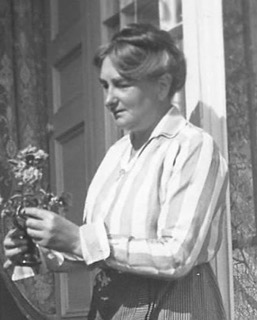
MacNeill is one of five children born to Archibald McNeill, a Roman Catholic working-class baker, sailor and merchant, and his wife, Rosetta McNeill (née McAuley), also a Catholic. He is raised in Glenarm, an area which “still retained some Irish-language traditions.” His niece is nationalist and teacher, Máirín Beaumont.

MacNeill is educated at St. Malachy’s College and Queen’s College, Belfast. He is interested in Irish history and immerses himself in its study. He achieves a Bachelor of Arts degree in economics, jurisprudence and constitutional history in 1888, and then works in the British Civil Service.

MacNeill co-founds the Gaelic League in 1893, along with Douglas Hyde. He is unpaid secretary from 1893 to 1897 and then becomes the initial editor of the League’s official newspaper An Claidheamh Soluis (1899–1901). He is also editor of the Gaelic Journal from 1894 to 1899. In 1908, he is appointed professor of early Irish history at University College Dublin (UCD).

MacNeill marries Agnes Moore on April 19, 1898. The couple has eight children, four sons and four daughters (though the 1911 census entry for MacNeill notes eleven children, seven of whom are still alive).

The Gaelic League is from the start strictly non-political, but in 1915, a proposal is put forward to abandon that policy and become a semi-political organisation. MacNeill strongly supports this and rallies to his side a majority of delegates at the 1915 Oireachtas. Douglas Hyde, a non-political Protestant, who had co-founded the League and been its president for 22 years, resigns immediately afterward.

Through the Gaelic League, MacNeill meets members of Sinn Féin, the Irish Republican Brotherhood (IRB), and other nationalists and republicans. One such colleague, The O’Rahilly, runs the league’s newspaper An Claidheamh Soluis, and in October 1913 asks MacNeill to write an editorial for it on a subject broader than Irish language issues. He submits a piece called “The North Began,” encouraging the formation of a nationalist volunteer force committed to Irish Home Rule, much as the unionists had done earlier in the year with the Ulster Volunteers to thwart Home Rule in Ireland. In July 1915, he comments on the threat that the unarmed nationalists in Ulster might face: “…a demented…English driven Orange Army would be let loose upon the helpless Catholic people of Ulster, who would be driven out of the province or massacred where they stood.”

Bulmer Hobson, a member of the IRB, approaches MacNeill about bringing the idea to fruition, and, through a series of meetings, MacNeill becomes chair of the council that forms the Irish Volunteers, later becoming its chief of staff. Unlike the IRB, he is opposed to the idea of an armed rebellion, except in resisting any suppression of the Volunteers, seeing little hope of success in open battle against the British army.

The Irish Volunteers have been infiltrated by the Irish Republican Brotherhood, which plan on using the organisation to stage an armed rebellion, to separate Ireland from the United Kingdom and establishing an Irish Republic. The entry of the UK into World War I is, in their view, a perfect opportunity to do that. With the cooperation of James Connolly and the Irish Citizen Army, a secret council of IRB officials plan a general rising at Easter 1916. On the Wednesday before Easter, they present MacNeill with a letter, allegedly stolen from high-ranking British staff in Dublin Castle, indicating that the British are going to arrest him and all the other nationalist leaders. Unbeknownst to MacNeill, the letter—called the Castle Document—is a forgery.

When MacNeill learns about the IRB’s plans, and when he is informed that Roger Casement is about to land in County Kerry with a shipment of German arms, he is reluctantly persuaded to go along with them, believing British action is now imminent and that mobilization of the Irish Volunteers will be justified as a defensive act. However, after learning that the German arms shipment has been intercepted and Casement arrested, and having confronted Patrick Pearse, who refuses to relent, MacNeill countermands the order for the Rising by sending written messages to leaders around the country, and placing a notice in the Sunday Independent cancelling the planned “manoeuvres.” This greatly reduces the number of volunteers who report for duty on the day of the Easter Rising.

Pearse, Connolly and the others agree that the uprising will go ahead anyway, but it begins one day later than originally intended to ensure that the authorities are taken by surprise. Beginning on Easter Monday, April 24, 1916, the Rising lasts less than a week. After the surrender of the rebels, MacNeill is arrested although he has taken no part in the insurrection. The rebel leader Tom Clarke, according to his wife Kathleen, warns her on the day before his execution, “I want you to see to it that our people know of his treachery to us. He must never be allowed back into the National life of this country, for so sure as he is, so sure will he act treacherously in a crisis. He is a weak man, but I know every effort will be made to whitewash him.”

MacNeill is released from prison in 1917 and is elected Member of Parliament (MP) for the National University and Londonderry City constituencies for Sinn Féin in the 1918 United Kingdom general election. In line with abstentionist Sinn Féin policy, he refuses to take his seat in the British House of Commons in London and sits instead in the newly convened Dáil Éireann in Dublin, where he is made Secretary for Industries in the second ministry of the First Dáil. He is a member of the Parliament of Northern Ireland for Londonderry between 1921 and 1925, although he never takes his seat. In 1921, he supports the Anglo-Irish Treaty. In 1922, he is in a minority of pro-Treaty delegates at the Irish Race Convention in Paris. Following the establishment of the Irish Free State, he becomes Minister for Education in its second (provisional) government, the third Dáil. He strongly supports the execution of Richard Barrett, Liam Mellows, Joe McKelvey and Rory O’Connor during the Irish Civil War.

In 1923, MacNeill, a committed internationalist, is also a key member of the diplomatic team that oversees Ireland’s entry to the League of Nations.

MacNeill’s family is split on the treaty issue. One son, Brian, takes the anti-Treaty side and is killed in disputed circumstances near Sligo by Free State troops during the Irish Civil War in September 1922. Two other sons, Niall and Turloch, as well as nephew Hugo MacNeill, serve as officers in the Free State Army. One of his brothers, James McNeill, is the second and penultimate Governor-General of the Irish Free State.

In 1924, the three-man Irish Boundary Commission is set up to settle the border between Northern Ireland and the Irish Free State. MacNeill represents the Irish Free State. He is the only member of the Commission without legal training and has been described as being “pathetically out of his depth.” However, each of the Commissioners is selected out of political expediency rather than for any established competence or insight into boundary making. On November 7, 1925, a conservative British newspaper, The Morning Post, publishes a leaked map showing a part of eastern County Donegal (mainly The Laggan district) that is to be transferred to Northern Ireland, the opposite of the main aims of the commission. Perhaps embarrassed by that, especially since he said that it had declined to respect the terms of the Treaty, MacNeill resigns from the commission on November 20. Hus performance in the Boundary Commission has been deemed highly negative in a 2025 study The Root of All Evil: The Irish Boundary Commission.

On November 24, 1925, MacNeill also resign as Minister for Education, a position unrelated to his work on the commission.

On December 3, 1925, the Free State government agrees with the governments in London and Belfast to end its onerous treaty requirement to pay its share of the United Kingdom’s “imperial debt” and, in exchange, agrees that the 1920 boundary will remain as it is, overriding the commission. This angers many nationalists and MacNeill is the subject of much criticism, but in reality, he and the commission have been sidestepped by the intergovernmental debt renegotiation. In any case, despite his resignations, the intergovernmental boundary deal is approved by a Dáil vote of 71–20 on December 10, 1925, and MacNeill is listed as voting with the majority in favour. He loses his Dáil seat at the June 1927 Irish general election.

MacNeill is an important scholar of Irish history and among the first to study Early Irish law, offering both his interpretations, which at times are coloured by his nationalism, and translations into English. He is also the first to uncover the nature of succession in Irish kingship, and his theories are the foundation for modern ideas on the subject.

MacNeill is a contributor to the Royal Irish Academy‘s Clare Island Survey, recording the Irish place names of the island. His disagreements and disputes with Goddard Henry Orpen, particularly over the latter’s book Ireland under the Normans, generate controversy.

MacNeill is President of the Royal Society of Antiquaries of Ireland (RSAI) from 1937 to 1940 and President of the Royal Irish Academy (RIA) from 1940 to 1943.

MacNeill retires from politics completely and becomes Chair of the Irish Manuscripts Commission. In his later years he devotes his life to scholarship and publishes several books on Irish history. He dies in Dublin of natural causes, aged 78, on October 15, 1945. He is buried in Kilbarrack Cemetery.

MacNeill’s grandson Michael McDowell serves as Tánaiste, Minister for Justice, Equality and Law Reform, TD and a Senator. Another grandson, Myles Tierney, serves as a member of Dublin County Council, where he is Fine Gael whip on the council.

Leave a comment

Birth of Charles Carrigan, Irish Republican

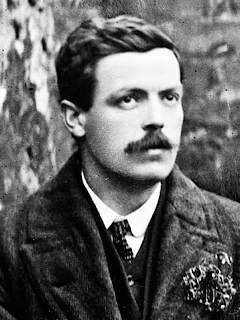
Charles (“Charlie”) Edward Carrigan (Irish: Cathal Éamonn O’Corragáin) an Irish republican, is born in Glasgow, Scotland, on April 28, 1882.

Carrigan is born to Irish parents in Glasgow, but moves to Denny, Stirlingshire, following the early death of his father. He is a trained tailor to trade but also attends classes in history and literature and is proficient in French and Latin, studies the Irish language, and is a Gaelic Leaguer.

Carrigan becomes president of his local branch of the United Irish League (UIL) in Denny in 1898 and later becomes a member of the Irish Republican Brotherhood (IRB). In 1905, he becomes the Chairman of Sinn Féin‘s first ever cumann in Scotland, the Éire Óg Craobh Cumann. In 1916, he is the official Scottish representative to the IRB.

Carrigan joins the Irish Volunteers in 1915 after the split from John Redmond’s National Volunteers. In January 1916, he and fellow IRB members from Glasgow travel to Dublin along with members of Fianna Éireann and Cumann na mBan and forms the Scottish Division of the Irish Volunteers. They are based at the home of Count George Noble Plunkett in Kimmage, County Dublin where they prepare for an insurrection against British rule in Ireland.

On Easter Monday, April 24, 1916, the overseas contingents including the Scottish Division and the North American-based Hibernian Rifles participate in the Easter Rising.

On April 28, 1916, his 34th birthday, during an evacuation of the General Post Office (GPO) in Dublin under the command of The O’Rahilly, Carrigan is shot and killed by British soldiers on Moore Street. He is buried in the St. Paul’s section of Glasnevin Cemetery in Dublin.


Leave a comment

Death of Tomás de Bhaldraithe, Irish Language Scholar

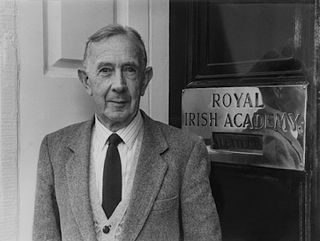
Tomás Mac Donnchadha de Bhaldraithe, Irish scholar notable for his work on the Irish language, particularly in the field of lexicography, dies in Dublin on April 24, 1996. He is best known for his English-Irish Dictionary, published in 1959.

De Bhaldraithe is born Thomas MacDonagh Waldron on December 14, 1916, in Ballincurra, County Limerick. He moves to Dublin with his family at the age of five. He is named after Thomas MacDonagh, one of the signatories of the Proclamation of the Irish Republic, who had been executed after the Easter Rising earlier in the year. He adopts the use of the Irish language version of the name in both Irish and English. He receives his second-level education at Belvedere College in Dublin.

De Bhaldraithe’s stance on standard forms and spellings is supported by Éamon de Valera despite opposition from traditionalists in the Department of Education, and the work is widely seen as an important benchmark in Irish scholarship.

In 1942, de Bhaldraithe is appointed a professor at the Dublin Institute for Advanced Studies (DIAS) in the department of Celtic Studies. In 1960 he is appointed professor of modern Irish language and literature in University College Dublin (UCD), where he develops an impressive archive of material on Irish dialects. Much of the material in this archive is later used as the basis of Niall Ó Dónaill‘s Foclóir Gaeilge-Béarla, published in 1978, for which he is consulting editor. Also during the 1970s, he translates the Irish language diary of Amhlaoibh Ó Súilleabháin into English. It is then published by Mercier Press as “The Diary of an Irish Countryman.”

The language laboratory which de Bhaldraithe sets up in UCD is the first of its kind in any university in Ireland. His interest in seanchas (folklore) leads to his publication of Seanchas Tomás Laighléis in 1977, while his earlier work includes the ground-breaking study of the Cois Fharraige dialect (a variety of Connacht Irish), Gaeilge Chois Fharraige: Deilbhíocht. In later years he works extensively on the definitive Irish dictionary, Foclóir Stairiúil na Nua-Ghaeilge, which remains unfinished when he dies on April 24, 1996, but which is still in progress today.


Leave a comment

Death of Laurence Ginnell, Politician, Lawyer & Member of Parliament

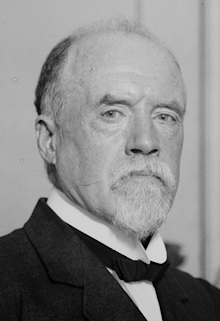
Laurence Ginnell, Irish nationalist politician, lawyer and Member of Parliament (MP) of the House of Commons of the United Kingdom of Great Britain and Ireland, dies in the United States on April 17, 1923. He serves as member of the Irish Parliamentary Party (IPP) for North Westmeath at the 1906 United Kingdom general election. From 1910 he sits as an Independent Nationalist and at the 1918 United Kingdom general election in Ireland he is elected for Sinn Féin.

Ginnell is born in Delvin, County Westmeath, in 1852, (baptised April 9, 1852) the son of Laurence Ginnell and Mary Monaghan and twin to Michael Ginnell. He is self-educated and is called to the Irish bar as well as the Bar of England and Wales. In his youth, he is involved with the Land War and acts as private secretary to John Dillon.

The last great social and agrarian campaign of the Irish home rule movement, the Ranch War (1906 and 1909), is largely led and organised by Ginnell from the central office of the United Irish League. He is elected an MP in 1906, takes his seat at Westminster and swears allegiance to Edward VII. On October 14, 1906, he launches the “war” at Downs, County Westmeath.

The purpose of the war is to bring relief to the large numbers of landless and smallholders, particularly in the West, who are relatively untouched by the Wyndham Land Act (1903) and by the larger policy of purchase. The strategy that Ginnell pursues is the Down’s Policy, or cattle driving, a proceeding designed to harass the prosperous grazier interests, whose “ranches” occupy large, under populated and under worked tracts. The Down’s Policy is also meant to draw public attention to the scandalous inequalities that survive in the Irish countryside. The conservatives within the home rule leadership are understandably suspicious about the revival of agrarian disturbances, but the mood of the party organisation is hardening in the aftermath of a disappointing devolution bill in May 1907, from the new Liberal government, so that it seems logical to turn to the traditional mechanism for reactivating the national question: agrarian agitation.

Ginnell’s cattle drives begin to tail off after the summer of 1908, and the agitation is finally dissolved with the passage of a 1909 Act by the Liberal Chief Secretary Augustine Birrell that allows the transfer to the Irish Land Commission of farmland by compulsory purchase, which is hailed by the national movement as an historic victory. In reality, the Ranch War involves an implosion within sectors of the Irish Parliamentary Party, as its leadership has not facilitated the working of the Wyndham Land Act in the first place because John Dillon and his like want conflict above victory.

In 1909, Ginnell is expelled from the Irish Parliamentary Party for the offence of asking to see the party accounts after which he sits as an Independent Nationalist. During this time, he is addressed frequently as “The MP for Ireland.” At Westminster, he is highly critical of the British government‘s war policy and its holding of executions of certain participants in the Easter Rising of 1916. On May 9, he accuses British Prime Minister H. H. Asquith, of “Murder” and is forcibly ejected from the Chamber. He visits many of the prisoners who are interned in various prisons in Wales and England.

In 1917, Ginnell campaigns to try to ensure the election of George Noble Plunkett in the North Roscommon by-election in which he defeats the IPP candidate on an abstentionist platform. Following the victory of Éamon de Valera in East Clare, while he is standing for Sinn Féin, on July 10, 1917, Ginnell joins Sinn Féin.

At the Sinn Féin ardfheis in 1917, at which the party is reconstituted as a republican party with de Valera as president, Ginnell and W. T. Cosgrave are elected Honorary Treasurers. He is imprisoned in March 1918 for encouraging land agitation and later deported to Reading Gaol. In the 1918 United Kingdom general election, he is elected as a Sinn Féin MP for the Westmeath constituency by comfortably defeating his IPP challenger. After his release from prison, he attends the proceedings of the First Dáil. Along with fellow TD James O’Mara, he is one of the only TDs to serve as a member in both the House of Commons and Dáil Éireann.

He is one of the few people to have served in the House of Commons and in the Oireachtas. He is appointed Director of Propaganda in the Second Ministry of the Irish Republic. After spending a year as a republican campaigner in Chicago, he is appointed the Representative of the Irish Republic in Argentina and South America by de Valera. He carries out his propaganda work here to distribute copies of the Irish Bulletin and to provide the Sinn Féin version of the conflict during the Irish War of Independence. On August 16, 1921, he returns home to attend the first meeting of the Second Dáil. He travels back to Argentina some months later to serve as the Representative of the Republic there.

Ginnell opposes the Anglo-Irish Treaty that is ratified by the Dáil in January 1922, and is elected as an anti-Treaty Sinn Féin TD at the 1922 Irish general election on the eve of the Irish Civil War.

On September 9, 1922, Ginnell is the only anti-Treaty TD to attend the inaugural meeting of the Provisional Parliament or Third Dáil. Before signing the roll, he says, “I want some explanation before I sign. I have been elected in pursuance of a decree by Dáil Éireann, which decree embodies the decree of May 20, 1922. I have heard nothing read in reference to that decree, nothing but an Act of a foreign Parliament. I have been elected as a member of Dáil Éireann. I have not been elected to attend any such Parliament. Will anyone tell me with authority whether it is…”.

Ginnell is at this point interrupted but resumes by saying that he will sign the roll and take his seat in the Assembly if the Assembly is Dáil Éireann. He is informed he is not allowed raise any such question until a Ceann Comhairle has been elected. He continues to ask questions regardless to which he gets no answer including his question: “Will any member of the Six Counties be allowed to sit in this Dáil?” W. T. Cosgrave moves at this point that he be excluded from the House. Ginnell protests, and he is dragged out by force.

De Valera later appoints Ginnell a member of his “Council of State,” a twelve-member body set up to advise him on the deteriorating situation in the civil war. He returns to the United States soon afterward to serve as the Republic‘s envoy in the country. He orders Robert Briscoe and some of his friends to take possession of the Consular Offices in Nassau Street, New York City, then in the hands of the Irish Free State Government, to obtain the list of the subscribers to the bond drive organized to aid the struggle in the War of Independence. At the time, a court case is ongoing to decide on who has the right to the funds: the newly installed Provisional Government or de Valera, as one of the three trustees among the anti-Treatyites.

Ginnell dies in Washington, D.C. on April 17, 1923, at the age of 71, still campaigning against the Anglo-Irish Treaty.


1 Comment

Birth of Michael O’Hanrahan, Irish Rebel

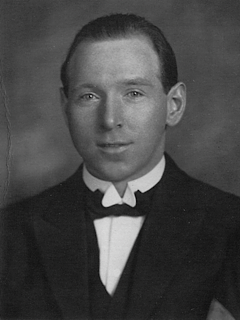
Michael O’Hanrahan (Irish: Mícheál Ó hAnnracháin), an Irish rebel who is executed for his active role in the 1916 Easter Rising, is born as Michael Hanrahan on March 17, 1877, in New Ross, County Wexford.

O’Hanrahan is the son of Richard Hanrahan, a cork cutter, and Mary Williams. His father appears to have been involved in the 1867 Fenian rising. The family moves to Carlow, County Carlow, where he is educated at Carlow Christian Brothers School and Carlow College Academy. On leaving school he works various jobs including a period alongside his father in the cork-cutting business. In 1898, he joins the Gaelic League and in 1899 founds the League’s first Carlow branch and becomes its secretary. Also in 1899 he helps found a working men’s club in Carlow. By 1903 he is in Dublin, where he is working as a proofreader for the Gaelic League printer An Cló Cumann. He publishes journalism under the by-lines “Art” and “Irish Reader” in several nationalist newspapers, including Sinn Féin and the Irish Volunteer. He is the author of two novels, A Swordsman of the Brigade (1914) and When the Norman Came (published posthumously in 1918).

In 1903, O’Hanrahan becomes involved in Maud Gonne’s and Arthur Griffith‘s campaign against the visit of King Edward VII to Ireland. The encounter with Griffith leads O’Hanrahan to join the newly formed Sinn Féin. He also becomes a member of the Irish Republican Brotherhood (IRB). In November 1913, he joins the Irish Volunteers. He is later employed as an administrator on the Volunteers headquarters staff. He is made quartermaster general of the 2nd Battalion. He and the commandant of the 2nd Battalion, Thomas MacDonagh, become close friends.

During the Easter Rising O’Hanrahan is second in command of Dublin’s 2nd Battalion under MacDonagh. He fights at Jacob’s Biscuit Factory, though the battalion sees little action other than intense sniping throughout Easter week, as the British Army largely stays clear of the impregnable factory dominating the road from Portobello Barracks on one side and Dublin Castle on the other. When the situation becomes desperate O’Hanrahan tells MacDonagh they “were inviting destruction of the factory by incendiary shells, and also of the surrounding thickly populated area.” MacDonagh orders a break-out amidst the chaos and confusion. O’Hanrahan leads “with some difficulty” the garrison out of the factory through New Bride Street gate.

O’Hanrahan is executed by firing squad on May 4, 1916 at Kilmainham Gaol. His brother, Henry O’Hanrahan, is sentenced to penal servitude for life for his role in the Easter Rising. After his execution, his mother and three sisters open a shop near Mountjoy Prison where they develop a secret line of communications between prisoners and their visitors.

In 1966, Wexford railway station is renamed Wexford O’Hanrahan Station in commemoration of O’Hanrahan, as is the road bridge over the River Barrow at New Ross. Two Gaelic games sports clubs are named after him: Geraldine O’Hanrahans GAA (New Ross) and O’Hanrahans GFC (Carlow).


Leave a comment

Birth of Charles McGuinness, Sailor & Adventurer

Charles John McGuinness, sailor and adventurer, is born on March 6, 1893, in Derry, County Londonderry.

McGuinness is the elder of two sons of John McGuinness, sea captain and harbourmaster who is born in the United States, and Margaret McGuinness (née Hernand) from Donegal, County Donegal.

In 1908, at the age of 15, McGuinness leaves home, stowing away in a ship and traveling extensively throughout the world for several years. At the age of 17 he is involved in the first of several shipwrecks, drifting for two weeks on a lifeboat before being rescued near Tahiti. He works as a pearl fisher in the South Seas for a year before resuming his nautical career.

In 1913, McGuinness travels through Canada, working as a panhandler and briefly joining the Canadian Militia. In August 1914, following the outbreak of World War I, he joins the British navy, serving in Admiral Reginald Bacon‘s Dover Patrol and in Cameroon. After learning of the 1916 Easter Rising, he deserts the British navy but later joins the South African Army, in which he fights in east Africa. He is captured by the German Schutztruppe of Colonel Paul von Lettow-Vorbeck but manages to escape by trekking through the jungle.

Disillusioned with the war, McGuinness resumes his travels. In 1920, he returns to Derry and joins the Irish Republican Army (IRA), leading a flying column in northwest Ireland. McGuinness, who reputedly introduces the first monkey to Derry, is viewed locally as an eccentric adventurer but is much celebrated for his instrumental role in the daring escape of Frank Carty, the IRA Sligo Brigade commander, from Derry jail.

Wanted for the murder of Inspector Robert Johnson in Glasgow, a charge he denies, McGuinness is captured by the British army in June 1921 after a failed bank raid in Glenties, County Donegal, but escapes from Derry’s Ebrington Barracks before his identity is established. Shortly after the truce in July 1921 he is sent by Liam Mellows to Germany, from where he smuggles arms to Ireland. After the treaty split, he continues to smuggle arms for the republican side but leaves the IRA, having become disillusioned with its incompetence. He claims to have been arrested in Berlin in 1922 for conspiring with Bulgarian revolutionaries, and released on condition that he leaves the state.

McGuinness emigrates to New York in 1923 where, following an alleged spell of employment by Chiang Kai-shek‘s forces in China, he establishes himself as a building contractor. In 1928, he joins Admiral Richard E. Byrd‘s expedition to the Antarctic, serving as a navigation officer. At a reception on his return in 1929, he presents the mayor of New York City, Jimmy Walker, with an Irish tricolour which, he claims, Byrd had flown over the South Pole. He is not, as he claims, awarded a congressional medal by the secretary of the navy.

In 1930, McGuinness embarks on a new career, smuggling rum between Canada and the United States (his memoirs of which are subsequently published in the American press under the pseudonym “Night-Hawk”). After losing his fortune when his boat and cargo are impounded in the summer of 1931, he travels to the Soviet Union to observe communism at first hand. He remains in the Soviet Union around two years, where he claims to work as a harbourmaster in Murmansk, and forms an unfavourable opinion of the Soviet Union.

McGuinness’s autobiography, Nomad, is published in 1934. His publisher, Methuen Publishing, is sued for considerable damages by the notorious Alderman John William Nixon, MP, as a result of McGuinness’s veiled reference to him as the former Royal Ulster Constabulary (RUC) detective inspector who led a murder gang in Belfast in 1922, believed responsible for the murder of the McMahon family.

In late 1936, McGuinness joins the International Brigades in the Spanish Civil War but soon deserts after disagreements with the authorities. He returns to Ireland, where he pens a sensational exposé of the International Brigades, I fought with the Reds, which is published by the Irish Independent. He also writes colourful accounts of life under communism, such as Behind the Iron Curtain, under the pseudonym “Peter Dawson.”

In 1942, while serving as chief petty officer in the marine service at Haulbowline, McGuinness offers to assist the German legation by smuggling spies out of Ireland. Despite his British naval service, he is virulently anti-British. According to local legend he has the sole of both feet tattooed with the Union Jack so wherever he goes he is safe in the knowledge that he is “trampling on the butcher’s apron.” He is arrested and sentenced to seven years imprisonment but is released shortly after the end of the Emergency.

McGuinness is believed to have died on December 4, 1947, when he supposedly drowns alongside four other crew members of the schooner Isaalt that he is piloting on Ballymoney Strand near Gorey, County Wexford. Two members of the crew survive, managing to swim ashore, the ship is a mere 100 metres from land. However, members of McGuinness’ family express doubt over the years. A nephew claims to have encountered McGuinness on the London Underground in 1955. Upon their gazes meeting, McGuinness is reported to smile and say four simple words: “You never saw me.”

(From: “McGuinness, Charles John” by Fearghal McGarry, Dictionary of Irish Biography, http://www.dib.ie, October 2009)


Leave a comment

The Irish Catholic Hierarchy Formally Endorses Home Rule

The Irish Catholic Hierarchy formally endorses Home Rule on February 16, 1886, a significant moment in the Irish political landscape.

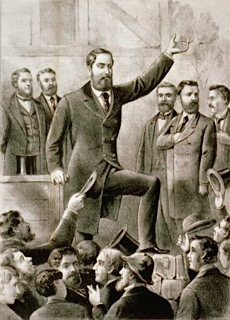
The Home Rule movement, led by Charles Stewart Parnell (pictured) and the Irish Parliamentary Party (IPP), seeks to establish a separate Irish parliament to handle domestic affairs while remaining within the British Empire. The campaign gains significant momentum throughout the late 19th century, but opposition from the British government and Irish unionists make progress difficult. Up to this point, the Catholic Church in Ireland had largely remained cautious about taking an overtly political stance on Home Rule. However, their endorsement on this day in 1886 changes the dynamic of the movement, giving it an unprecedented boost in legitimacy and support among the Irish people.

The Catholic Church plays a central role in Irish society, wielding immense influence over the daily lives of the majority Catholic population. Many of the clergy are already sympathetic to nationalist aspirations, but an official endorsement from the hierarchy signals a unified front that cannot be ignored. By formally backing Home Rule, the bishops strengthen nationalist demands and provide moral authority to the movement, reinforcing the argument that Home Rule is not just a political necessity but also a just and rightful cause.

This endorsement comes at a critical time. British Prime Minister William Ewart Gladstone is preparing to introduce the Government of Ireland Bill 1886, commonly known as the First Home Rule Bill, in April 1886, a legislative measure that, if passed, would grant Ireland limited self-government. The backing of the Catholic hierarchy is instrumental in rallying public support and reinforcing Parnell’s leadership. While the bill ultimately fails in the House of Commons on June 8, 1886, due to strong opposition from Conservative and Unionist factions, the Catholic Church’s stance ensures that Home Rule remains a dominant political issue for decades to come.

Despite the failure of the 1886 bill, the endorsement by the Catholic bishops has long-term implications. It solidifies a powerful alliance between Irish nationalism and the Church, an influence that persists well into the 20th century. The endorsement also helps to counteract Protestant unionist claims that Home Rule is merely a radical or sectarian endeavor, presenting it instead as a moderate and just political cause with widespread backing.

Over the following years, Home Rule remains a contentious issue, with subsequent attempts to pass similar legislation met with resistance. The Government of Ireland Bill 1893, commonly known as the Second Home Rule Bill, is again defeated in the House of Lords, and it is not until the Government of Ireland Act 1914, commonly referred to as the Third Home Rule Bill, that significant progress is made. Even then, implementation is delayed by World War I and ultimately overshadowed by the 1916 Easter Rising and the Irish War of Independence.

Looking back, the Catholic Church’s endorsement of Home Rule on February 16, 1886, is a defining moment in Ireland’s political history. It reinforces the nationalist cause, legitimizes the demand for self-governance, and plays a crucial role in shaping Ireland’s path toward eventual independence. While Home Rule itself is never fully realized in the form originally envisioned, its legacy influences the Irish Free State’s establishment in 1922 and Ireland’s eventual emergence as a fully independent republic.

(From: “February 16, 1886 – The Catholic Church Embraces Home Rule,” by Bagtown Clans, This Day in Irish History Substack, http://www.thisdayinirishhistory.substack.com, February 2025)


Leave a comment

Death of Thomas Johnson, Irish Labour Party Politician

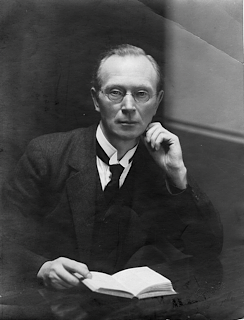
Thomas Ryder Johnson, Irish Labour Party politician and trade unionist who serves as Leader of the Opposition from 1922 to 1927 and Leader of the Labour Party from 1917 to 1927, dies on January 17, 1963, at Clontarf, Dublin. He serves as a Teachta Dála (TD) for Dublin County from 1922 to 1927. He is a Senator for the Labour Panel from 1928 to 1934.

Johnson is born on May 17, 1872, in Liverpool, England. He works on the docks for an Irish fish merchant, spending much of his time in Dunmore East and Kinsale. It is this way that he picks up ideas about socialism and Irish nationalism, joining a Liverpool branch of the Independent Labour Party in 1893. In 1900 he starts work as a commercial traveller, then moves in 1903 with his family to Belfast where he becomes involved in trade union and labour politics.

In 1907, Johnson helps James Larkin organise a strike in the port, but has to watch in dismay as the strike, which begins with remarkable solidarity between labour, Orange, and nationalist supporters, collapses in sectarian rioting. At various times he is the president, treasurer and secretary of the Irish Trades Union Congress (ITUC) which is, at the time, also the Labour Party in Ireland, until officially founded in 1912 by James Connolly and James Larkin. Johnson becomes Vice-President of the ITUC in 1913, and President in 1915.

Johnson sympathizes with the Irish Volunteers, many of whom are sacked from their jobs, for illegal activities. During the Easter Rising, he notes in his diary that people in Ireland paid little heed to the fate of the defeated revolutionaries. He succeeds as leader of the Labour Party from 1917, when the party does not contest the 1918 Irish general election. When the British government tries to enforce conscription in Ireland in 1918, he leads a successful strike in conjunction with other members of the Irish anti-conscription movement.

Johnson is later elected a TD for Dublin County to the Third Dáil at the 1922 Irish general election and remains leader of the Labour Party until 1927. As such, he is Leader of the Opposition in the Dáil of the Irish Free State, as the anti-treaty faction of Sinn Féin refuses to recognise the Dáil as constituted. He issues a statement of support for the Government of the 4th Dáil when the Irish Army Mutiny threatens civilian control in March 1924.

Johnson is the only Leader of the Labour Party who serves as Leader of the Opposition in the Dáil. He loses his Dáil seat at the September 1927 Irish general election, and the following year he is elected to Seanad Éireann, where he serves until the Seanad’s abolition in 1936.

In 1896 he meets Marie Tregay, then a teacher in St. Multose’s National school, outside Kinsale. A native of Cornwall, she has advanced political views. They marry in 1898 in Liverpool. Their only son, Frederick Johnson, is born in 1899, and becomes a well-known actor. Johnson dies on January 17, 1963, at 49 Mount Prospect Avenue, Clontarf, Dublin.

Each summer, Labour Youth holds the “Tom Johnson Summer School” to host panel discussions, debates and workshops.


Leave a comment

Birth of Louie Bennett, Suffragette, Trade Unionist, Journalist & Writer

Louisa (Louie) Bennett, suffragette, trade unionist, and peace activist, is born on January 7, 1870, in Garville Avenue, Rathgar, Dublin, the eldest daughter of James Cavendish Bennett, a prosperous auctioneer, and his wife Susan (née Bolger). She is brought up at Temple Hill, Blackrock, and educated at Alexandra College, and at an academy for young ladies in London, where she and her sisters form an Irish League. She goes on to study singing in Bonn, Germany. Already as a teenager she shows an interest in writing, her first literary effort being Memoirs of the Temple Road in the 80s. Afterward she publishes two unsuccessful romantic novels, The Proving of Priscilla (1902) and A Prisoner of His Word (1908), the latter set in County Down in the aftermath of the Irish Rebellion of 1798.

Bennett turns her attention to women’s issues and by 1910 has become involved in the suffrage movement, initially through her reading of the suffrage monthly The Irish Citizen. In 1911, she co-founds, with her life-long friend and colleague Helen Chenevix, the Irish Women’s Suffrage Federation, an umbrella organisation, which by 1913 has connected fifteen Irish suffrage societies and has established links with Europe and the United States. She and Chenevix are the organisation’s first honorary secretaries. She is also associated with the Irish Women’s Franchise League, for which she runs public speaking classes. However, as the divide between militants and opponents of the use of violence become more pronounced, Bennett, as a confirmed pacifist, who endorses what she calls “constructive, rather than destructive action,” distances herself from the league, and through her involvement in the production of The Irish Citizen seeks to sideline the militants.

Bennett’s concerns are not limited to the question of women’s franchise. As founder of the Irish Women’s Reform League, she not only addressea the suffrage question, but examines many social issues concerning women. The league focuses on working conditions, monitors court cases involving women, and demands school meals and better education. She is among those who assist in the relief effort at Liberty Hall during the 1913 strike and lockout in Dublin, and she appeals for funds for strikers’ families through The Irish Citizen. In the period that follows she maintains her links with the labour movement. She often opposes the direct, uncompromising approach of both James Connolly and Helena Molony, and argues that labour and women’s issues can only be hampered by any affiliation with nationalist politics. The aftermath of the Easter Rising, and in particular, the murder of Francis Sheehy-Skeffington, causes her to revise some of her views on nationalism. In late 1916 she accepts an invitation to reorganise the Irish Women Workers’ Union (IWWU), on the understanding that she would have complete independence from Liberty Hall. Assisted by Chenevix and Father John Flanagan, she re-creates the union along professional lines, and by 1918 its membership has risen dramatically from a few hundred to 5,300. She consistently defends its separatist stance, arguing that women’s concerns in a male-dominated union will always be of secondary importance.

Throughout World War I Bennett campaigns for peace, and she is selected as the Irish representative to the Women’s International League for Peace and Freedom. She leads the IWWU in its opposition to the attempted introduction of conscription in 1918, and in 1920 she travels to the United States to highlight Black and Tan atrocities (she later meets David Lloyd George and demands the removal of the Black and Tans from Ireland). As a member of the Women’s Peace Committee, she acts as a mediator during the Irish Civil War.

In 1925, Bennett is appointed to an Irish Trades Union Congress (ITUC) committee to promote a scheme of working class education with the assistance of the labour movement. Her interest in adult education later leads to her involvement with The People’s College. A member of the national executive of the ITUC (1927–32, 1944–50), she becomes the first female president of the congress in 1932. She serves a second presidential term in 1947. Her knowledge of labour issues is officially acknowledged by the Irish government in 1932, when she is sent as a representative to Geneva to put forward the case of Irish women workers. In 1938 she delivers a paper entitled Industrialism in an Agrarian Country to the International Relations Institute in the Netherlands.

Despite the depth of Bennett’s involvement with the union movement, she has ambitions outside trade unionism, and in 1938 she lets her name be put forward by the IWWU as a congress candidate for election to the senate, but this comes to nothing. In that year she is appointed to the government commission on vocational organisation (1938–43). In 1943, she is elected as a Labour Party member of the Dún Laoghaire borough council. As a councillor she consistently lobbies for improved housing and is instrumental in the establishment of Dún Laoghaire’s housing council in 1949. She had refused a labour nomination in the 1918 general election, but she stands for Dublin County Council and Dáil Éireann in 1944, in both cases unsuccessfully. She is the only Labour Party member to criticise the party’s support for the Fianna Fáil minority government of 1932, arguing that it is “never right or wise to co-operate with another party with fundamentally different principles.” As an elected member of the Labour Party executive, she represents Ireland at the International Labour Organization in Europe. She is also a representative at the League of Nations.

Throughout her public career Bennett consistently condemns colonialism, fascism, and armaments expenditure. She is possibly best remembered for her leadership in the laundry workers’ strike of 1945, during which IWWU members successfully fight for a fortnight‘s paid holiday. Her management of the IWWU, which lasts until 1955, is marked by determination and diplomacy, though she often uses threatened resignations as a means of controlling her colleagues. She died, unmarried, on November 25, 1956, in Killiney, County Dublin.

(From: “Bennett, Louisa (‘Louie’)” by Frances Clarke, Dictionary of Irish Biography, October 2009)


Leave a comment

Birth of P. S. O’Hegarty, Writer, Editor & Historian

Patrick Sarsfield O’Hegarty (Irish: Pádraig Sáirséal Ó hÉigeartaigh), Irish writer, editor and historian and a member of the Supreme Council of the Irish Republican Brotherhood, is born on December 29, 1879, at Carrignavar, County Cork.

O’Hegarty is born to John and Katherine (née Hallahan) Hegarty. His parents’ families emigrate to the United States after the Great Famine, and his parents are married in Boston, Massachusetts. His father is a member of the Irish Republican Brotherhood (IRB).

O’Hegarty is educated at North Monastery CBS, where he forms an enduring friendship with Terence MacSwiney. In 1888, his father dies of tuberculosis at the age of 42. Left destitute, his mother pawns her wedding ring to pay for an advertisement looking for work, and eventually becomes a cook.

O’Hegarty joins the postal service in Cork in 1897. Along with J. J. Walsh, he plays on the Head Post Office hurling team. He joins the IRB and represents Munster on the IRB Supreme Council. He starts writing for Arthur Griffith‘s United Irishman and The Shan Van Vocht, a periodical established by Alice Milligan and Ethna Carbery.

O’Hegarty serves at the main Postal Sorting Office in Mount Pleasant, London, from 1902 to 1913. Along with J. J. Walsh, he spends three years at King’s College London, studying for the Secretary’s Office. While he succeeds in his studies, Walsh does not and returns to Ireland. O’Hegarty becomes the IRB representative for South East England and joins the Gaelic League and Sinn Féin and becomes a strong advocate of the Irish language. In 1905, he is elected secretary of the local Dungannon Club, which draws in as members Robert Lynd, Herbert Hughes and George Cavan. In 1907, as Sinn Féin’s London Secretary, he approves and signs the membership card of Michael Collins, later becoming friend and mentor to Collins.

O’Hegarty has to return to Ireland for a break due to overwork in 1909 and gives up some of his work for the Gaelic League. However, he takes over as editor of the IRB publication, Irish Freedom. It is in this publication that he famously writes, concerning the visit of King George V to Ireland in 1911: “Damn your concessions, England: we want our country!” In 1912, at the height of the Playboy riots, he writes four articles entitled “Art and the Nation” in Irish Freedom, which take a very liberal and inclusionist approach to Anglo-Irish literature and art in general but invokes the wrath of many of the paper’s readers.

In 1913, he is re-posted to Queenstown (present-day Cobh) as postmaster. He continues editing nationalist newspapers such as Irish Freedom (founded in 1910 and suppressed in December 1914 on account of its seditious content) and An tÉireannach and joins the Irish Volunteers. At the outbreak of war he is moved to Shrewsbury, probably on account of his political activities. In 1915, he marries Wilhelmina “Mina” Smyth, a schoolteacher and suffragist, and is then moved to Welshpool, Montgomeryshire. In the aftermath of the 1916 Easter Rising, he is opposed to physical force. In 1918, he refuses to take the British Oath of Allegiance and resigns his position in the Post Office.

O’Hegarty feels that the Abbey Theatre is “doing good for Ireland” and supports W. B. Yeats against attacks from Arthur Griffith and like-minded Nationalists. He opposes the extremist views of D. P. Moran, who seeks a Roman Catholic Irish-speaking Ireland.

O’Hegarty is Secretary of the Irish Department of Post and Telegraphs from 1922 to 1945. He is elected a member of the Irish Academy of Letters in 1954.

O’Hegarty’s son, Seán Ó hÉigeartaigh, is a founder of the Irish-language publishing house Sáirséal agus Dill. His daughter Gráinne, a harpist, marries Senator Michael Yeats, son of W. B. Yeats.

O’Hegarty dies on December 17, 1955.

O’Hegarty’s papers are acquired by the Kenneth Spencer Research Library at the University of Kansas. This includes an outstanding collection of books, pamphlets and periodicals of W. B. Yeats.

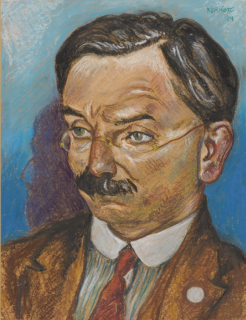
(Pictured: “P. S. O’Hegarty, 1929,” pastel on paper by Harry Kernoff, RHA, property from the Yeats family)