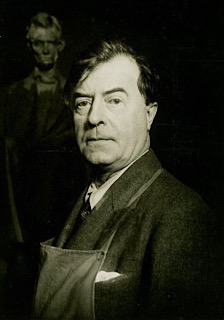
O’Connor’s father, Andrew O’Connor (1846–1924), of Lanarkshire, Scotland, is a stonecutter who becones a professional sculptor. As a teenager, he apprentices to his father, helping him to design monuments for cemeteries.
O’Connor is involved in a minor controversy in 1909 when he is commissioned to design a statue for Commodore John Barry, of the American Revolutionary-era navy. His first design is heatedly attacked by Irish American groups. He submits a second version, but it too is ultimately rejected, and the sculptor John J. Boyle received the commission.
O’Riordan is the youngest child among two sons and three daughters of Daniel O’Connell O’Riordan, a barrister and justice of the peace (JP), and Katharine O’Riordan (née O’Neil), who is her husband’s first cousin. At age of four he witnesses his mother’s death in a carriage accident. His formal education, firstly as a day student at Belvedere College, Dublin (1881–85), and secondly as a boarder at Clongowes Wood College, County Kildare (1887–88), is interrupted by ill health and periods of self-education at home, marked by omnivorous reading in his father’s library.
While engaged in military studies in Bonn, Germany (March–September 1890), preparatory to entering Royal Military Academy Sandhurst in Great Britain, he falls from a horse during riding lessons, suffering a back injury that results in permanent spinal damage, thus precluding a military career.
Left with limited means after his father’s death, O’Riordan moves to London in 1891, where, after attempting suicide, he finds work as a stage actor with the Independent Theatre Society of J. T. Grein and other companies, both in London and touring the provinces, and is noted for his interpretations of Henrik Ibsen. Active in the Irish Literary Society, where he meets W. B. Yeats, he writes fiction under the pseudonym “F. Norreys Connell,” which he also adopts for his stage work.
O’Riordan’s early publications include In the Green Park (1894), a collection of connected short stories, The House of the Strange Woman (1895), a provocative novel of sexual promiscuity in upper-class London bohemia, boycotted by some booksellers as being “morally tainted,” and several books reflecting his deep interest in all things military, most notably The pity of war (1906), a collection of Kiplingesque short stories. Largely abandoning fiction for some years to concentrate on writing for the stage, he returns to Dublin for the first time in fourteen years to direct his controversial one-act play The Piper, which opens at the Abbey Theatre on February 13, 1908. It is jeered as a slander on Irish patriots in disturbances mildly reminiscent of the “Playboy” riots thirteen months previously. The audience on the third night is placated by Yeats, who in a speech from the stage interprets the play – in which a party of rebels in the 1798 rising disdain to set sentries as they argue interminably and discursively, only to be surprised and slaughtered by yeomanry – as a satirical allegory on the fruitless debate that followed the Parnellite split. The work can more usefully be read as a meditation on the propensity of democracy to disintegrate at moments of crisis into ineffectual and dillusory demagoguery. The Piper weathers the controversy to become a frequently performed staple of the Abbey Theatre repertoire during the 1910s.
After the death of John Millington Synge, O’Riordan serves briefly as managing director of the Abbey Theatre from March 25 to July 2, 1909, during which time he produces and directs two of his own one-act plays – Time on April 1, in which he also acts, and An Imaginary Conversation on May 13 – as well as the first revival of Synge’s The Playboy of the Western World on May 27. Wearied by the repeated interferences in the theatre’s affairs by its financial backer, Annie Horniman, he resigns abruptly during her fit of pique when the actress Sara Allgood recites poetry at a private gathering of suffragettes.
O’Riordan scores a major triumph on the London stage with Captain Hannibal (1909), his adaptation of a novel by Stanley Weyman, on the proceeds of which he lives for many years. Settling permanently in London, in 1910 he purchases a house at 106 Meadvale Road, Ealing, his home for the rest of his life. Rejected by the British Army at the outset of World War I owing to his disability, after several failed attempts to secure war work he eventually goes to the front in 1918 in charge of YMCA rest huts at Étaples railway junction, where he befriends the doomed soldier poet Wilfred Owen.
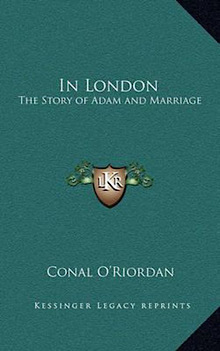
O’Riordan achieves his most accomplished writing within a cycle of twelve novels, published under his own name, chronicling the experiences of several inter-connected Irish and English families from the Napoleonic Wars to the 1920s. First of the series to appear was Adam of Dublin (1920), a combined Bildungsroman and roman-à-clef of the literary revival, with vignettes of Dublin slum life, Belvedere College, and the early years of the Abbey Theatre. He follows his protagonist, Adam Quinn, through the sexual turmoil of adolescence, an itinerant acting career, and an unhappy marriage in three sequels: Adam and Caroline (1921), In London (1922), and Married life (1924). These four novels chronologically conclude the narrative of the completed cycle. The narrative commences with the “Soldier” tetralogy – Soldier Born (1927), Soldier of Waterloo (1928), Soldier’s Wife (1935), and Soldier’s End (1938) – a picaresque treatment of the multifarious and farflung experiences of David Quinn, a forebear of Adam, from an Irish childhood and English education, to the Battle of Waterloo, where he suffers horrible facial mutilation, through the Irish famine and the American Civil War, to his death at the hands of Versaillais troops during the suppression of the Paris commune. Judith Quinn (1939) and Judith’s Love (1940), about the disappointments in love and marriage of a late-Victorian Dublin woman, link the narratives of the “Adam” and “Soldier” tetralogies, while The Age of Miracles(1925) and Young Lady Dazincourt (1926) are chronologically contemporaneous with the latter “Adam” novels. Inconsistent in intention, and uneven in execution, the cycle is strongest in its evocative descriptions of Dublin, London, and other cities, with their varied social strata, in different historical periods, in the sharp-edged, witty dialogue, and in the juxtaposition of dazzling comedy and an ironic sense of tragedy.
O’Riordan continues to write successful, if lightweight, stage plays. His 1928 production of Napoleon’s Josephine features a stellar cast including Edith Evans. Among his published plays are Shakespeare’s End, and Other Irish Plays (1912), Rope Enough (1914), His Majesty’s Pleasure (1925), The King’s Wooing (1929), and Captain Falstaff and Other Plays (1935). The historical commentary Napoleon Passes (1933) reflects his abiding interest in the French emperor. President of the Irish Literary Society from 1937 to 1939, he resigns after failing to persuade his colleagues to repudiate Ireland’s wartime neutrality. Despite age, disability, and increasing reclusivity, throughout World War II he serves as an air raid warden from 1940 to 1945. Elected a fellow of the Royal Society of Literature (1945–48), he represents the society on the council of the newly formed National Book League, and is the society’s Tredegar lecturer in 1946. Charming and convivial, a witty and erudite conversationalist, he cultivates numerous literary friendships, and is an inveterate womaniser, enjoying countless intimate relationships, both sexual and platonic.
O’Riordan marries firstly Florence Derby in 1903, a nurse eight years his senior, with whom he has one son. They are estranged by the time of her death in 1923. In 1924, he marries secondly Olga Buckley, his lover since 1920, and secretary to the wife of G. K. Chesterton. They have two sons (both born before the marriage) and one daughter. Despite considerable contemporary celebrity and critical acclaim, his work compared to that of Charles Dickens and Honoré de Balzac, he has been ignored by posterity. The best of his writing, especially the “Adam” and “Soldier” novels, merit rediscovery.
O’Riordan dies at his London home on June 18, 1948, the anniversary of the Battle of Waterloo. A special O’Riordan number of the Journal of Irish Literature (September 1985), edited by his daughter Judith, includes a portrait photograph, the text of The Piper, and a detailed chronology.
(From: “O’Riordan, Conal Holmes O’Connell (‘Norreys Connell’)” by Lawrence William White and Aideen Foley, Dictionary of Irish Biography, http://www.dib.ie, October 2009)
Dillon leaves school at the age of fourteen and for seven years works as a painter and decorator, mostly in London. From an early age he is interested in art, cinema, and theatre. About 1936 he starts out as an artist.
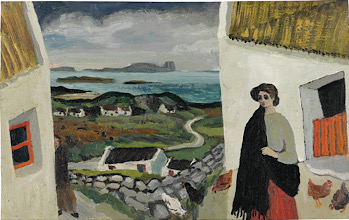
Dillon’s Connemara landscapes provide the viewer with context, portraits of the characters who work the land, atmosphere and idiosyncratic colour interpretations. At the age of 18, he goes to London, initially working as a decorator. With the outbreak of World War II, he returns to Belfast. Over the next five years he develops as a painter in Dublin and Belfast. His works during this period are more than simple depictions of the life and people around him, they are reactions and interactions in paint.
In 1942, Dillon’s first solo exhibition is opened by his friend and fellow artist, Mainie Jellett, at The Country Shop, St. Stephen’s Green, Dublin. “Father, Forgive Them Their Sins” depicts his concerns about the new war that has broken out. Despite a growing reputation, he returns to London in 1944 to work on demolition gangs to restore his finances. In the late 1940s and during the 1950s, he finds himself favouring the town of Roundstone, County Galway. In 1951 he is introduced to Noreen Rice by her piano teacher. She has no formal training and takes Dillon and George Campbell as her mentors for decades and her work is of a similar surrealistic and primitive style.
In 1958, Dillon has the double honour of representing Ireland at the Guggenheim International, and Great Britain at the Pittsburg International Exhibition. He and his sister, Mollie, have a property on Abbey Road in 1958. They let out part of the house to Arthur Armstrong and they let a flat to Noreen Rice and her brother. He and Noreen tour junk yards to find objects like leather and string that they include in their artwork.
Dillon travels widely in Europe and teaches for brief periods in the London art schools.
In 1967, Dillon suffers a stroke and spends six weeks in hospital. From this time his work changes direction. A notion of imminent death sends his work almost into another world, a realm of dreams and paintings intimating his death. In 1968 he is back in Dublin, where he helps to design sets and costumes for Seán O’Casey‘s play Juno and the Paycock. He continues to paint and also to make tapestries, sitting at his Singersewing machine.
In 1969, Dillon pulls his artworks from the Belfast leg of the Irish Exhibition of Living Art in purported protest during the Troubles against the “arrogance of the Unionist mob.” However, he does send work to Ulster when he donates work to Sheelagh Flanagan who had organised an exhibition for the relief of victims of the Belfast riots, in October 1969. His picture is hanged alongside the donated works of T. P. Flanagan, William Scott, F. E. McWilliam, Deborah Brown and Carolyn Mulholland as well as more than twenty others. Michael Longley retorts in a further letter, “Belfast needed creativity, it needed people like Gerard Dillon.” During his last years, he is invited to be involved in a children’s art workshop in the National Gallery of Ireland.
Dillon dies of a second stroke at the age of 55 on June 14, 1971. His grave, as requested, is unmarked in Belfast’s Milltown Cemetery. Danlann Gerard Dillon/The Gerard Dillon Gallery in Cultúrlann McAdam Ó Fiaich is named in his honour.
In his biography of the artist, James White briefly touches on the artists homosexuality: “such was his religious feeling that although he was drawn to people of that type, if he once had an encounter I believe that it never occurred again.” The artist’s nephew, Martin Dillon, recalls that after his uncle’s death he found a diary entry describing a homosexual encounter with a sense of guilt, but the author Gerard Keenan insists he was “a very well-adjusted homosexual.” Reihill expands on this, pointing to a probably unrequited love for the painter Daniel O’Neill and also highlights Dillon’s association with Basil Rákóczi and The White Stag Group‘s Kenneth Hall both strong gay connections. Pictures with both overt and covert references are known.
Although O’Connell begins calling for repeal in the early 1830s, the formal Association is only established in 1840. Prior to this, candidates supporting repeal contest the 1832 United Kingdom general election and between 1835 and 1841, form an electoral pact with the Whigs. Repealer candidates, unaffiliated with the Whigs also contest the 1841 and 1847 general elections.
Following the movement’s decline in the late 1840s, nationalists, including members of the Young Ireland movement, emerge from its ranks.
Ordained in 1924, the theology in which McQuaid is trained is conservative — strongly neo-scholastic and hostile to modernism and liberalism. His hatred of the French Revolution is expressed in several pastorals and speeches throughout his career. He also regards Protestantism as a fundamental error from which Irish Catholics should be quarantined as much as possible.
Appointed Dean of Studies at Blackrock College, McQuaid becomes a prominent figure in Catholic education and chairs the Catholic Headmasters’ Association for several years. In 1931 he is appointed president of Blackrock College, in which capacity he becomes acquainted with Éamon de Valera, the future Irish Taoiseach whose sons attend the school. In 1936, while drafting a new Irish constitution, de Valera consults McQuaid, although he rejects McQuaid’s draft “One, True Church” clause which states, among other things, that the Catholic Church is the one true church in Ireland.
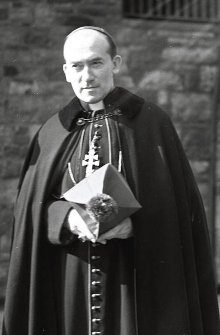
When McQuaid is appointed Archbishop of Dublin in 1940, the appointment of a priest from the regular clergy causes considerable surprise. Irish government archives reveal that de Valera, as is suspected at the time, presses McQuaid’s claims at the Vatican. However, it is doubtful whether the Vatican needs much persuasion. There is a dearth of potential episcopal talent and McQuaid has an outstanding reputation as a Catholic educationalist.
Once appointed, McQuaid proves to be one of the ablest administrators in the history of the Irish Church. In the first two years of his episcopate, he sets up the Catholic Social Service Conference to alleviate the poverty and distress in Dublin which is aggravated by the war, and the Catholic Social Welfare Bureau to help the thousands of Irish emigrants going to Britain for war work. These two organizations fill a much-needed gap and continue to exist after the war. The expansion of Dublin city and its suburbs during his episcopate requires the building of new churches, schools, and hospitals. Meeting these demands also necessitates a considerable increase in the number of clergies, secular and regular, whose numbers more than double in the period from 1941 to 1972.
Given his previous career, the importance McQuaid assigns to education is not surprising. He is critical of the low priority accorded to education by successive governments and is particularly critical of the poor and pay conditions of teachers. His intervention in the primary teachers’ strike in 1946 is poorly received by the government and marks the souring of his relationship with de Valera. During his episcopate the number of primary schools increases by a third while the number of secondary schools more than double but, as with social welfare, the government increasingly assumes a dominant role in education from the 1960s onwards. Almost immediately after his appointment in 1940, he takes a hardline stand against the attendance of Catholic students at Trinity College Dublin (TCD). The ban lasts until 1970, when the increase in student numbers renders it untenable and he accedes reluctantly.
McQuaid has a formidable list of achievements in health care, especially maternity and pediatric services, physical and mental handicap services, and the treatment of alcoholism. It is ironic, therefore, that the most controversial episode of his career occurs in this area — the Irish hierarchy’s rejection in 1951 of a free mother-and-child health service. This leads to the resignation of the Minister for Health, Dr. Noël Browne, and is a watershed in Church-State relations in Ireland. With Irish tuberculosis and infant mortality statistics ranking among the highest in the world, the hierarchy, and particularly McQuaid, lose considerable support by lining up with the conservative medical establishment to resist efforts at socialized medicine.
From various pastorals that McQuaid issues at the time, it is clear that he does not see the need for the Second Vatican Council. As its deliberations proceed, his unease grows, and he becomes increasingly preoccupied with the issue of episcopal power and independence that he believes are being threatened by the Council. In the areas of liturgical reform, greater lay participation, and ecumenism, he is slow in implementing the Vatican II reforms. His views on ecumenism had always been lukewarm and had led to allegations that he was anti-Protestant. His personality and policies are criticized by a more assertive Dublin laity, but being a shy, reserved man who increasingly feels the isolation of office, he never responds to such comments. In 1968 the reaction to Humanae vitae causes open rebellion in the Dublin diocese, the force of which catches him unaware. His last pastoral as archbishop in 1971 betrays his anger and bemusement at the response to Humanae vitae in Dublin.
At the age of 75, McQuaid submits his resignation to the Vatican, and it is accepted. His resignation is announced in January 1972, when he is replaced by Dermot Ryan. McQuaid dies in Loughlinstown, County Dublin, the following year on April 7, 1973. He is buried in St. Mary’s Pro-Cathedral in Dublin, the seat of the Roman Catholic Archdiocese of Dublin.
McQuaid’s substantial archives are released by the Dublin Diocesan Archives in the late 1990s. In 1999 journalist John Cooney publishes a hostile biography of McQuaid, which makes controversial allegations of sexual abuse against McQuaid. The allegations are based on tenuous evidence gathered by McQuaid’s nemesis from the 1951 Mother and Child controversy, Dr. Noël Browne, who had died in 1997. No corroborating evidence is produced or has since emerged.
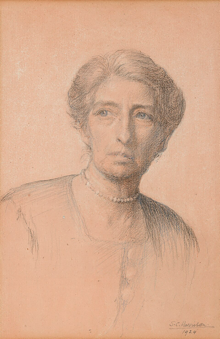
Best is born in Dublin on July 11, 1865, the youngest of fourteen children of Dublin merchant, Eldred Oldham, and Annie (née Alker). Two of her siblings are Alice Oldham, the first of nine women to graduate from university with a degree in either Great Britain or Ireland, and Charles Hubert Oldham, first professor of national economics at University College Dublin (UCD). She attends the Royal Irish Academy of Music (RIAM), studying under Margaret O’Hea and Robert Prescott Stewart. She wins the Lord O’Hagan’s prize in 1883. She is one of the first three candidates to win a scholarship to the Royal College of Music, London, in 1883, becoming an associate of the College by competitive examination in 1887. She is a close friend and confidante of the College’s director, Sir George Grove, to which his 514 letters to her from 1883 to 1899, now housed in the Royal College of Music library, testify.
Best returns to the RIAM as a piano teacher in 1887, remaining in that post until 1932. She is the first female teacher in the RIAM listed as holding a diploma in music. She is also an assistant to Michele Esposito as a local centre examiner. She is a founding member of the Feis Ceoil, undertaking large responsibility for its organisation, and it becomes an annual event under her leadership. In 1898, she describes the foundation of the Feis in a paper to the Incorporated Society of Musicians as being inspired to “ultimately do more for the art of music in Ireland than anything which has yet been attempted.” Along with Joseph Seymour and Edward Fournier she visits the Welsh Eisteddfod to compare it with the Feis, and hopes it will become as influential as the Welsh festival. She works with Eoin MacNeill and the Gaelic League to promote the Feis, and to organise prizes. Under her influence, the festival broadens its scope beyond purely Irish music. She serves as the honorary secretary of the Feis Ceoil Association from 1896 to 1905, and vice-president from 1905 to 1950. In 1897, Esposito dedicates his cantata Deirdre to her. She is a founding member of the Dublin Orchestral Society in 1899, and she succeeds Esposito as the director of music at Alexandra College, Dublin, in 1927. She is made an associate of the Royal Dublin Societyin 1892, and fellow of the RIAM in 1938.
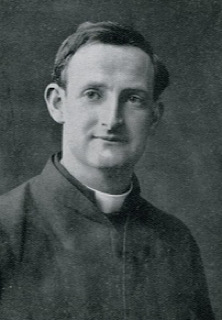
Doyle is awarded the Military Cross for his bravery during the assault on the village of Ginchy during the Battle of the Somme in 1916. He is also posthumously recommended for both the Victoria Cross and the Distinguished Service Order, but is awarded neither. It is possible that anti-Catholicism played a role in the British Army’s decision not to grant him both awards.
General William Hickie, the commander-in-chief of the 16th (Irish) Division, describes Father Doyle as “one of the bravest men who fought or served out here.”
Irish folk singer Willie ‘Liam’ Clancy is named after Doyle due to his mother’s fondness for him, although they never meet.
In August 2022, the Father Willie Doyle Association is established to petition the Catholic Church to introduce a cause for canonisation for Doyle. In January 2022, the Supplex Libellus, the formal petition, is presented to Bishop Thomas Deenihan. Having consulted with the Irish Bishops’ Conference and the Dicastery for the Causes of Saints, Deenihan issues an edict on October 27, 2022, announcing the opening of a cause. The Opening Session takes place on November 20, 2022, at the Cathedral of Christ the King, Mullingar.
Patterson is born in Belfast on April 18, 1802, the eldest son among three sons and a daughter of Robert Patterson, ironmonger, who supplies equipment for linen mills, and his wife Catherine Patterson (neé Clarke), who is from Dublin. He attends Belfast Royal Academy, and from 1814 is one of the first pupils of the Belfast Academical Institution. He is apprenticed in 1818 to his father, and takes over the business on his father’s death in 1831. Even as a boy, he devotes his leisure time to the study of natural history, and during summer holidays investigates the flora and fauna of the countryside and seaside resorts near Belfast. One of his brothers, William (1805–37), has similar interests.
At the age of 18, Patterson is a founder along with seven others, including James Lawson Drummond, James MacAdam and George Crawford Hyndman, of the Belfast Natural History Society in 1821 (from 1842 “and Philosophical” is added to the society’s name). He is the society’s president for many years, taking a leading role in setting up its museum in 1830–31, and over the years giving many lectures, mostly published in its proceedings. Like many contemporaries, he is an enthusiast for the study of phrenology, and lectures on the subject in Belfast in 1836.
In 1871, Patterson is presented with an illuminated address by the BNHPS for his work to promote the study of natural history, especially as a subject in education. He is the only recipient of the Society’s Templeton medal. Though still engaged in business, he makes a reputation as Belfast’s most distinguished amateur naturalist, publishing monographs such as Letters on the Insects Mentioned by Shakespeare (1838). During dredging excursions in Belfast Lough he discovers several forms of marine life new to Great Britain and Ireland. He is one of the earliest members of the British Association for the Advancement of Science, and secretary of its natural history section from 1839 to 1844. When the Association meets in Belfast in 1852, he acts as local treasurer. He corresponds with prominent naturalists, including Charles Darwin.
In 1843, Patterson publishes in The Zoologist magazine The Reptiles Mentioned by Shakespeare. His Zoology for Schools (2 volumes, 1846, 1848) is followed by First Steps in Zoology (2 volumes, 1849, 1851). A large volume, Zoological Diagrams, with colour illustrations, is published in 1853. All his books have a wide circulation, particularly in the national schools, and stimulates the study of zoology. In accordance with the will of his friend William Thompson, Patterson and James Ramsey Garrett begin to prepare the final volume of Thompson’s Natural History of Ireland for publication. Garrett dies in 1855 and Patterson completes the volume in 1856. He is elected Member of the Royal Irish Academy (MRIA) in 1856, and Fellow of the Royal Society (FRS) in 1859.
Patterson is in the vanguard of a generation of Ulster naturalists who through their work encourage the study of Irish flora and fauna and the establishment of field clubs and natural history societies. He also takes an active part in the public life of Belfast, and in philanthropy. He is a member of the unitarian congregation. He is one of the founders of the Ulster Society for the Prevention of Cruelty to Animals and is particularly interested in the Belfast Society for Promoting Knowledge (the Linen Hall Library), in the Botanic Gardens, and in his old school, Royal Belfast Academical Institution. As a Belfast harbour commissioner (1858–70), he brings commercial and environmental insights to decisions concerning port development.
Patterson marries Mary Elizabeth Ferrar in 1833. She is the daughter of a Belfast magistrate, William H. Ferrar, and writes poetry. Patterson also writes poetry, as well as hymns. Many of their poems are collected in Verses by Robert and Mary Patterson (1886), and they are represented in Selections from the British Poets, published for the use of national schools in 1849. They have five sons and six daughters. His second son, Robert Lloyd Patterson, is also a naturalist. Another son was William H. Patterson. His grandson Robert Patterson, editor of the Irish Naturalist, is secretary of the Belfast Natural History and Philosophical Society, secretary and president of the Belfast Naturalists’ Field Club and secretary of the Ulster Fisheries and Biology Association, which he founds. Robert M. Patterson, a grandson, is a prominent businessman and highly regarded amateur artist. Rosamond Praeger is a granddaughter, and Robert Lloyd Praeger a grandson. The latter writes of his grandfather: “After seventy-five years I can still see him – a man of middle height, and rather formal manner, pursuing his country rambles on Saturday afternoons in black frock-coat and top hat, and pointing out to us delighted children lady-birds and tree-creepers.”
Patterson retires from business in 1865, and dies on February 14, 1872, at his residence in College Square North, Belfast. He is buried in Belfast City Cemetery, where there is a monument to his memory.
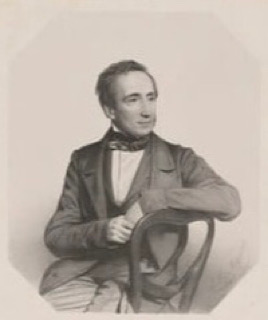
(From: “Patterson, Robert” by Andrew O’Brien, Dictionary of Irish Biography, http://www.dib.ie, October 2009 | Pictured: “Robert Patterson” by Thomas Herbert Maguire, printed by M & N Hanhart lithograph, 1849, National Portrait Gallery)
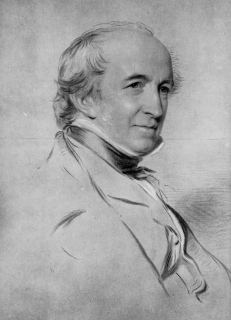
Spring Rice is educated at Trinity College, Cambridge, and later studies law at Lincoln’s Inn, but is not called to the Bar. His family is politically well-connected, both in Ireland and Great Britain, and he is encouraged to stand for Parliament by his father-in-law, Lord Limerick.
Spring Rice first stands for election in Limerick City in 1818 but is defeated by the Tory incumbent, John Vereker, by 300 votes. He wins the seat in 1820 and enters the House of Commons. He positions himself as a moderate unionist reformer who opposes the radical nationalist politics of Daniel O’Connell and becomes known for his expertise on Irish and economic affairs. In 1824 he leads the committee which establishes the Ordnance Survey in Ireland.
Spring Rice’s fluent debating style in the Commons brings him to the attention of leading Whigs and he comes under the patronage of the Marquess of Lansdowne. As a result, he is made Under-Secretary of State for the Home Department under George Canning and Lord Goderich in 1827, with responsibility for Irish affairs. This requires him to accept deferral of Catholic emancipation, a policy which he strongly supports. He then serves as joint Secretary to the Treasury from 1830 to 1834 under Lord Grey. Following the Reform Act 1832, he is elected to represent Cambridge from 1832 to 1839. In June 1834, Grey appoints him Secretary of State for War and the Colonies, with a seat in the cabinet, a post he retains when Lord Melbourne becomes Prime Minister in July. A strong and vocal unionist throughout his life, he leads the Parliamentary opposition to Daniel O’Connell’s 1834 attempt to repeal the Acts of Union 1800. In a six-hour speech in the House of Commons on April 23, 1834, he suggests that Ireland should be renamed “West Britain.” In the Commons, he also champions causes such as the worldwide abolition of slavery and the introduction of state-supported education.
The Whig government falls in November 1834, after which Spring Rice attempts to be elected Speaker of the House of Commons in early 1835. When the Whigs return to power under Melbourne in April 1835, he is made Chancellor of the Exchequer. As Chancellor, he has to deal with crop failures, a depression and rebellion in North America, all of which create large deficits and put considerable strain on the government. His Church Rate Bill of 1837 is quickly abandoned and his attempt to revise the charter of the Bank of Ireland ends in humiliation. Unhappy as Chancellor, he again tries to be elected as Speaker but fails. He is a dogmatic figure, described by Lord Melbourne as “too much given to details and possessed of no broad views.” Upon his departure from office in 1839, he has become a scapegoat for the government’s many problems. That same year he is raised to the peerage as Baron Monteagle of Brandon, in the County of Kerry, a title intended earlier for his ancestor Sir Stephen Rice. He is also Comptroller General of the Exchequer from 1835 to 1865, despite Lord Howick‘s initial opposition to the maintenance of the office. He differs from the government regarding the exchequer control over the treasury, and the abolition of the old exchequer is already determined upon when he dies.
From 1839 Spring Rice largely retires from public life, although he occasionally speaks in the House of Lords on matters generally relating to government finance and Ireland. He vehemently opposes John Russell, 1st Earl Russell‘s policy regarding the Irish famine, giving a speech in the Lords in which he says the government had “degraded our people, and you, English, now shrink from your responsibilities.”
Spring Rice is well regarded in Limerick, where he is seen as a compassionate landlord and a good politician. An advocate of traditional Whiggism, he strongly believes in ensuring society is protected from conflict between the upper and lower classes. Although a pious Anglican, his support for Catholic emancipation wins him the favour of many Irishmen, most of whom are Roman Catholic. He leads the campaign for better county government in Ireland at a time when many Irish nationalists are indifferent to the cause. During the Great Famine of the 1840s, he responds to the plight of his tenants with benevolence. The ameliorative measures he implements on his estates almost bankrupts the family and only the dowry from his second marriage saves his financial situation. A monument in honour of him still stands in the People’s Park in Limerick.
Even so, Spring Rice’s reputation in Ireland is not entirely favourable. In a book regarding assisted emigration from Ireland, a process in which a landlord pays for their tenants’ passage to the United States or Australia, Moran suggests that Spring Rice was engaged in the practice. In 1838, he is recorded as having “helped” a boat load of his tenants depart for North America, thereby allowing himself the use of their land. However, he is also recorded as being in support of state-assisted emigration across the British Isles, suggesting that his motivation is not necessarily selfish.
Conor is born on May 9, 1881, in Fortingale Street, Belfast, the third son and fourth child of William Connor, a tinsmith and sheet metal worker, who later becomes a gas fitter, and Mary Connor (née Wallace). He is educated at the Clifton Park central national school, where his artistic abilities are noticed by his music teacher. In 1894, he enrolls at the Belfast government school of design. He is a very successful student, and by 1903 has become an assistant teacher. He completes his studies in 1904, and begins an apprenticeship with the Belfast firm of lithographers, David Allen and Son. Through his work in the poster design department he develops an enthusiasm for using crayons on a textured surface. This becomes a characteristic feature of his later drawings. In these early years he first starts recording images of Belfast life, often sketched from behind a folded newspaper in the street. Influenced by the Gaelic revival, in the years 1907–9 he signs his name in several different ways such as “Liam” and “Liam Conor.” In later years he signs himself simply “Conor.”
Having abandoned his career as a lithographer around 1910, Conor concentrates his efforts on painting professionally. He begins exhibiting with the Belfast Art Society in 1910, and in the period that follows he spends time in Craigavad, County Down, the Blasket Islands in County Kerry, Dublin, and Donegal. During a visit to Paris, which he later recalls as being in 1912 and 1913, he meets the painter André Lhote. After his return to Belfast he is elected to the committee of the Belfast Art Society in 1913. On the outbreak of World War I, he is commissioned by the British government to record the everyday activities of munitions workers and soldiers in Ulster. His pictures mostly show soldiers in training and various scenes from the home front, including the work of women in munitions factories and hospitals. Described as “vigorous and personable, if rather folksy . . . effectively uniformed versions of the tinkers and shipyard workers for which he subsequently became known,” these paintings are exhibited and subsequently, in 1916, auctioned for the Ulster Volunteer Patriotic Fund. His long association with the Royal Hibernian Academy (RHA) begins in 1918 and he shows up to 200 works at the academy over the next forty-nine years.
In 1921, Conor moves to London, where he becomes acquainted with, among others, Sir William Orpen, Sir John Lavery, and Augustus John. He becomes a member of the Chelsea Arts Club, and contributes four paintings to the National Portrait Society as part of its spring exhibition in 1921. His friendship with Lavery is significant. Through him Conor receives a commission to paint the opening of the first Northern Ireland parliament in June 1921. He goes on to exhibit with a variety of influential bodies, including the Royal Academy of Arts, the Société Nationale des Beaux-Arts in Paris, and the Royal Society of Portrait Painters. In 1922, The Twelfth, executed c.1918, is shown in the Galerie Barbazanges in Paris, under the title Le cortège Orangiste à Belfast, as part of the World Congress of the Irish Race. He is represented at the Paris salon in 1923 and the following year he has a successful exhibition at the St. Stephen’s Green Gallery, Dublin.
In 1926, Conor travels to Philadelphia and New York, where, during his nine-month stay, he receives numerous commissions for portraits and has work shown in the Babcock Galleries, the Brooklyn Art Gallery, and the American Irish Historical Society. In 1932, he designs the costumes for the principals in the Pageant of St. Patrick, which marks the 1,500th anniversary of the saint’s coming to Ireland. That year also sees the unveiling of his muralUlster Past and Present at the Belfast Municipal Museum and Art Gallery. Measuring 2.8 by 7.4 metres, it is at the time the largest mural in the country. During World War II he is again appointed an official war artist and his work is represented at the exhibition of war artists at the National Gallery, London, in 1941. His book The Irish Scene is published in 1944, and though it sells well, the subsequent bankruptcy of his publishers mean that Conor receives no royalties. He also provides the illustrations for books by Lynn C. Doyle, the pseudonym of his friend Leslie Montgomery.
Although Conor is best known for his depictions of the everyday life of people in his native Belfast, in which he attempts to capture the “flash of humour which lightens their daily toil,” he also produces landscapes and portraits. His sitters included Douglas Hyde, St. John Greer Ervine, Charles D’Arcy, and Charles Vane-Tempest-Stewart, 7th Marquess of Londonderry. The Council for the Encouragement of Music and the Arts organises several successful Conor exhibitions. Their one-man show of 1945 becomes the first to tour the province, while their exhibition of his work in 1954 has an attendance in excess of 2,800. Conor closes his long-established studio on Stranmillis Road in 1960 but continuea to exhibit, notably with the Bell Gallery in 1964, 1966, and 1967.
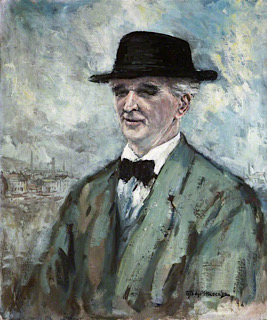
(From: “Conor, William” by Frances Clarke, Dictionary of Irish Biography, http://www.dib.ie, October 2009 | Pictured: “William Conor,” oil on canvas by Gladys Maccabe, Ulster Folk Museum)