seamus dubhghaill

Promoting Irish Culture and History from Little Rock, Arkansas, USA


Leave a comment

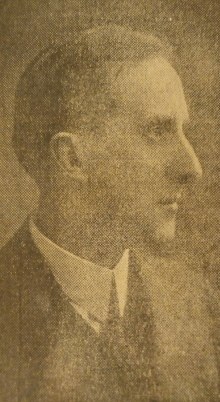
Birth of Thomas Sinclair, Businessman & Politician

Thomas Sinclair, Ulster Scots businessman and politician who drafted the Ulster Covenant, is born in Belfast on September 23, 1838.

Sinclair’s parents are Thomas (1811–1867), merchant and ship-owner, and Sarah Sinclair (née Archer) (1800–1849). His father goes into business with his brother John (1808–1856), setting up a provisions and general merchant store at 5–11 Tomb Street, Belfast. John marries Eliza Pirrie, a relative of the prominent ship builder William Pirrie, 1st Viscount Pirrie. After the death of his father in 1867, Sinclair inherits £35,000 as his mother, brother and sister are all deceased.

In 1876, Sinclair marries Mary Duffin of Strandtown Lodge, Belfast. They have a daughter, Frances Elizabeth Crichton, and a son. She dies in 1879. He marries Elizabeth Richardson in 1882. She is the niece of John Grubb Richardson and the widow of Sinclair’s cousin, John M. Sinclair. They have three sons and two daughters.

Sinclair attends Royal Belfast Academical Institution and Queen’s College Belfast, graduating with a BA with gold medal for mathematics in 1856, and an MA with gold medals in logic, political economy, and English literature in 1859. After his father’s death, he takes over running the family business. He expands and grows it by merging it with another large provisions business with American branches, Kingan & Co. He is related to the Kingans through his cousin Sarah, who is married to the owner, Samuel Kingan.

Despite numerous requests, Sinclair never stands for parliament, instead serving as deputy lieutenant, justice of the peace, president of the Ulster chamber of commerce in 1876 and 1902, and privy councilor in 1896. Having been a supporter of William Ewart Gladstone, he joins the Ulster Liberal Party in 1868, supporting the land acts of 1870 and 1881. Following the home rule bill of 1886, he convenes a meeting in the Ulster Hall of liberals on April 30, 1886, which passes a resolution in condemnation of the bill. Forming the Ulster Liberal Unionist Association, of which he is chair, he organises the Ulster Convention in Belfast. Held on June 17, 1892, it sees 11,879 Ulster unionists meet to protest home rule. Nine months after the convention, he is appointed to the executive committee of the new unionist clubs, which are founded to protect the union. The defeat of the British Liberal Party in 1895 significantly decreases the threat of home rule, leading to the unionists’ clubs being suspended, and Sinclair returning to his activities in liberal reform. He is the leading Ulster member of the recess committee from 1895, which is founded by Horace Plunkett. He supports Plunkett’s backing of T. P. Gill as secretary of the Irish Agricultural Organisation Society (IAOS) in 1899, in the face of strong protest by conservative unionists.

Despite his unionist politics, Sinclair is nonsectarian, and during his time as chairman of the convocation of the Queen’s University he defends the core non-sectarian principles of the institution and refuses to allow any form of denominational teaching. Through his work with the recess committee, he ensures that the new Department of Agriculture’s vocational and technical education will remain secular.

By 1904 and the devolution crisis, Sinclair sides with conservative unionists, being of the 30 members of the standing committee of the Ulster Unionist Council on its foundation in December 1904. He proposes that all suspended unionist clubs be reestablished in January 1911, with the purpose of increasing their membership and responsibilities. This results in the clubs taking up arms, with over 80 groups drilling by April 1911, which goes on to form the core of the Ulster Volunteers. On September 25, 1911, he is appointed to a five-man commission tasked with writing a constitution for a provisional government of Ulster. He is one of the contributors to the 1912 collection of essays from the unionist party, Against home rule. He identifies the six county Ulster, proffering the idea of a two-nation island, warning that Ulster will never form part of an independent Ireland. Later in 1912, he is tasked with drafting Ulster’s Solemn League and Covenant, a pledge for signatories to oppose and defeat home rule and never recognise an Irish parliament.

Sinclair dies from kidney failure on February 14, 1914, at his home, Hopefield House, Belfast. His funeral procession on February 18 is headed by 200 UVF officers. The Ulster Museum holds a portrait of Sinclair by Frank McKelvey, and QUB holds one by Henrietta Rae (pictured above). A memorial window at Church House, the headquarters of the Presbyterian Church, is unveiled in his memory on June 8, 1915, and there is a Sinclair Memorial Hall opened in his honour on September 10, 1915. A blue plaque is erected to him on the Duncairn Centre for Arts & Culture.

The Sinclair Ward in the Royal Victoria Hospital, Belfast, is originally funded by Sinclair’s father, in honour of his wife Sarah under the Sinclair Memorial Fund. The surgeon and politician Thomas Sinclair is also a relative.


Leave a comment

Death of “Mick” Mannock, British-Irish Flying Ace

Edward Corringham “Mick” Mannock VC, DSO & Two Bars, MC & Bar, a British-Irish flying ace who serves in the Royal Flying Corps (RFC) and Royal Air Force (RAF) during World War I, is killed on July 26, 1918, when his plane crashes behind German lines. He is a pioneer of fighter aircraft tactics in aerial warfare. At the time of his death, he has amassed 61 aerial victories, making him the fifth highest scoring pilot of the war. He is among the most decorated men in the British Armed Forces. He is honoured with the Military Cross (MC) twice, is one of the rare three-time recipients of the Distinguished Service Order (DSO) and is posthumously awarded the Victoria Cross (VC).

Mannock was born on May 24, 1887, to an English father, Edward Mannock, and an Irish mother, Julia Sullivan. His father serves in the British Army and in 1893, deeply in debt and exasperated with civilian life, he re-enlists, and the family moves to Meerut, India when he is five years old. In his early years, he is sickly and develops several ailments. Soon after arriving in Asia, he contracts malaria, narrowly avoiding death. Upon his return to England, he becomes a fervent supporter of Irish nationalism and the Irish Home Rule movement but becomes a member of the Independent Labour Party (ILP).

In 1914, Mannock is working as a telephone engineer in Turkey. After the Ottoman Empire‘s entry into the war on the side of the Central Powers he is interned. Poorly fed and cared for, his health rapidly declines in prison. Dysentery racks his intestines, and he is confined to a small cell. Turkish authorities repatriate him to Britain believing him to be unfit for war service. He recovers and joins the Royal Engineers (RE) and then the Royal Army Medical Corps (RAMC). He moves services again and in 1916 joins Royal Flying Corps (RFC). After completing his training, he is assigned to No. 40 Squadron RFC. He goes into combat on the Western Front, participating in three separate combat tours. After a slow start he begins to prove himself as an exceptional pilot, scoring his first victory on May 7, 1917.

By February 1918, Mannock has achieved sixteen victories and is appointed a Flight Commander in No. 74 Squadron. He amasses thirty-six more victories from April 12 — June 17, 1918. After returning from leave he is appointed commanding officer of No. 85 Squadron in July 1918, and scores nine more victories that month.

On July 26, Major Mannock offers to help a new arrival, Lt. Donald C. Inglis from New Zealand, obtain his first victory. After shooting down an enemy LVG two-seater behind the German front-line, Mannock is believed to have dived to the crash site to view the wreckage, seemingly breaking one of the unwritten rules of fellow pilots about the hazards of flying low into ground fire. In consequence, while crossing the trenches the fighters are met with a massive volley of ground fire. The engine of his aircraft is hit and immediately catches fire, and shortly thereafter the plane crashes behind German lines. His body is believed to have been found, though this is unproven, about 250 yards (250m) from the wreck of his plane, perhaps thrown, perhaps jumped. The body shows no gunshot wounds although he had vowed to shoot himself if shot down in flames.

The exact cause of Mannock’s death remains uncertain. A year later, after intensive lobbying by Ira Jones and many of his former comrades, he is awarded the Victoria Cross (VC).

Mannock’s body is not subsequently recovered by the Commonwealth War Graves Commission (CWGC), so officially he has no known grave. His name is commemorated on the Arras Flying Services Memorial to the missing at the Faubourg d’Amiens CWGC Cemetery in Arras, France. There is also a memorial plaque in his honour in Canterbury Cathedral.

Mannock’s name is listed on the Wellingborough War Memorial with the other fallen men from the town and the local Air Training Corps (ATC) unit bears his name – 378 (Mannock) Squadron. Additionally, Mannock Road, a residential street in Wellingborough, is named after him.

On June 24, 1988, a plaque is unveiled at 183 Mill Road, Wellingborough, by top scoring World War II British fighter pilot Air Vice-Marshal Johnnie Johnson. Mannock had lived at that address prior to the war after being befriended by the Eyles family.


Leave a comment

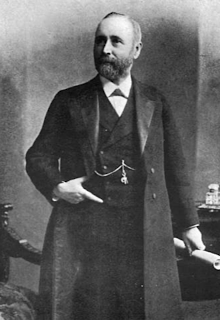
Birth of John Gray, Physician, Journalist & Politician

Sir John Gray JP, Irish physician, surgeon, newspaper proprietor, journalist and politician, is born in Claremorris, County Mayo, on July 13, 1815. He is active both in municipal and national government for much of his life and has nationalist ideals, which he expresses as owner of the Freeman’s Journal, chairman of the Dublin Corporation Water Works Committee between 1863 and 1875, and Member of Parliament in the House of Commons of the United Kingdom of Great Britain and Ireland for Kilkenny City from 1865 until his death.

Gray is the third son of John and Elizabeth Gray of Mount Street. He is educated at Trinity College Dublin and obtains the degree of M.D. and Master of Surgery at the University of Glasgow in 1839. Shortly before his marriage in the same year, he settles in Dublin and takes up a post at a hospital in North Cumberland Street. He is admitted as a licentiate of the Royal College of Physicians in due course.

Gray is publicly minded and contributes to periodicals and the newspaper press. In 1841, he becomes joint proprietor of the Freeman’s Journal, a nationalist paper which is then published daily and weekly. He acts as political editor of the Journal for a time, before becoming sole proprietor in 1850. As owner, he increases the newspaper’s size, reduces its price and extends its circulation.

Gray enters politics at a relatively young age and attaches himself to Daniel O’Connell‘s Repeal Association. As a Protestant Nationalist, he supports the movement for the repeal of the Acts of Union with Britain. In October 1843, he is indicted with O’Connell and others in the Court of the Queen’s Bench in Dublin on a charge of sedition and “conspiracy against the queen.” The following February, he, together with O’Connell, is condemned to nine months imprisonment, but in early September 1844 the sentence is remitted on appeal. The trial has a strong element of farce, as the hot-tempered Attorney-General for Ireland, Sir Thomas Cusack-Smith, challenges Gray’s counsel, Gerald Fitzgibbon, to a duel, for which he is sternly reprimanded by the judges. From then on Gray is careful to distance himself from the advocacy of violence in the national cause, though he is sympathetic to the Young Ireland movement without being involved in its 1848 rebellion. Through the growing influence of the Freeman’s Journal, he becomes a significant figure in Dublin municipal politics. He is also active in national politics during an otherwise quiet period of Irish politics up until 1860. With the resurgence of nationalism after the famine, he helps to organise the Tenant’s League founding conference in 1850, standing unsuccessfully as the League’s candidate for Monaghan in the 1852 United Kingdom general election.

Later Gray originates and organises the “courts of arbitration” which O’Connell endeavours to substitute for the existing legal tribunals of the country. Following O’Connell’s death, in 1862 he inaugurates an appeal for subscriptions to build a monument to O’Connell on Sackville Street (now O’Connell Street). Independent from O’Connell, he continues to take a prominent part in Irish politics and in local affairs.

In municipal politics, Gray is elected councillor in 1852 and alderman of Dublin Corporation and takes an interest in the improvement of the city. As chairman of the committee for a new water supply to Dublin, he actively promotes what becomes the “Vartry scheme.” The Vartry Reservoir scheme involves the partial redirection and damming of the River Vartry in County Wicklow, and the building of a series of water piping and filtering systems (and related public works) to carry fresh water to the city. This work is particularly important in the improvement of conditions in the city, and to public health, as it improves sanitation and helps reduce outbreaks of cholera, typhus and other diseases associated with contaminated water. On the opening of the works on June 30, 1863, he is knighted by the Earl of Carlisle, then Lord Lieutenant of Ireland. Partially in recognition of these efforts, he is later be nominated for the position of Lord Mayor of Dublin for the years 1868–69, but he declines to serve.

In national politics, the Liberal government at the time is keen to conciliate an influential representative of the moderate nationalists to support British Liberalism and who will resume O’Connell’s constitutional agitation. In an unusual alliance with the Catholic Archbishop of Dublin, Paul Cullen, a man devoted to O’Connell’s memory, Gray’s newspaper exploits this shift in government policy. It supports the archbishop’s creation, the National Association of Ireland, established in 1864 with the intention of providing a moderate alternative to the revolutionary nationalism of the Fenians. The Freeman’s Journal adopts the aims of the Association as its own: it advocates the disestablishment of the Anglican Church of Ireland, reform of the land laws, educational aspirations of Irish Catholicism and free denominal education.

In the 1865 United Kingdom general election Gray is elected MP for Kilkenny City as a Liberal candidate. In this capacity he campaigns successfully at Westminster and in Ireland for the reforms also advocated in his paper. His newspaper’s inquiry into the anomalous wealth of the established church amidst a predominately Catholic population contributes considerably to William Ewert Gladstone‘s Irish Church Act 1869. He helps to furnish the proof that Irish demands are not to be satisfied by anything other than by radical legislation. He fights for the provision in the new Landlord & Tenant (Ireland) Act 1870 for fixity of tenure, which Gladstone eventually concedes. The Act’s other weaknesses, however, result in its failure to resolve the “land question,” the accompanying coercion, the disappointment with Gladstone’s handling of the university question and national education, causing Gray to deflect from the Liberals and become mistrusted in Britain. In the 1874 United Kingdom general election he is re-elected as a Home Rule League MP for Kilkenny, joining its Home Rule majority in the House of Commons, and holds his seat until his death the following year.

Gray dies at Bath, Somerset, England, on April 9, 1875. His remains are returned to Ireland, and he is honoured with a public funeral at Glasnevin Cemetery. Almost immediately afterwards public subscriptions are sought for the erection in O’Connell Street, of a monument to Gray. The monument is completed in 1879 and is dedicated to the “appreciation of his many services to his country, and of the splendid supply of pure water which he secured for Dublin.” His legacy also includes his contributions to the passage of the Irish Church and Land Bills, his advocacy for tenant’s rights and his support of the Home Rule movement.

Gray marries Mary Anna Dwyer of Limerick in 1839, and they have five children, three sons and two daughters. One of his sons, Edmund Dwyer Gray, takes over the management of the Freeman’s Journal. Edmund also follows his father into politics, eventually becoming MP for Dublin St. Stephen’s Green, Lord Mayor of Dublin (1880–1881), and a supporter of Charles Stewart Parnell. Edmund John Chisholm Dwyer-Gray, Edmund Dwyer Gray’s son and John Gray’s grandson, becomes Premier of Tasmania.

(Pictured: Statue to Sir John Gray on Dublin’s O’Connell Street, designed by Thomas Farrell and unveiled on June 24, 1879. Photo credit: Graham Hickey)


Leave a comment

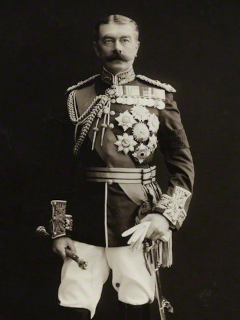
Birth of Horatio Herbert Kitchener, 1st Earl Kitchener

Horatio Herbert Kitchener, 1st Earl Kitchener of Khartoum and Broome in Kent, British Army officer and colonial administrator, is born on June 24, 1850, at Gunsborough Villa, north of Listowel, County Kerry.

Kitchener is the second son of Lieutenant Colonel Henry Horatio Kitchener and his first wife, Frances Anne (née Chevallier), daughter of clergyman John Chevallier. Col. Kitchener resigns his commission in 1849 and purchases Ballygoghlan House estate near Tarbert, County Kerry, in early 1850 under the provisions of the Encumbered Estates Act of 1849. Ballygoghlan House is in a state of disrepair, however, and the family lives in Gunsborough Villa until the end of 1850. In 1857, Col. Kitchener purchases Crotta House, near Kilflynn, County Kerry, and the Kitcheners divide their time between the two residences. While innovative and successful in his agricultural methods, Col. Kitchener is harsh towards his tenants and, after carrying out many evictions, becomes extremely unpopular in the area. He is a rigid disciplinarian and occasionally punishes his son severely.

Although Kitchener attends Ballylongford village school, his education is largely neglected. When examined by his cousin Francis Elliot Kitchener, fellow of Trinity College Dublin (TCD), he is found to have only the most rudimentary knowledge of grammar and arithmetic. Education by private tutors follows. In 1864, his father sells his Irish estates and moves to Switzerland for the sake of his wife’s health. After further private tuition, he passes into the Royal Military Academy, Woolwich, in 1868, and is commissioned into the Royal Engineers in December 1870.

Kitchener begins his career on survey missions and carries out such work in Palestine (1874–78) and Cyprus (1878–82). He then enters the Egyptian Army and takes part in the Sudan campaign of 1883–85, organised to relieve Genral Charles George Gordon. Subsequent appointments include governor of Suakin (1886–88), adjutant-general of the Egyptian Army (1888–92), and Sirdar (Commander-in-Chief) of the Egyptian Army (1892–96). After the Dongola Expedition in 1896, he is promoted to major-general. He commands the Khartoum Expedition of 1898, defeating Mahdist forces at Atbara and Omdurman, and is raised to the peerage.

At the outbreak of the Second Boer War in 1899, he is appointed chief of staff to Frederick Roberts, 1st Earl Roberts, and assumes total command, with the rank of lieutenant-general, in 1900. While acting as commander-in-chief in South Africa he reorganises the British forces and, using new tactics, manages finally to defeat the Boers. He is severely criticised in the world press for the conditions in the concentration camps where Boer families are confined, but is made a viscount, promoted to general, and awarded £50,000 by parliament at the end of the war.

Kitchener serves as commander-in-chief in India beginning in 1902, is promoted to Field Marshal in 1909, and is a member of the Committee of Imperial Defence (1910) and consul-general in Egypt (1911–14). At the outbreak of World War I he is made Secretary of State for War and begins to reorganise the British Army, an immense achievement, raising 1,700,000 men in service battalions by May 1915, creating an army of volunteers to reinforce the depleted regular army in Belgium and France. An archconservative, he totally opposes Home Rule for Ireland, and initially blocks plans by John Redmond for the formation of a southern Irish division from members of the National Volunteers. Convinced that an all-Irish brigade or division would be a security risk, he rejects Redmond’s suggestions in a meeting of August 1915 and originally proposes dispersing Irish recruits through the numerous regiments in the army. Impressed by Redmond’s persistence, and impelled by the recruiting crisis of late 1915, he finally reverses his decision and sanctions the establishment of the 16th (Irish) Division.

On June 5, 1916, Kitchener is making his way to Russia on HMS Hampshire to attend negotiations with Tsar Nicholas II when in bad weather the ship strikes a German mine 1.5 miles (2.4 km) west of Orkney, Scotland, and sinks. He is among 737 who perish. He is the highest-ranking British officer to die in action in the entire war.

Although he only spends his early years in Kerry, Kitchener occasionally returns to Ireland. While on leave in June 1910 he goes on a tour of County Kerry, visiting places connected to his childhood. There are numerous portraits and memorials to him in England, including a marble effigy by W. Reid Dick in St. Paul’s Cathedral in London and a statue by John Tweed in Horse Guards Parade, London. There is a commemorative bible in the Church of Ireland church at Kilflynn, County Kerry, where he regularly attended Sunday service as a boy. There are some Kitchener letters in the John Redmond papers in the National Library of Ireland.

(From: “Kitchener, Horatio Herbert” by David Murphy, Dictionary of Irish Biography, http://www.dib.ie, October 2009)


1 Comment

King Edward VII Begins Eight-Day Visit to Ireland

In 1904, King Edward VII and Queen Alexandra travel to Ireland for a semi-official eight-day visit, arriving in Kingstown (now Dún Laoghaire) on April 26. They are accompanied by their daughter, Princess Victoria.

They travel by rail to Naas via the Great Southern and Western Railway Company. They are seated in a luxuriously upholstered carriage, the engine decorated with flags and streamers. The visit triggers a frenzy of preparation among the elite and merchants of Naas. Leading citizens from diverse backgrounds, including Protestants, Catholics, Loyalists, and Home Rulers, come together to welcome the royal visitors. The town is adorned with bunting, banners, and arches bearing royal and loyalist symbols, creating an extravagant showpiece of imperial loyalty.

During their visit to Naas, the King and Queen attend the Punchestown Races, adding a touch of glamour to the occasion.

They stay in the Dublin area for a few days, attending several events and ceremonies. After finishing in Dublin, the royals board their royal train for a three-day visit to Kilkenny.

For the arrival of the King and Queen in Kilkenny, significant efforts are undertaken to ensure the city is elegantly presented. In the weeks and months prior to the visit, local businessmen convene meetings in how best to organise the occasion.

The city is heavily festooned with bunting and streamers, and the route from the railway station to Kilkenny Castle is decorated with tiny fairy lights of every colour. During the visit, Princess Victoria plants three trees on the grounds of the Castle.

The visit is well-received in Kilkenny, although sometimes expressed in primitive fashion: an old man remarks, “Sure, the King’s a man after all,” his wife correcting him, “But he’s a great man, and the lovely lady’s an angel.” Although well-supported, black flags protesting the visit are hung from some buildings along the route. (It is more than 110 years before another royal visit is made to Kilkenny when Prince Charles and Princess Camilla visit the city on May 11, 2017.)

The King and Queen travel to Waterford on May 2, where they stay at Lismore Castle, home of the Duke of Devonshire. Thomas Horgan of Youghal, County Cork, makes the first known film in Ireland of this event.

The royal visit to Ireland comes to an end on May 4.

(Pictured: King Edward VII and Queen Alexandra in the grandstand of the Kilkenny Agricultural Show 1904)


Leave a comment

John Boland Becomes First Irish Olympic Gold Medal Winner

On March 30, 1896, an Irishman wins an Olympic gold medal for the first time when John Mary Pius Boland triumphs in tennis at the first modern Olympics, which take place in Athens, Greece. In addition to being a gold medalist tennis player, he is an Irish Nationalist politician and Member of Parliament (MP) in the House of Commons of the United Kingdom of Great Britain and Ireland and as member of the Irish Parliamentary Party (IPP) for South Kerry from 1900 to 1918.

Boland is born on September 16, 1870, at 135 Capel Street, Dublin, to Patrick Boland, businessman, and Mary Donnelly. Following the death of his mother in 1882, he is placed with his six siblings under the guardianship of his uncle, Nicholas Donnelly, auxiliary bishop of Dublin.

Boland is educated at two private Catholic schools, the Catholic University School, Dublin, and Birmingham Oratory in Birmingham, England, where he becomes head boy. His secondary education at the two schools help give him the foundation and understanding to play an influential role in the politics of Great Britain and Ireland at the beginning of the 20th century, when he is a member of the Irish Parliamentary Party, which pursues constitutional Home Rule.

In 1892, Boland graduates with a BA from London University. He studies for a semester in Bonn, Germany, where he is a member of Bavaria Bonn, a student fraternity that is member of the Cartellverband. He studies law at Christ Church, Oxford, graduating with a BA in 1896 and MA in 1901. Although called to the Bar in 1897, he never practises.

Boland is the first Olympic champion in tennis for Great Britain and Ireland at the first modern Olympics, which take place in Athens in 1896. He visits his friend Thrasyvoulos Manos in Athens during the Olympics, and Manos, a member of the organising committee, enters Boland in the tennis tournament. He promptly wins the singles tournament, defeating Friedrich Traun of Germany in the first round, Evangelos Rallis of Greece in the second, Konstantinos Paspatis of Greece in the semifinals, and Dionysios Kasdaglis of Greece in the final.

Boland then enters the doubles event with Traun, the German runner whom he had defeated in the first round of the singles. Together, they win the doubles event. They defeat Aristidis and Konstantinos Akratopoulos of Greece in the first round, have a bye in the semifinals, and defeat Demetrios Petrokokkinos of Greece and Dimitrios Kasdaglis in the final. When the Union Jack and the German flag are run up the flagpole to honour Boland and Traun’s victory, Boland points out to the man hoisting the flags that he is Irish, adding “It [the Irish flag]’s a gold harp on a green ground, we hope.” The officials agreed to have an Irish flag prepared.

Following a visit to County Kerry, Boland becomes concerned about the lack of literacy among the native population. He also has a keen interest in the Irish Language.

Boland’s patriotic stand is well received in nationalist circles in Ireland. This and a lifelong friendship with John Redmond gain for him an invitation to stand as a candidate for the Irish Parliamentary Party in the safe seat of South Kerry, which he holds from 1900 to 1918. He is unopposed in the general elections of 1900 and 1906, and the first of 1910. In the second election of 1910 he is challenged by a local man, T. B. Cronin, who stands as an independent nationalist in the interest of William O’Brien. Boland stands down at the 1918 United Kingdom general election.

In 1908, Boland is appointed a member of the commission for the foundation of the National University of Ireland (NUI). From 1926 to 1947, he is General Secretary of the Catholic Truth Society. He receives a papal knighthood, becoming a Knight of St. Gregory in recognition for his work in education. In 1950, he is awarded an honorary Doctor of Law by the NUI.

Boland marries Eileen Moloney at SS Peter and Edward, Palace Street, Westminster, on October 22, 1902, the daughter of an Australian Dr. Patrick Moloney. They have one son and five daughters. His daughter Honor Crowley succeeds her husband Frederick Crowley upon his death sitting as Fianna Fáil TD for South Kerry from 1945 until her death in 1966. His daughter Bridget Boland is a playwright who notably writes The Prisoner and co-writes the script for Gaslight, and, among other books, co-authors Old Wives’ Lore for Gardeners with her sister, Maureen Boland.

Boland dies at his home, 40 St George’s Square, in London on Saint Patrick’s Day, March 17, 1958.


Leave a comment

Birth of Sir Edward Carson, Politician, Barrister & Judge

Edward Henry Carson, Baron Carson, Irish unionist politician, barrister and judge, known as the “uncrowned king of Ulster,” is born on February 9, 1854, at 4 Harcourt Street, in Dublin. He serves as the Attorney General and Solicitor General for England, Wales and Ireland as well as the First Lord of the Admiralty for the British Royal Navy.

Although Carson is to become the champion of the northern province, he is born into a Protestant family in southern Ireland. He is educated at Portarlington School, Wesley College, Dublin, and Trinity College Dublin, where he reads law and is an active member of the College Historical Society. He graduates BA and MA.

From 1877, early in his Irish legal career, he comes to mistrust the Irish nationalists. As senior Crown prosecutor, he sternly enforces the Criminal Law and Procedure (Ireland) Act 1887, securing numerous convictions for violence against Irish estates owned by English absentee landlords. He is appointed Solicitor-General for Ireland and elected to the British House of Commons in 1892, is called to the English bar at Middle Temple on April 21, 1893, and serves as Solicitor General for England and Wales from 1900 to 1905. During these years he achieves his greatest success as a barrister. In 1895, his cross-examination of Oscar Wilde largely secures the Irish writer’s conviction for homosexuality.

On February 21, 1910, Carson accepts the parliamentary leadership of the anti-Home Rule Irish Unionists and, forfeiting his chance to lead the British Conservative Party, devotes himself entirely to the Ulster cause. His dislike of southern Irish separatism is reinforced by his belief that the heavy industry of Belfast is necessary to the economic survival of Ireland. The Liberal government (1908–16) under H. H. Asquith, which in 1912 decides to prepare a Home Rule bill, cannot overcome the effect of his extra-parliamentary opposition. The Solemn League and Covenant of resistance to Home Rule, signed by Carson and other leaders in Belfast on September 28, 1912, and afterward by thousands of Ulstermen, is followed by his establishment of a provisional government in Belfast in September 1913. Early in that year he recruits a private Ulster army, the Ulster Volunteer Force, that openly drills for fighting in the event that the Home Rule Bill is enacted. In preparation for a full-scale civil war, he successfully organizes the landing of a large supply of weapons from Germany at Larne, County Antrim, on April 24, 1914. The British government, however, begins to make concessions to Ulster unionists, and on the outbreak of World War I he agrees to a compromise whereby the Home Rule Bill is enacted but its operation suspended until the end of the war on the understanding that Ulster’s exclusion will then be reconsidered.

Appointed Attorney General for England in Asquith’s wartime coalition ministry on May 25, 1915, Carson resigns on October 19 because of his dissatisfaction with the conduct of the war. In David Lloyd George’s coalition ministry (1916–22) he is First Lord of the Admiralty from December 10, 1916, to July 17, 1917, and then a member of the war cabinet as minister without portfolio until January 21, 1918.

Disillusioned by the Government of Ireland Act 1920 that partitions Ireland and establishes what is essentially a Home Rule parliament in Belfast, Carson declines an invitation to head the Northern Ireland government and resigns as Ulster Unionist Party leader in February 1921. Accepting a life peerage, he serves from 1921 to 1929 as Lord of Appeal in Ordinary and takes the title Baron Carson of Duncairn.

Carson retires in October 1929. In July 1932, during his last visit to Northern Ireland, he witnesses the unveiling of a large statue of himself in front of Parliament Buildings at Stormont. The statue is sculpted by Leonard Stanford Merrifield, cast in bronze and placed upon a plinth. The inscription on the base reads “By the loyalists of Ulster as an expression of their love and admiration for its subject.” It is unveiled by James Craig, 1st Viscount Craigavon, in the presence of more than 40,000 people.

Carson lives at Cleve Court, a Queen Anne house near Minster-in-Thanet in the Isle of Thanet, Kent, bought in 1921. It is here that he dies peacefully on October 22, 1935. A warship brings his body to Belfast for the funeral. Thousands of shipworkers stop work and bow their heads as HMS Broke steams slowly up Belfast Lough, with his flag-draped coffin sitting on the quarterdeck. Britain gives him a state funeral on Saturday, October 26, 1935, which takes place in Belfast’s St. Anne’s Cathedral. He remains the only person to have been buried there. From a silver bowl, soil from each of the six counties of Northern Ireland is scattered onto his coffin, which had earlier been covered by the Union Jack. At his funeral service the choir sings his own favourite hymn, “I Vow to Thee, My Country.”


Leave a comment

The 1918 Irish General Election & Rise of Sinn Féin

The 1918 Irish general election is the part of the 1918 United Kingdom general election which takes place in Ireland on December 14, 1918. It is a key moment in modern Irish history because it sees the overwhelming defeat of the moderate nationalist Irish Parliamentary Party (IPP), which had dominated the Irish political landscape since the 1880s, and a landslide victory for Sinn Féin. Sinn Féin had never previously stood in a general election but had won six seats in by-elections in 1917–18. The party vows in its manifesto to establish an independent Irish Republic. In Ulster, however, the Irish Unionist Alliance (IUA) is the most successful party.

In 1918, a system called plural voting is in place in both Britain and Ireland. Plural voting is a practice whereby one person might be able to vote multiple times in an election. Property and business owners can vote both in the constituency where their property lay and that in which they live, if the two are different. In the newly formed Irish Free State this system is ended by the Electoral Act 1923 and is abolished in the United Kingdom by the Representation of the People Act 1948. Plural voting remains in effect in Northern Ireland until 1969.

The 1918 election is held in the aftermath of World War I, the Easter Rising and the Conscription Crisis. It is the first general election to be held after the Representation of the People Act 1918. It is thus the first election in which women over the age of 30, and all men over the age of 21, can vote.

Sinn Féin is founded by Arthur Griffith in 1905. He believes that Irish nationalists should emulate the Ausgleich of Hungarian nationalists who, in the 19th century under Ferenc Deák, had chosen to boycott the imperial parliament in Vienna and unilaterally establish their own legislature in Budapest.

Griffith initially favours a peaceful solution based on “dual monarchy” with Britain, that is two separate states with a single head of state and a limited central government to control matters of common concern only. However, by 1918, under its new leader, Éamon de Valera, Sinn Féin has come to favour achieving separation from Britain by means of an armed uprising if necessary and the establishment of an independent republic.

In the aftermath of the 1916 Easter Rising, the party’s ranks are swelled by participants and supporters of the rebellion as they are freed from British gaols and internment camps. At its 1917 Ardfheis (annual conference) de Valera is elected leader, and the new, more radical policy is adopted.

Prior to 1916, Sinn Féin had been a fringe movement having a limited cooperative alliance with William O’Brien‘s All-for-Ireland League and enjoyed little electoral success. However, between the Easter Rising of that year and the 1918 general election, the party’s popularity increases dramatically. This is due to the failure to have the Home Rule Bill implemented when the IPP resists the partition of Ireland demanded by Ulster Unionists in 1914, 1916 and 1917, but also popular antagonism towards the British authorities created by the execution of most of the leaders of the 1916 rebels and by their botched attempt to introduce Home Rule on the conclusion of the Irish Convention linked with military conscription in Ireland (see Conscription Crisis of 1918).

Sinn Féin demonstrates its new electoral capability in four by-election successes in 1917 in which George Noble Plunkett, Joseph McGuinness, de Valera and W. T. Cosgrave are each elected, although it loses three by-elections in early 1918 before winning two more with Patrick McCartan and Arthur Griffith. In one case there are unproven allegations of electoral fraud. The party benefits from a number of factors in the 1918 elections, including demographic changes and political factors.

In the aftermath of the elections, Sinn Féin’s elected members refuse to attend the British Parliament in Westminster, and instead form a parliament in Dublin, Dáil Éireann (“Assembly of Ireland”), which declares Irish independence as a republic. The Irish War of Independence is conducted under this revolutionary government which seeks international recognition and sets about the process of state-building. The next election is part of 1921 Irish elections.

(Pictured: L to R, Éamon de Valera of Sinn Féin, Sir Edward Carson on the Irish Unionist Alliance, and John Dillon of the Irish Parliamentary Party)


Leave a comment

Death of Joseph McGarrity, Irish American Political Activist

Joseph McGarrity, Irish American political activist best known for his leadership in Clan na Gael in the United States and his support of Irish republicanism back in Ireland, dies of cancer on September 4, 1940.

McGarrity is born on March 28, 1874, in Carrickmore, County Tyrone. His family grows up in poverty, motivating his need to immigrate later in life. He grows up hearing his father discussing Irish politics, including topics such as the Fenians, the Irish Parliamentary Party (IPP), and Irish Home Rule. By the time he is an adult, he has developed a keen interest in politics himself.

McGarrity immigrates to the United States in 1892 at the age of 18. He is reputed to have walked to Dublin before boarding a cattle boat to Liverpool disguised as a drover, and then sailing to the United States using a ticket belonging to someone else. He settles in Philadelphia, Pennsylvania and becomes successful in the liquor business. His business fails, however, on three occasions, twice due to embezzlement by his business partner.

In 1893 McGarrity joins Clan na Gael, an Irish organisation based in the United States committed to aiding the establishment of an independent Irish state. Clan na Gael had been heavily involved with the Fenian Brotherhood that McGarrity had grown up hearing about, and by the latter half of the 19th century had become a sister organisation of the Irish Republican Brotherhood (IRB). In the decade just before McGarrity joins, Clan na Gael and the Fenian movement had waged the Fenian dynamite campaign, where they attempted to force the British state to make concessions in Ireland by bombing British infrastructure. However, this had caused a split within Clan na Gael that is not mended until seven years after McGarrity joins when, in 1900, the factions reunite and plead to support “the complete independence of the Irish people, and the establishment of an Irish republic.” In the years that follow the 1880s and 1890s, he is, amongst others, credited with helping to stitch the organisation back together and bring it renewed strength.

McGarrity helps sponsor several Irish Race Conventions and founds and runs a newspaper called The Irish Press from 1918-22 that supports the Irish War of Independence. He is the founder of the Philadelphia chapter of Clan Na Gael.

During World War I, while the United States is still neutral, McGarrity is involved in the Hindu–German Conspiracy. He arranges the Annie Larsen arms purchase and shipment from New York to San Diego for India.

When Éamon de Valera arrives in the United States in 1919 they strike up an immediate rapport and McGarrity manages de Valera’s tour of the country. He persuades de Valera of the benefits of supporting him and the Philadelphia branch against the New York branch of the Friends of Irish Freedom organisation led by John Devoy and Judge Daniel F. Cohalan. He becomes president of the American Association for the Recognition of the Irish Republic. He christens his newborn son Éamon de Valera McGarrity, although their relationship becomes strained upon de Valera’s entry back into Dáil Éireann in the Irish Free State.

McGarrity opposes the Anglo-Irish Treaty and travels to Dublin in 1922 and assists the development of the short-lived Collins/De Valera Pact by bringing de Valera and Michael Collins together before the 1922 Irish general election.

The Irish Civil War sees a split in Clan na Gael just as it had split Sinn Féin back in Ireland. McGarrity and a minority of Clan na Gael members support the anti-treaty side but a majority support the pro-treaty side, including John Devoy and Daniel Cohalan. Furthermore, in October 1920 Harry Boland informs the Clan na Gael leadership that the IRB will be cutting their ties to the Clan unless the IRB is given more influence over their affairs. Devoy and Cohalan resist this, but McGarrity sees the Clan’s connection with the IRB as vital. While McGarrity’s faction is initially labelled “Reorganised Clan na Gael,” they are able to inherit total control of the Clan na Gael name as Devoy is not able to keep effective organisation of the group. In general, however, the in-fighting amongst the Irish on both sides of the Atlantic is quite disheartening for Irish Americans and in the years to come neither pro nor anti-treaty sides of Clan na Gael see much in the way of donations.

With the scope of Clan na Gael now narrowed, and Devoy and Cohalan removed from the picture, McGarrity becomes chairman of the organisation. He does not support the founding of Fianna Fáil in 1926 and opposes the party’s entry into the Dáil in 1927. Even after the Irish Civil War, he still supports the idea that a 32-county Irish Republic can be achieved through force. in the spring of 1926, he receives Chief of Staff of the Irish Republican Army Andrew Cooney to the United States. Cooney and Clan na Gael formally agree that each organisation will support the other and that Clan na Gael will raise funds, purchase weapons and build support for the IRA in the United States.

Going into the late 1920s though Clan na Gael, as are most Irish American organisations, is struggling. Having limped past the split caused by the Irish Civil War, the rejection of Fianna Fáil has caused a second split in the membership. Many Irish Americans see the IRA and Fianna Fáil as one and the same at that point and Clan na Gael and McGarrity’s hostility to them causes much friction.

By July 1929, the Clan’s membership in one of its strongholds, New York City, is down to just 620 paid members. Then in October of that same year Wall Street crashes and the Great Depression hits. In 1933 McGarrity is left almost bankrupt after he is found guilty of “false bookkeeping entries.” His livelihood is saved when he becomes one of the main ticket agents in the United States for the Irish Hospitals’ Sweepstake. He is a personal friend of Joseph McGrath, one of the founders of the Sweepstake. The sweepstakes allow him to turn his fortunes around.

Despite the trying times of both Clan na Gael and his personal life, McGarrity holds fast in his belief in physical force Irish Republicanism. In 1939 he supports the demand from Seán Russell for the “S-Plan” bombing campaign in Britain, which proves disastrous. He allegedly meets Hermann Göring in Berlin in 1939 to ask for aid for the IRA, which leads indirectly to “Plan Kathleen.”

McGarrity is a lifelong friend of fellow Carrickmore native and avid Republican, Patrick McCartan. When he dies on September 4, 1940 a mass is held in the St. Mary’s Pro-Cathedral in Dublin. He remains an unrepentant physical force republican all his life. A number of McGarrity’s papers are in the National Library of Ireland. He donates his personal Library to Villanova University.

The IRA signs all its statements ‘J.J. McGarrity’ until 1969 when the organisation splits into the ‘Official‘ and ‘Provisional‘ movements. Thereafter the term continues to be used by the Officials while the Provisionals adopt the moniker ‘P.O’Neill.’


Leave a comment

Birth of Edward Plunkett, 18th Baron of Dunsany

Edward John Moreton Drax Plunkett, 18th Baron of Dunsany FRSL, Anglo-Irish writer and dramatist, is born in London, England, on July 24, 1878. Over 90 volumes of fiction, essays, poems and plays appear in his lifetime, and a modest amount of material is published posthumously.

Plunkett, known to his family as “Eddie,” is the first son of John William Plunkett, 17th Baron of Dunsany (1853–1899), and his wife, Ernle Elizabeth Louisa Maria Grosvenor Ernle-Erle-Drax (née Burton) (1855–1916). From a historically wealthy and famous family, he is related to many well-known Irish figures. He is a kinsman of the Catholic Saint Oliver Plunkett, the martyred Archbishop of Armagh. He is also related to the prominent Anglo-Irish unionist and later nationalist Home Rule politician Sir Horace Plunkett and George Noble Plunkett, Papal Count and Republican politician, father of Joseph Plunkett, executed for his part in the 1916 Easter Rising.

Plunkett’s only grown sibling, a younger brother, from whom he is estranged from about 1916, for reasons not fully clear but connected to his mother’s will, is the noted British naval officer Sir Reginald Drax. Another younger brother dies in infancy.

Plunkett grows up at the family properties, notably, Dunstall Priory in Shoreham, Kent, and Dunsany Castle in County Meath, but also in family homes such as in London. His schooling is at Cheam School, Eton College and the Royal Military College, Sandhurst, which he enters in 1896.

The title passes to Plunkett at his father’s death in 1899 at a fairly young age. The young Lord Dunsany returns to Dunsany Castle in 1901 after war duty. In that year he is also confirmed as an elector for the Representative Peers for Ireland in the House of Lords.

In 1903, Plunkett meets Lady Beatrice Child Villiers (1880–1970), youngest daughter of Victor Child Villiers, 7th Earl of Jersey, who is then living at Osterley Park. They marry in 1904. Their one child, Randal, is born in 1906. Lady Beatrice is supportive of her husband’s interests and helps him by typing his manuscripts, selecting work for his collections, including the 1954 retrospective short story collection, and overseeing his literary heritage after his death.

The Plunketts are socially active in Dublin and London and travel between homes in Meath, London and Kent, other than during the First and Second World Wars and the Irish War of Independence. He circulates with many literary figures of the time. To many of these in Ireland he is first introduced by his uncle, the co-operative pioneer Sir Horace Plunkett, who also helps to manage his estate and investments for a time. He is friendly, for example, with George William Russell, Oliver St. John Gogarty, and for a time, W. B. Yeats. He also socialises at times with George Bernard Shaw and H. G. Wells and is a friend of Rudyard Kipling.

In 1910 Plunkett commissions a two-story extension to Dunsany Castle, with a billiard room, bedrooms and other facilities. The billiard room includes the crests of all the Lords Dunsany up to the 18th.

Plunkett serves as a second lieutenant in the Coldstream Guards in the Second Boer War. Volunteering in World War I and appointed Captain in the Royal Inniskilling Fusiliers, he is stationed for a time at Ebrington Barracks in Derry, Northern Ireland. Hearing while on leave of disturbances in Dublin during the Easter Rising of 1916, he drives in to offer help and is wounded by a bullet lodged in his skull. After recovery at Jervis Street Hospital and what is then the King George V Hospital (now St. Bricin’s Military Hospital), he returns to duty. His military belt is lost in the episode and later used at the burial of Michael Collins. Having been refused forward positioning in 1916 and listed as valuable as a trainer, he serves in the later war stages in the trenches and in the final period writing propaganda material for the War Office with MI7b. There is a book at Dunsany Castle with wartime photographs, on which lost members of his command are marked.

During the Irish War of Independence, Plunkett is charged with violating the Restoration of Order in Ireland Act 1920, tried by court-martial on February 4, 1921, convicted, and sentenced to pay a fine of 25 pounds or serve three months in prison without labour. The Crown Forces had searched Dunsany Castle and had found two double-barrelled shotguns, two rook rifles, four Very pistols, an automatic pistol and a large quantity of pistol ammunition, along with shotgun and rifle ammunition.

During World War II, Plunkett signs up for the Irish Army Reserve and the British Home Guard, the two countries’ local defence forces, and is especially active in Shoreham, Kent, the English village bombed most during the Battle of Britain.

Plunkett’s fame arises chiefly from his prolific writings. He is involved in the Irish Literary Revival. Supporting the Revival, he is a major donor to the Abbey Theatre, and he moves in Irish literary circles. He is well acquainted with W. B. Yeats, Lady Gregory, Percy French, George “AE” Russell, Oliver St. John Gogarty, Padraic Colum and others. He befriends and supports Francis Ledwidge, to whom he gives the use of his library, and Mary Lavin.

Plunkett makes his first literary tour to the United States in 1919 and further such visits up to the 1950s, in the early years mostly to the eastern seaboard and later, notably, to California. His own work and contribution to the Irish literary heritage are recognised with an honorary degree from Trinity College Dublin.

In 1940, Plunkett is appointed Byron Professor of English in the University of Athens in Greece. Having reached Athens by a circuitous route, he is so successful that he is offered a post as Professor of English in Istanbul. However, he has to be evacuated due to the German invasion of Greece in April 1941, returning home by an even more complex route, his travels forming a basis for a long poem published in book form (A Journey, in 5 cantos: The Battle of Britain, The Battle of Greece, The Battle of the Mediterranean, Battles Long Ago, The Battle of the Atlantic, special edition January 1944). Olivia Manning‘s character Lord Pinkrose in her novel sequence the Fortunes of War is a mocking portrait of Dunsany in that period.

In 1947, Plunkett transfers his Meath estate in trust to his son and heir and settles in Kent at his Shoreham house, Dunstall Priory, not far from the home of Rudyard Kipling. He visits Ireland only occasionally thereafter and engages actively in life in Shoreham and London. He also begins a new series of visits to the United States, notably California, as recounted in Hazel Littlefield-Smith’s biographical Dunsany, King of Dreams.

In 1957, Plunkett becomes ill while dining with the Earl and Countess of Fingall at Dunsany, in what proves to be an attack of appendicitis. He dies in hospital in Dublin, at the age of 79, on October 25, 1957. He is buried in the churchyard of the ancient church of St. Peter and St. Paul, Shoreham, Kent. His funeral is attended by many family members, representatives of his old regiment and various bodies in which he had taken an interest, and figures from Shoreham. A memorial service is held at Kilmessan in County Meath, with a reading of “Crossing the Bar,” which coincides with the passing of a flock of geese.

Beatrice survives Plunkett, living mainly at Shoreham and overseeing his literary legacy until her death in 1970. Their son Randal succeeds to the barony and is in turn succeeded by his grandson, the artist Edward Plunkett. Plunkett’s literary rights pass from Beatrice to Edward.