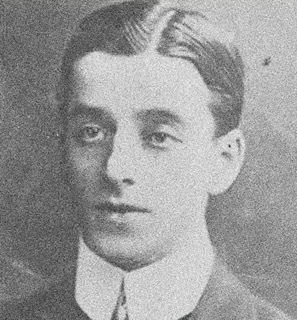
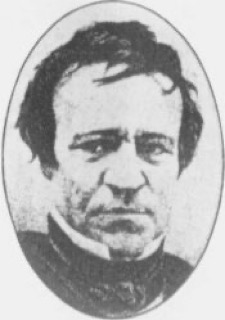
Carrigan is born to Irish parents in Glasgow, but moves to Denny, Stirlingshire, following the early death of his father. He is a trained tailor to trade but also attends classes in history and literature and is proficient in French and Latin, studies the Irish language, and is a Gaelic Leaguer.
Carrigan becomes president of his local branch of the United Irish League (UIL) in Denny in 1898 and later becomes a member of the Irish Republican Brotherhood (IRB). In 1905, he becomes the Chairman of Sinn Féin‘s first ever cumann in Scotland, the Éire Óg Craobh Cumann. In 1916, he is the official Scottish representative to the IRB.
On April 28, 1916, his 34th birthday, during an evacuation of the General Post Office (GPO) in Dublin under the command of The O’Rahilly, Carrigan is shot and killed by British soldiers on Moore Street. He is buried in the St. Paul’s section of Glasnevin Cemetery in Dublin.
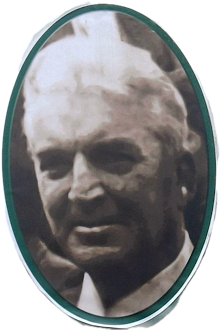
Mac Airt first becomes involved in Irish republicanism as a boy when he joins the Fianna Éireann. His first imprisonment is in 1942 when he is sent to jail for illegal military foot drilling. He Is later interned during the IRA’s Border Campaign of 1956-1962.
Having retired at some earlier point, Mac Airt returns to the republican movement in 1969, throwing his lot in with the newly established Provisional Irish Republican Army (PIRA) and their political arm Provisional Sinn Féin. Indeed, in early 1970 his Patrick Pearsecumann, which he sets up in the Clonard area of the Falls Road, is the first branch of Provisional Sinn Féin established in Belfast and proves central to the growth of the dissident party in the city. In August 1970, he Is appointed editor of the Belfast-based Republican News, succeeding Jimmy Steele who had died soon after being appointed editor. Despite his advancing age Mac Airt also becomes involved in the gun battles that rage between the republicans from Falls and loyalists from the neighbouring Shankill Road. As a consequence, he becomes one of the leaders of the nascent PIRA in Belfast. He is publicly named as a leading republican by General Anthony Farrar-Hockley who commands the British Army present during the clashes and with whom Mac Airt has held failed negotiations at the scene of conflict. He serves as Adjutant to Billy McKee, who is first commander of the Provisional IRA Belfast Brigade. According to Brendan Hughes, Mac Airt’s Kane Street home doubles as Belfast Brigade headquarters at the early stage in the movement’s history.
On April 15, 1971, Mac Airt, along with Billy McKee, is arrested by the British Army when found in possession of a handgun. Both men are sentenced under the Explosive Substances Act 1883 and sent to Crumlin Road Gaol. In the prison the two men are recognised as the leaders of the republican prisoners, a role held by Gusty Spence on the loyalist side. They co-operate informally with Spence to maintain order until they agree to establish an official Camp Council. The make-up of this group sees Mac Airt and McKee representing the PIRA, Spence and an associate identified only as “Robert” representing the Ulster Volunteer Force (UVF) and Ned McCreery and James Craig as Ulster Defence Association (UDA) delegates, with members of the Official IRA (OIRA) and Irish National Liberation Army (INLA) eventually added.
Mac Airt is involved in the talks held between republicans and clergymen from various Protestant churches held at Feakle, County Clare, on December 12, 1974. While the talks produced little, he Is one of those who maintains contact with the clergymen. Indeed, on January 19, 1975, one of the ministers, Rev William Arlow of the Irish Council of Churches (ICC), even introduces Mac Airt and his ally Jimmy Drumm to British government officials Michael Oatley and James Allan in an attempt to have the republican grievances heard.
Although a new generation of leaders emerges in the Provisional IRA and Sinn Féin, Mac Airt remains an influential veteran. He is close to Danny Morrison and Tom Hartley and helps to ensure the removal of Seán Caughey from the editorship of Republican News in 1975 and his replacement by Morrison.
In 1968, Mac Airt records two vocal songs, “Croppy Boy” and “Flag of the Fianna” on the LP record Irish Songs of Freedom produced for the Outlet Recording Co. Ltd, Belfast.
Mac Airt dies on January 8, 1992, at the age of 69. The President of Sinn Féin, Gerry Adams, delivers the graveside oration at his funeral, describing him as “a radical in the Connolly tradition.”
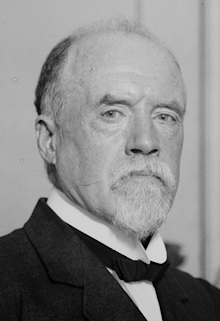
Ginnell is born in Delvin, County Westmeath, in 1852, (baptised April 9, 1852) the son of Laurence Ginnell and Mary Monaghan and twin to Michael Ginnell. He is self-educated and is called to the Irish bar as well as the Bar of England and Wales. In his youth, he is involved with the Land War and acts as private secretary to John Dillon.
The last great social and agrarian campaign of the Irish home rule movement, the Ranch War (1906 and 1909), is largely led and organised by Ginnell from the central office of the United Irish League. He is elected an MP in 1906, takes his seat at Westminster and swears allegiance to Edward VII. On October 14, 1906, he launches the “war” at Downs, County Westmeath.
The purpose of the war is to bring relief to the large numbers of landless and smallholders, particularly in the West, who are relatively untouched by the Wyndham Land Act (1903) and by the larger policy of purchase. The strategy that Ginnell pursues is the Down’s Policy, or cattle driving, a proceeding designed to harass the prosperous grazier interests, whose “ranches” occupy large, under populated and under worked tracts. The Down’s Policy is also meant to draw public attention to the scandalous inequalities that survive in the Irish countryside. The conservatives within the home rule leadership are understandably suspicious about the revival of agrarian disturbances, but the mood of the party organisation is hardening in the aftermath of a disappointing devolution bill in May 1907, from the new Liberal government, so that it seems logical to turn to the traditional mechanism for reactivating the national question: agrarian agitation.
Ginnell’s cattle drives begin to tail off after the summer of 1908, and the agitation is finally dissolved with the passage of a 1909 Act by the Liberal Chief Secretary Augustine Birrell that allows the transfer to the Irish Land Commission of farmland by compulsory purchase, which is hailed by the national movement as an historic victory. In reality, the Ranch War involves an implosion within sectors of the Irish Parliamentary Party, as its leadership has not facilitated the working of the Wyndham Land Act in the first place because John Dillon and his like want conflict above victory.
In 1909, Ginnell is expelled from the Irish Parliamentary Party for the offence of asking to see the party accounts after which he sits as an Independent Nationalist. During this time, he is addressed frequently as “The MP for Ireland.” At Westminster, he is highly critical of the British government‘s war policy and its holding of executions of certain participants in the Easter Rising of 1916. On May 9, he accuses British Prime MinisterH. H. Asquith, of “Murder” and is forcibly ejected from the Chamber. He visits many of the prisoners who are interned in various prisons in Wales and England.
At the Sinn Féin ardfheis in 1917, at which the party is reconstituted as a republican party with de Valera as president, Ginnell and W. T. Cosgrave are elected Honorary Treasurers. He is imprisoned in March 1918 for encouraging land agitation and later deported to Reading Gaol. In the 1918 United Kingdom general election, he is elected as a Sinn Féin MP for the Westmeath constituency by comfortably defeating his IPP challenger. After his release from prison, he attends the proceedings of the First Dáil. Along with fellow TDJames O’Mara, he is one of the only TDs to serve as a member in both the House of Commons and Dáil Éireann.
He is one of the few people to have served in the House of Commons and in the Oireachtas. He is appointed Director of Propaganda in the Second Ministry of the Irish Republic. After spending a year as a republican campaigner in Chicago, he is appointed the Representative of the Irish Republic in Argentina and South America by de Valera. He carries out his propaganda work here to distribute copies of the Irish Bulletin and to provide the Sinn Féin version of the conflict during the Irish War of Independence. On August 16, 1921, he returns home to attend the first meeting of the Second Dáil. He travels back to Argentina some months later to serve as the Representative of the Republic there.
On September 9, 1922, Ginnell is the only anti-Treaty TD to attend the inaugural meeting of the Provisional Parliament or Third Dáil. Before signing the roll, he says, “I want some explanation before I sign. I have been elected in pursuance of a decree by Dáil Éireann, which decree embodies the decree of May 20, 1922. I have heard nothing read in reference to that decree, nothing but an Act of a foreign Parliament. I have been elected as a member of Dáil Éireann. I have not been elected to attend any such Parliament. Will anyone tell me with authority whether it is…”.
Ginnell is at this point interrupted but resumes by saying that he will sign the roll and take his seat in the Assembly if the Assembly is Dáil Éireann. He is informed he is not allowed raise any such question until a Ceann Comhairle has been elected. He continues to ask questions regardless to which he gets no answer including his question: “Will any member of the Six Counties be allowed to sit in this Dáil?” W. T. Cosgrave moves at this point that he be excluded from the House. Ginnell protests, and he is dragged out by force.
De Valera later appoints Ginnell a member of his “Council of State,” a twelve-member body set up to advise him on the deteriorating situation in the civil war. He returns to the United States soon afterward to serve as the Republic‘s envoy in the country. He orders Robert Briscoe and some of his friends to take possession of the Consular Offices in Nassau Street, New York City, then in the hands of the Irish Free State Government, to obtain the list of the subscribers to the bond drive organized to aid the struggle in the War of Independence. At the time, a court case is ongoing to decide on who has the right to the funds: the newly installed Provisional Government or de Valera, as one of the three trustees among the anti-Treatyites.
Ginnell dies in Washington, D.C. on April 17, 1923, at the age of 71, still campaigning against the Anglo-Irish Treaty.
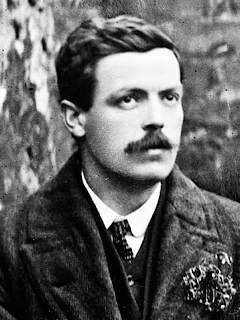
O’Hanrahan is the son of Richard Hanrahan, a cork cutter, and Mary Williams. His father appears to have been involved in the 1867 Fenian rising. The family moves to Carlow, County Carlow, where he is educated at Carlow Christian Brothers School and Carlow College Academy. On leaving school he works various jobs including a period alongside his father in the cork-cutting business. In 1898, he joins the Gaelic League and in 1899 founds the League’s first Carlow branch and becomes its secretary. Also in 1899 he helps found a working men’s club in Carlow. By 1903 he is in Dublin, where he is working as a proofreader for the Gaelic League printer An Cló Cumann. He publishes journalism under the by-lines “Art” and “Irish Reader” in several nationalist newspapers, including Sinn Féin and the Irish Volunteer. He is the author of two novels, A Swordsman of the Brigade (1914) and When the Norman Came (published posthumously in 1918).
In 1903, O’Hanrahan becomes involved in Maud Gonne’s and Arthur Griffith‘s campaign against the visit of King Edward VII to Ireland. The encounter with Griffith leads O’Hanrahan to join the newly formed Sinn Féin. He also becomes a member of the Irish Republican Brotherhood (IRB). In November 1913, he joins the Irish Volunteers. He is later employed as an administrator on the Volunteers headquarters staff. He is made quartermaster general of the 2nd Battalion. He and the commandant of the 2nd Battalion, Thomas MacDonagh, become close friends.
During the Easter Rising O’Hanrahan is second in command of Dublin’s 2nd Battalion under MacDonagh. He fights at Jacob’s Biscuit Factory, though the battalion sees little action other than intense sniping throughout Easter week, as the British Army largely stays clear of the impregnable factory dominating the road from Portobello Barracks on one side and Dublin Castle on the other. When the situation becomes desperate O’Hanrahan tells MacDonagh they “were inviting destruction of the factory by incendiary shells, and also of the surrounding thickly populated area.” MacDonagh orders a break-out amidst the chaos and confusion. O’Hanrahan leads “with some difficulty” the garrison out of the factory through New Bride Street gate.
O’Hanrahan is executed by firing squad on May 4, 1916 at Kilmainham Gaol. His brother, Henry O’Hanrahan, is sentenced to penal servitude for life for his role in the Easter Rising. After his execution, his mother and three sisters open a shop near Mountjoy Prison where they develop a secret line of communications between prisoners and their visitors.
From the late 1960s until the late 1990s, Northern Ireland undergoes a conflict known as the Troubles, in which more than 3,500 people are killed. More than 700 of those killed are British military personnel, deployed as part of Operation Banner. The vast majority of these British military personnel are killed by the Provisional Irish Republican Army (IRA), which wages an armed campaign to force the British to negotiate a withdrawal from Northern Ireland. In 1997, the IRA calls a final ceasefire and in 1998 the Good Friday Agreement is signed. This is widely seen as marking the end of the conflict.
However, breakaway groups of dissident Irish republicans oppose the ceasefire and continue a low-level armed campaign against the British security forces in Northern Ireland. The main group involved is an IRA splinter group known as the Real IRA. In 2007, the British Army formally ends Operation Banner and greatly reduces its presence in Northern Ireland.
The low-level dissident republican campaign continues. In January 2009, security forces have to defuse a bomb in Castlewellan, County Down, and in 2008 three separate incidents see dissident republicans attempt to kill PSNI officers in Derry, Castlederg and Dungannon. In all three cases, PSNI officers are seriously wounded. Two of the attacks involve firearms while the other involves an under-car booby-trap bomb.
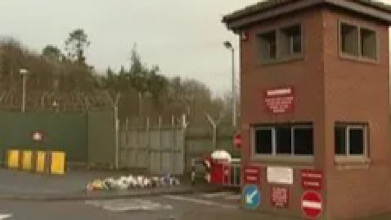
At about 9:40 p.m. on the evening of Saturday, March 7, four off-duty British soldiers of the Royal Engineers walk outside the barracks to receive a pizza delivery from two delivery men. As the exchange is taking place, two masked gunmen in a nearby car open fire with PM md. 63assault rifles. The firing lasts for more than 30 seconds with more than 60 shots being fired. After the initial burst of gunfire, the gunmen walk over to the wounded soldiers lying on the ground and fire again at close range, killing two of them. Those killed are Sappers Mark Quinsey from Birmingham and Patrick Azimkar from London. The other two soldiers and two deliverymen are wounded. The soldiers are wearing desert fatigues and were to be deployed to Afghanistan the following day. A few hours later, the stolen car involved is found abandoned near Randalstown, eight miles (13 km) from the barracks.
A Dublin-based newspaper, the Sunday Tribune, receives a phone call from a caller using a recognised Real IRA codeword. The caller claims responsibility for the attack on behalf of the Real IRA, adding that the civilian pizza deliverymen were legitimate targets as they were “collaborating with the British by servicing them.”
The shootings are the first British military fatalities in Northern Ireland since Lance Bombardier Stephen Restorick was shot dead by the Provisional IRA in February 1997, during the Troubles. The attack comes days after a suggestion by Northern Ireland’s police chief, Sir Hugh Orde, that the likelihood of a “terrorist” attack in Northern Ireland is at its highest level in several years.
Civilian security officers belonging to the Northern Ireland Security Guard Service are criticised for not opening fire during the incident, as a result of which plans are made to retrain and rearm them.
The morning after the attack, worshippers come out of St. Comgall’s Church after mass and keep vigil near the barracks. They are joined by their priest and clerics from the town’s other churches. On March 11, 2009, thousands of people attend silent protests against the killings at several venues in Northern Ireland.
The killings are condemned by all mainstream political parties in Northern Ireland, as well as the Irish government, the United States government and Pope Benedict XVI. Sinn Féin condemns the killings, but is criticised for being less vehement than others in its condemnation.
On March 14, 2009, the PSNI arrests three men in connection with the killings, one of whom is former IRA prisoner Colin Duffy. He had broken away from mainstream republicanism and criticised Sinn Féin’s decision to back the new PSNI. On March 25, 2009, after a judicial review of their detention, all the men are ordered to be released by the Belfast High Court. Duffy is immediately re-arrested on suspicion of murder. On March 26, 2009, Duffy is charged with the murder of the two soldiers and the attempted murder of five other people. The following day he appears in court for indictment and is remanded in custody to await trial after it is alleged that his full DNA profile had been found on a latex glove inside the vehicle used by the gunmen. There is also soil found in the car they drove that matches the soil on the ground in front of the barracks.
Brian Shivers, a cystic fibrosis sufferer, is charged with the soldiers’ murders and the attempted murder of six other people. He is also charged with possession of firearms and ammunition with intent to endanger life. He is arrested in Magherafelt, County Londonderry, in July 2009.
In January 2012, Shivers is convicted of the soldiers’ murders, but Duffy is acquitted. In January 2013, Shivers’s conviction is overturned by Northern Ireland’s highest appeals court. A May 2013 retrial finds Shivers not guilty. He is cleared of all charges and immediately released from jail. The judge questions why the Real IRA would choose Shivers as the gunman, with his cystic fibrosis and his engagement to a Protestant woman.
The barracks are shut down in 2010 as part of the reduction of the British Army presence in Northern Ireland.
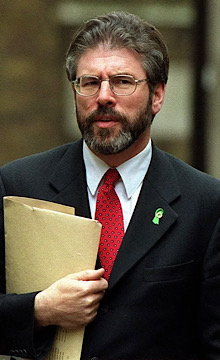
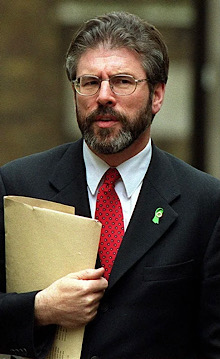
Adams tells reporters, “I don’t intend to spend the rest of my life trying to shore up a process that is going to be in perpetual crisis.” His words are taken as those of an exhausted and deeply frustrated politician, angry that the bulk of the blame for the impasse has been directed at him and his colleagues.
They also raise, in a very stark way, the question of what effect the suspension of the new political institutions will have on Sinn Féin. In the days leading up to Adams’s announcement, the efforts of London and Dublin are primarily directed at saving David Trimble‘s leadership of his party. Peter Mandelson, MP for Hartlepool, emphasises the importance of this in the House of Commons on February 8. To abandon Trimble at this time would be seen as a betrayal that would even further harden political attitudes in the broad unionist community.
This leads to both governments putting a degree of pressure on the republican movement, Sinn Féin as well as the Irish Republican Army (IRA), which is having entirely predictable and dangerous results. The old, familiar sense of beleaguered isolation, summed up in the party’s name, is reasserting itself. Adams has told the British government that he believes his position as Sinn Féin’s president will very quickly become untenable if the political institutions are suspended. The most common reaction to this news is, “Well, he would, wouldn’t he?” The inference is that Adams is firing a warning shot across the bows of both governments, that there are two parties to this dispute and both need to be protected.
There is deep pessimism among republicans about what will happen if the Executive is suspended for any length of time. The fear is that it will be extremely difficult, probably impossible, to put it together again. Over a period of weeks and months, confidence in the political process, already pretty fragile at grass roots level, will likely ebb even further. Adams, Martin McGuinness, Mitchel McLauglin and others closely identified with the move to a political strategy will be seen to have failed.
One Sinn Féin source, a staunch supporter of the peace process, says, “Already there’s a widespread suspicion that we’ve been suckered into this by the British government, helped by Dublin. The long-term aim has always been to destroy Sinn Féin politically. There’s no pressure on the loyalists to disarm because they don’t represent a political threat. If Adams is seen to have misjudged this, what else can he do but resign?”
Many dismiss this as the old republican paranoia coming once again into play. But it is important to understand how this crisis appears to very many people within Sinn Féin. It is not just a matter of a hundred or so IRA activists seeing the hand-over of weapons as a surrender. There has always been a profound suspicion of politics, not only within the IRA, but at many other levels. Politics has always failed to deliver the holy grail of a united Ireland.
Some of these people believe that Gerry Adams and Martin McGuinness are cynical opportunists who have sold out for the rewards of office. Many more see them as sincere, but mistaken, in their strategy. They genuinely believe that they have been seduced by the British government, probably with the active co-operation of Dublin, by the promise of political progress. Now they are in a position where Sinn Féin is carrying all the opprobrium for the breakdown.
If, as seems likely, it is necessary to hold an election for a new assembly, Sinn Féin will be greatly weakened. The party’s hopes of taking Dáil seats will also be diminished. As Sinn Féin is seen to lose ground, there will almost certainly be a drift back to violence, sporadic at first, but gathering momentum.
This conspiracy theory, and the bleak scenario it predicts probably sounds utterly fanciful to many, those who lay the blame for this threat to the peace process squarely on the IRA. Possibly the republican movement is simply preparing itself for a retreat to the political trenches, and putting forward reasons to justify this. But there is also a danger that such an interpretation of what has happened could gain much wider credibility in the nationalist community in Northern Ireland.
There is a profound sense of disappointment that the Executive is about to be suspended. It is quite striking how many professional interest groups – doctors, teachers, farmers – express their satisfaction with local politicians and a reluctance to go back to dealing with “remote, ignorant, arrogant” British ministers.
For nationalists there has been the added satisfaction of seeing their own elected representatives taking up posts in government and performing well. For the first time, many of them feel that they are equal citizens in Northern Ireland. Now, it seems, that could be put at risk, to save David Trimble’s “pretty valuable” skin.
If this does prove to be the case, sympathy will swing back to Sinn Féin. Within his own community, Adams is not seen as having betrayed the peace process. On the contrary, along with John Hume, he is seen as one of its main architects. If Adams had decided to resign the leadership of his party, or had been forced to do so, it would have been seen by many nationalists as proving that politics, within the context of Northern Ireland, cannot work.
(From: “What future if Adams walks away from peace efforts now?” by Mary Holland, The Irish Times, http://www.irishtimes.com, February 10, 2000)
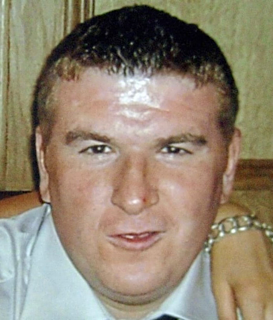
McCartney, born in 1971, is a Roman Catholic and lives in the predominantly nationalistShort Strand area of east Belfast, and is said by his family to be a supporter of Sinn Féin. He is the father of two children and is engaged to be married in June 2005 to his longtime girlfriend, Bridgeen Hagans.
McCartney is involved in an altercation in Magennis’ Bar on May Street in Belfast’s city centre on the night of January 30, 2005. He is found unconscious with stab wounds on Cromac Street by a police patrol car and dies at the hospital the following morning. He is 33 years old.
The fight arises when McCartney is accused of making an insulting gesture or comment to the wife of an IRA member in the social club. When his friend, Brendan Devine, refuses to accept this or apologise, a brawl begins. McCartney, who is attempting to defend Devine, is attacked with a broken bottle and then dragged into Verner Street, beaten with metal bars and stabbed. Devine also suffers a knife attack, but survives. The throats of both men are cut and McCartney’s wounds include the loss of an eye and a large blade wound running from his chest to his stomach. Devine is hospitalised under armed protection.
When Police Service of Northern Ireland (PSNI) officers arrive at the scene, their efforts to investigate the pub and surrounding area are met with an impromptu riot. Rioting by youths, specifically attacking the police, force them to pull back from the area, which delays initial investigation. Police with riot gear arrive later in the evening and are also attacked. Alex Maskey of Sinn Féin claims, “It appears the PSNI is using last night’s tragic stabbing incident as an excuse to disrupt life within this community, and the scale and approach of their operation is completely unacceptable and unjustifiable.” There are suggestions that the rioting is organised by those involved in the murder, so that a cleanup operation can take place in and around where the murder took place. Clothes worn by McCartney’s attackers are burned, CCTV tapes are removed from the bar and destroyed and bar staff are threatened. No ambulance is called. McCartney and Devine are noticed by a police car on routine patrol, who call an ambulance to the scene.
When the police launch the murder investigation they are met with a “wall of silence” None of the estimated seventy or so witnesses to the altercation come forward with information. In conversations with family members, seventy-one potential witnesses claim to have been in the pub’s toilets at the time of the attacks. As the toilet measures just four feet by three feet, this leads to the toilets being dubbed the TARDIS, after the time machine in the television series Doctor Who, which is much bigger on the inside than on the outside.
Sinn Féin suspends twelve members of the party and the IRA expels three members some weeks later.
Gerry Adams, then president of Sinn Féin, urges witnesses to come forward to “the family, a solicitor, or any other authoritative or reputable person or body”. He continues, “I want to make it absolutely clear that no one involved acted as a republican or on behalf of republicans.” He suspends twelve members of Sinn Féin. He stops short of asking witnesses to contact the police directly. The usefulness of making witness statements to the victim’s family or to a solicitor is derided by the McCartneys and by a prominent lawyer and Social Democratic and Labour Party (SDLP) politician, Alban Maginness, soon afterward.
On February 16, 2005, the IRA issues a statement denying involvement in the murder and calls on the perpetrators to “take responsibility.”
On March 8, 2005, the IRA issues an unprecedented statement saying that four people are directly involved in the murder, that the IRA knows their identity, that two are IRA volunteers, and that the IRA has made an offer to McCartney’s family to shoot the people directly involved in the murder.
In May 2005, Sinn Féin loses its council seat in the Pottinger area, which covers the Short Strand, with the McCartney family attributing the loss to events surrounding the murder.
Since this time, the sisters of McCartney have maintained an increasingly public campaign for justice, which sees Sinn Féin chief negotiator Martin McGuinness make a public statement that the sisters should be careful that they are not being manipulated for political ends.
Support for Sinn Féin by some American politicians is diminished. Adams is not invited to the White House in 2005 and Senator Edward Kennedy backs out of a meeting that had been previously scheduled. The McCartney family, previously Sinn Féin supporters, pledge to never support the party again, and a cousin of the sisters who raised funds for Sinn Féin in the United States insist that she will not be doing so in the future.
On May 5, 2005, Terence Davison and James McCormick are remanded in custody, charged with murdering McCartney and attempting to murder Devine respectively. McCormick is originally from England. They are held in the republican wing of HM Prison Maghaberry. Roughly four months later the accused are released on bail, and in June 2006, the attempted murder charge against McCormick is dropped, leaving a charge of causing an affray. On June 27, 2008, Terence Davison is found not guilty of committing the murder. Two other men charged with affray are also cleared.
In November 2005, the McCartney sisters and Bridgeen Hagans, the former partner of McCartney, refuse to accept the Outstanding Achievement award at the Women of the Year Lunch, because it would mean their sharing a platform with Margaret Thatcher, whom they dislike.
In December 2005, the McCartney sisters meet with UK Prime MinisterTony Blair, and tell him they believe the murder had been ordered by a senior IRA member, and that Sinn Féin was still not doing all it could to help them.
On January 31, 2007, two years after the murder, and in line with the party’s new policy of supporting civil policing, Sinn Féin president Gerry Adams says that anyone with information about the murder should go to the police.
On May 5, 2015, an IRA man believed to have been involved in the death of McCartney, Gerard ‘Jock’ Davison, is shot dead. Early in the investigation the police rule out either a sectarian attack or the involvement of dissident republicans.
The McCartney family has lived in the Short Strand area of Belfast for five generations. However, some local people in the Short Strand area, which is a largely nationalist area, does not welcome their dispute with the IRA. A campaign of intimidation by republicans drives members of the family and McCartney’s former fiancée to relocate and also causes one member to close her business in the city centre. The last McCartney sister to leave the area, Paula, departs Short Strand on October 26, 2005.
The family remain in contact with the family of Joseph Rafferty of Dublin, who dies under similar circumstances on April 12, 2005.
With a report due on Monday, January 31, and widely expected to state that the IRA is not ready to disarm, the Northern Ireland peace process appears headed for a fresh crisis. The report by Canadian Gen. John de Chastelain, head of the province’s independent commission overseeing the handing in of weapons, is expected to confirm that no arms have been turned in.
The Ireland on Sunday newspaper says de Chastelain will tell the British and Irish governments that the IRA has put most of its weapons into secret, sealed dumps in the Republic of Ireland. Such disclosures put enormous pressure on Adams, the leader of the Irish republican political party, Sinn Féin.
The UUP, the province’s main Protestant political group, has already threatened to pull out of Northern Ireland‘s fledgling power-sharing government if the IRA does not start disarming.
The UUP calls a top-level party meeting for February 12. A negative report from the decommissioning body will heighten fears that UUP leader David Trimble will make good on his threat to resign as leader of the new government, effectively allowing his party to shut down the province’s first government in 25 years.
Of Adams’s role in the disarmament process, Trimble says, “He asked us to create the circumstances to help him … we did that … we took the risk and created the situation he asked us to create. “Now we hope he now is able to demonstrate his good faith by responding.”
Adams says, “I am concerned at what appears to be an attempt by unionists to hijack the entire process, put up unilateral demands, perhaps in the course of that, tear down the institutions that are only two months in being. I understand why unionists want decommissioning. It is just not within my grasp to deliver it on their terms, and neither is it my responsibility.”
Adams says he can give no assurances that the IRA will hand over its weapons by May 22, the date set by the 1998 Good Friday Agreement for the completion of disarmament, although he stresses he is committed to decommissioning. “No, I can’t and it isn’t up to me,” Adams tells BBC Television when asked if he can guarantee disarmament by May.
Political insiders hint that the report will not be published until Monday (January 31) afternoon, suggesting the highly sensitive document is still being worked on by de Chastelain.
Any unionist pullout from the home-rule government on February 12 will create a political vacuum. Britain may intervene before that to suspend the fledgling executive, in the hope that it can be resurrected quickly if progress eventually is made on disarmament. Sinn Féin warns that either course of action could lead to the IRA breaking off contact with de Chastelain and the ending of disarmament prospects.
Meanwhile, on the eve of the report, thousands of Roman Catholics mark an event and day that symbolizes the province’s past troubles — Bloody Sunday.
Waving Irish flags, some 5,000 protesters retrace the steps of a civil rights march in Londonderry in 1972 that ended in bloodshed when British troops fired on unarmed protesters and killed thirteen people, mostly teenagers. A fourteenth man died later from his wounds. Victims’ relatives and local children carry fourteen white crosses, photos of the dead and a banner that reads, “Bloody Sunday, the day innocence died.” The march passes the scene of the killings and ends in front of Londonderry’s city hall — a spot where the 1972 march was supposed to have finished.
Organizers issue a message to British Prime MinisterTony Blair that they want a forthcoming inquiry not to end in the same way as a probe held within months of the killings, which exonerated the British soldiers by suggesting that some of the victims had handled weapons that day. “Twenty-eight years on from Bloody Sunday, there is still no recognition of the role the British government played in the premeditated attack on unarmed demonstrators,” Barbara de Brun, a top IRA official, tells the crowd.
Relatives of those killed are upset that soldiers who took part in the shootings would be allowed to remain anonymous during the new probe. They are also concerned about a newspaper report that the army recently destroyed thirteen of the rifles used by the soldiers, complicating any ballistics tests at the inquiry.
“Once again, the political and military establishment are up to their old tricks. We won’t accept a public relations exercise,” Alana Burke, who was injured by an armored car during the Bloody Sunday march, tells the crowd.
(From: “Hopes dim for IRA disarmament, peace accord” by Nic Robertson and Reuters, CNN, cnn.com, January 30, 2000)
In 1849, O’Donoghue, together with William Smith O’Brien, Terence MacManus, Thomas Francis Meagher and many others, are on board the prisoner transport ship The Swift for a six-month, 14,000-mile journey under difficult conditions on which some fellow prisoners do not survive.
On January 26, 1850, “Using materials he had begged and borrowed” as one account gives it, O’Donoghue starts publishing in Hobart a weekly newspaper named The Irish Exile, aimed mainly at fellow Irish prisoners and deportees and considered to be the first Irish Nationalist paper to be published in Australia.
The paper features Irish ballads and poetry, articles about Irish history, and a regular column by John Martin reporting on the situation of the Repeal Movement, a campaign to repeal the Acts of Union 1800 under which the Irish Parliament had been abolished. There is also local news of the Irish deportee community, then numbering in the thousands, and of Hobart daily life in general.
O’Donoghue uses The Irish Exile to publish excerpts of his journal aboard The Swift, which are reprinted in Australian, British and Irish newspapers. Brisbane‘s The Moreton Bay Courier, reprinted from Dublin’s The Nation, finds that the journal “will show how severely the tyrannical government of England visited the offences of the Ballingarry cabbage-tree heroes. The studies of Messrs. O’Brien, Meagher (afterwards O’), and O’Donoghoe, will amuse the reader”. While in Van Diemen’s Land, The Examiner, the daily newspaper of Launceston, Tasmania, reprints London‘s The Examiner‘s view that “a singularly large amount of mercy has been shown to those grown-up children who made the escapade from Dublin to raise the standard of Irish rebellion at Ballingarry. One of the worthies, Mr. Patrick O’Donoghue, has published an account of his deportation; and certainly a more pleasureable [sic] voyage could not have been under taken at the expanse of government. A roomy cabin, a capital library, a fair dinner, with a couple of glasses of wine, and cigars upon deck, from the dietary and the entertainment of the political exiles.”
Publication of the paper is not in itself illegal, but is highly displeasing to the Governor, Sir William Denison, who finds that the paper can be suppressed by arresting O’Donoghue and charging him with having “left his allocated district.” He is sentenced to one year’s work in a chain gang – a time spent at hard labour, living in a convict station and wearing a convict uniform, mainly in the company of non-political prisoners such as “rapists, muggers and thieves.”
In March 1851, O’Donoghue is released and taken back to Hobart. Undeterred, he immediately restarts his paper, prominently featuring an extensive personal account of his year with the chain gang. The governor reacts by sending him again to a chain gang, at a more distant location this time – the Cascades Penal Station. Three months later the governor orders him released from there and sent to Launceston.
On the way there, O’Donoghue succeeds in escaping from his guards with the help of fellow-prisoners, who manage to smuggle him on board the ship Yarra Yara, on its way to Melbourne. There, he successfully hides from the British authorities and, with further help from Irish sympathisers, manages to get to San Francisco, where some of his fellows such as MacManus and Meagher have also ended up.
O’Donoghue dies in New York City on January 22, 1854, shortly before the arrival of his wife on a ship from Ireland. The time spent in the chain gang may have contributed to undermining his health. The other escaped state prisoners do not attend his funeral, although Michael Doheny and Michael Cavanagh, fellow Young Irelanders who are living in New York City at the time, are in attendance.
The local Sinn Féin branch in Carlow is named after O’Donoghue.
Johnson is born on May 17, 1872, in Liverpool, England. He works on the docks for an Irish fish merchant, spending much of his time in Dunmore East and Kinsale. It is this way that he picks up ideas about socialism and Irish nationalism, joining a Liverpool branch of the Independent Labour Party in 1893. In 1900 he starts work as a commercial traveller, then moves in 1903 with his family to Belfast where he becomes involved in trade union and labour politics.
In 1907, Johnson helps James Larkin organise a strike in the port, but has to watch in dismay as the strike, which begins with remarkable solidarity between labour, Orange, and nationalist supporters, collapses in sectarian rioting. At various times he is the president, treasurer and secretary of the Irish Trades Union Congress (ITUC) which is, at the time, also the Labour Party in Ireland, until officially founded in 1912 by James Connolly and James Larkin. Johnson becomes Vice-President of the ITUC in 1913, and President in 1915.
Johnson sympathizes with the Irish Volunteers, many of whom are sacked from their jobs, for illegal activities. During the Easter Rising, he notes in his diary that people in Ireland paid little heed to the fate of the defeated revolutionaries. He succeeds as leader of the Labour Party from 1917, when the party does not contest the 1918 Irish general election. When the British government tries to enforce conscription in Ireland in 1918, he leads a successful strike in conjunction with other members of the Irish anti-conscription movement.
Johnson is later elected a TD for Dublin County to the Third Dáil at the 1922 Irish general election and remains leader of the Labour Party until 1927. As such, he is Leader of the Opposition in the Dáil of the Irish Free State, as the anti-treaty faction of Sinn Féin refuses to recognise the Dáil as constituted. He issues a statement of support for the Government of the 4th Dáil when the Irish Army Mutiny threatens civilian control in March 1924.
Johnson is the only Leader of the Labour Party who serves as Leader of the Opposition in the Dáil. He loses his Dáil seat at the September 1927 Irish general election, and the following year he is elected to Seanad Éireann, where he serves until the Seanad’s abolition in 1936.
In 1896 he meets Marie Tregay, then a teacher in St. Multose’s National school, outside Kinsale. A native of Cornwall, she has advanced political views. They marry in 1898 in Liverpool. Their only son, Frederick Johnson, is born in 1899, and becomes a well-known actor. Johnson dies on January 17, 1963, at 49 Mount Prospect Avenue, Clontarf, Dublin.
Each summer, Labour Youth holds the “Tom Johnson Summer School” to host panel discussions, debates and workshops.